
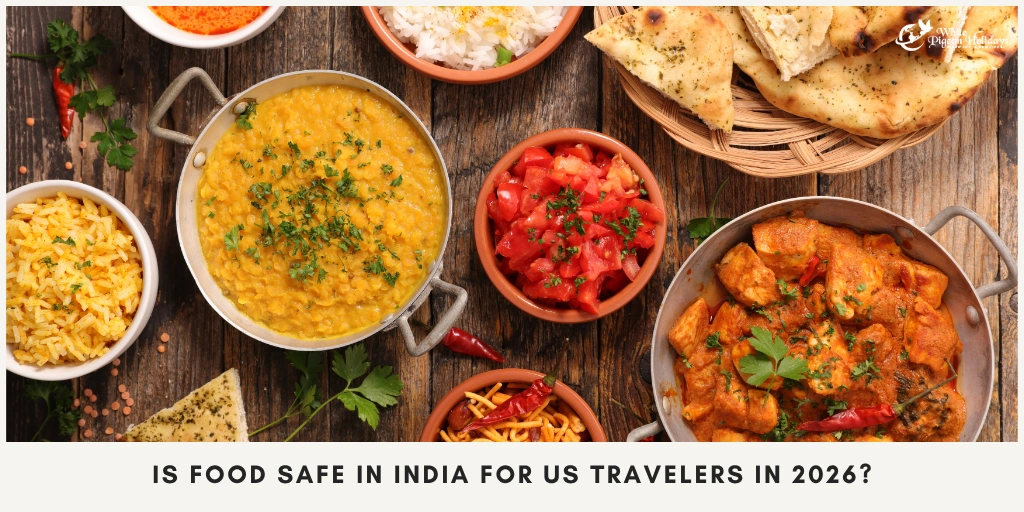
Let’s be direct about something.
“Delhi Belly” is real.
According to the CDC Yellow Book 2026 edition, attack rates for traveler’s diarrhea range from 30% to 70% during a two-week trip to South Asia — and India is one of the highest-risk destinations in that category.
That does not mean you will get sick.
It means you need to understand what actually causes illness, what prevents it, and what to do if it happens — because most of what you read about “food safety in India” is either too vague to act on, or unnecessarily alarming.
This page gives you the real picture.

Written by
Nitin Batra
Founder & Travel Expert · White Pigeon Holidays
With 25+ years in the tourism industry — from Airport Concierge to Vice President — Nitin founded White Pigeon Holidays in 2021 to help international travellers explore India with confidence. His hands-on experience across Asia, Europe, the Middle East, and the West shapes every journey he crafts.
Free India Food Safety & Health Consultation
Traveling with family, seniors, or young children? Book a free 15-minute call with Nitin Batra to discuss food safety, drinking water, and practical health precautions based on your itinerary and travel style.
What Actually Causes Food-Related Illness in India
Most travelers assume the problem is the spices or the “exotic” food.
It’s not.
According to the CDC Yellow Book 2026 Travelers’ Diarrhea chapter, the primary causes of illness are:
- Bacteria — responsible for 75%–90% of cases, most commonly enterotoxigenic E. coli, Campylobacter jejuni, Shigella, and Salmonella
- Viruses (especially norovirus) — account for 10%–25%
- Protozoal parasites (Giardia, Cryptosporidium) — slower onset, more common in long-term travelers
The CDC notes that poor hygiene in local restaurant kitchens and inadequate water sanitation infrastructure are the largest contributors to risk — not the food itself, and not the spices.
What this means for you: the risk is real but manageable, and it has far more to do with where you eat and how your food is handled than with what you order.
The Water Rule — This Comes First
Before any food discussion, you need to understand the water rule.
Never drink tap water in India.
That includes:
- Ice cubes in restaurants (unless you are at a 5-star hotel that explicitly uses purified ice)
- Water used to rinse salad greens
- Water at juice stalls
- Brushing teeth with tap water in budget accommodation
Tap water in India is not treated to the standard US travelers’ systems are accustomed to, and the CDC’s food and water precautions for travelers make this a first-order recommendation for South Asia.
Which Bottled Water Brands Are Actually Safe
The trusted national brands are Bisleri, Kinley (Coca-Cola), and Aquafina (PepsiCo).
Here is something most travel guides do not mention: counterfeit bottled water is a genuine problem in India.
A 2024 investigation uncovered over 2,600 bottles sold under fake names like “Bilseri,” “Bisferi,” “Bisllari,” and “Beslare” — designed to look exactly like Bisleri. Counterfeiters refill empty bottles with tap water, replicate the seals and caps, and sell them at normal prices.
How to verify your bottle:
- Check that the seal has not been tampered with — a genuinely sealed bottle makes a slight cracking sound when you first twist it open
- Squeeze the full bottle before opening — fakes often feel slightly flimsy because they’re not filled under pressure
- Buy from hotel minibar, reputable restaurants, large chain pharmacies (Apollo Pharmacy, MedPlus), or branded convenience stores (7-Eleven, Spencer’s, Reliance Smart) rather than random roadside stalls
- In smaller towns, a sealed water packet (pouch) from a large hotel kitchen is often safer than a roadside bottle
Understanding Your Risk Level: A Practical Framework
Not all food and eating situations carry the same level of risk.
| Risk Level | Situation | Practical Guidance |
|---|---|---|
| Very Low | 5-star hotel restaurants and buffet dining | Eat freely. International food safety and hygiene standards are generally maintained. |
| Low | Well-reviewed mid-range restaurants (4★+ ratings with steady customer traffic) | A good choice for most meals. Check recent reviews and avoid restaurants that appear empty. |
| Moderate | Local dhabas (roadside restaurants) that are popular with local residents | Usually safe for experienced travelers. Choose busy places where food is freshly prepared. |
| Higher | Street food, even when freshly cooked at busy stalls | Order food cooked in front of you. Avoid items that have been sitting uncovered or kept warm for long periods. |
| Highest | Raw salads, cut fruit, chaat with water-based chutneys, and uncooked garnishes | Exercise extra caution outside premium restaurants. When unsure, choose cooked food instead. |
Situation
5-star hotel restaurants and buffet dining.
Practical Guidance
Eat freely. International hygiene standards are generally maintained.
Situation
Well-reviewed mid-range restaurants (4★+ ratings with steady customer traffic).
Practical Guidance
Good for most meals. Verify recent reviews and choose busy restaurants.
Situation
Popular local dhabas and roadside restaurants.
Practical Guidance
Usually safe if food is freshly prepared and the restaurant is busy.
Situation
Street food from busy vendors.
Practical Guidance
Choose freshly cooked food and avoid items left sitting uncovered.
Situation
Raw salads, cut fruit, chaat with water-based chutneys, and uncooked garnishes.
Practical Guidance
Be cautious outside premium restaurants. Cooked food is usually the safer choice.
What Is Safe to Eat — Category by Category
Cooked Vegetarian Dishes
This is your safest category in any restaurant.
Dal (lentil soup), rice, roti, naan, paneer curry, rajma (kidney beans), aloo gobi (potato and cauliflower) — when freshly cooked and served hot, these are safe choices at virtually every level of restaurant.
The cooking temperatures involved in Indian curries and breads are more than sufficient to eliminate foodborne pathogens.
Dairy: The Nuanced Answer
Dairy Foods: What Is Safe to Eat in India?
| Dairy Item | Safety Level | Notes |
|---|---|---|
| Chai from a Busy Tea Stall | Safe | Milk is boiled thoroughly. Freshly prepared chai is one of the safest drinks in India. |
| Curd / Yogurt from a Restaurant | Generally Safe | Freshly prepared and naturally acidic, which helps reduce bacterial growth. |
| Packaged Milk (Amul, Mother Dairy) | Safe | Pasteurized and sealed. Buy unopened cartons or bottles. |
| Paneer in Cooked Dishes | Safe | Choose dishes where the paneer is thoroughly cooked, such as paneer tikka, palak paneer, or shahi paneer. |
| Lassi from a 5-Star Hotel or Reputable Restaurant | Safe with Caution | Drink only where clean water and good hygiene standards are maintained. |
| Lassi from a Street Vendor | Avoid During the First 4 to 5 Days | Water source and storage conditions may be uncertain, especially for first-time visitors. |
| Ice Cream from Hotel or Major Brand | Generally Safe | Packaged brands such as Amul and Kwality Wall's are reliable. Avoid unrefrigerated street-cart ice cream. |
Safety Level
Safe
Notes
Milk is fully boiled, making fresh chai one of the safest drinks in India.
Safety Level
Generally Safe
Notes
Freshly prepared and naturally acidic, helping reduce bacterial growth.
Safety Level
Safe
Notes
Pasteurized and sealed. Choose trusted brands such as Amul or Mother Dairy.
Safety Level
Safe
Notes
Best when thoroughly cooked in dishes such as paneer tikka or palak paneer.
Safety Level
Safe with Caution
Notes
Choose places where clean water and proper hygiene are evident.
Safety Level
Avoid During the First 4 to 5 Days
Notes
The water source may be uncertain and storage conditions can vary.
Safety Level
Generally Safe
Notes
Choose packaged brands and avoid ice cream from unrefrigerated street carts.
Meat and Seafood
Chicken, lamb, and fish are safe when thoroughly cooked at a reputable restaurant.
The important considerations:
- Order meat well done, not medium
- Seafood inland (Delhi, Agra, Jaipur) carries higher risk than coastal cities (Mumbai, Goa, Kochi, Chennai) — freshness is harder to guarantee
- Shellfish anywhere below upscale restaurants — skip it entirely, as most travel medicine doctors recommend
- High turnover restaurants are safer because their meat stock is fresher — a restaurant packed with diners at lunchtime replenishes its stock; a quiet restaurant may not
Street Food: What’s Safe, What’s Not
India’s street food culture is extraordinary, and avoiding it entirely would mean missing some of the best food you’ll ever eat.
The key is not whether to eat street food — it’s which street foods to eat.
Lower risk street foods (cooked fresh in front of you at high heat):
- Samosas, pakoras, bajji — deep-fried at high temperature
- Dosa and idli from busy South Indian carts — steamed or cooked on a flat iron
- Corn on the cob roasted over coal
- Boiled eggs
- Fresh sugarcane juice from machines (the cane is clean; the machine may not be — use judgment)
Higher risk street foods (avoid in first week, approach with caution after):
- Gol gappa / pani puri / puchka — the flavored water (pani) is almost always made with tap water or ice
- Bhel puri and sev puri with raw chutneys — chutneys are water-based
- Pre-cut fruit salads from open stalls — cutting exposes the fruit to ambient contamination
- Cold lassi and other chilled drinks from street vendors — unknown water source
If you want to try street food without worrying:
Book a street food tour with a reputable local guide who knows which stalls are safe for international visitors.
This is one of the most practical things you can do — good guides have years of experience vetting vendors, and eating with local knowledge behind you changes the experience entirely.
Meat and Seafood
Chicken, lamb, and fish are safe when thoroughly cooked at a reputable restaurant.
The important considerations:
- Order meat well done, not medium
- Seafood inland (Delhi, Agra, Jaipur) carries higher risk than coastal cities (Mumbai, Goa, Kochi, Chennai) — freshness is harder to guarantee
- Shellfish anywhere below upscale restaurants — skip it entirely, as most travel medicine doctors recommend
- High turnover restaurants are safer because their meat stock is fresher — a restaurant packed with diners at lunchtime replenishes its stock; a quiet restaurant may not
Street Food: What’s Safe, What’s Not
India’s street food culture is extraordinary, and avoiding it entirely would mean missing some of the best food you’ll ever eat.
The key is not whether to eat street food — it’s which street foods to eat.
Lower risk street foods (cooked fresh in front of you at high heat):
- Samosas, pakoras, bajji — deep-fried at high temperature
- Dosa and idli from busy South Indian carts — steamed or cooked on a flat iron
- Corn on the cob roasted over coal
- Boiled eggs
- Fresh sugarcane juice from machines (the cane is clean; the machine may not be — use judgment)
Higher risk street foods (avoid in first week, approach with caution after):
- Gol gappa / pani puri / puchka — the flavored water (pani) is almost always made with tap water or ice
- Bhel puri and sev puri with raw chutneys — chutneys are water-based
- Pre-cut fruit salads from open stalls — cutting exposes the fruit to ambient contamination
- Cold lassi and other chilled drinks from street vendors — unknown water source
If you want to try street food without worrying:
Book a street food tour with a reputable local guide who knows which stalls are safe for international visitors.
This is one of the most practical things you can do — good guides have years of experience vetting vendors, and eating with local knowledge behind you changes the experience entirely.
The Spice Reality: What No One Tells First-Timers
Indian food in India is spicier than Indian-American restaurant food.
Often significantly so.
This is not a food safety issue — it’s a comfort issue that can be mistaken for illness.
Genuine spice heat causes discomfort, running nose, sweating, and an upset stomach in people unaccustomed to it.
To manage this:
- Ask for “mild” or “less chili” — Indian restaurants accommodate this regularly and it’s a completely normal request
- Order raita (yogurt dip) with every meal — it neutralizes heat far better than water
- Eat with rice or bread — both absorb spice
- Dairy cools the mouth faster than water
- By day 3–4, most travelers find their tolerance has already adjusted considerably
Medicines to Pack Before You Leave the US
You will find some medicines in India, but you may not find the same brands, and you do not want to spend your first evening sick in a Delhi pharmacy trying to translate labels.
Pack these in your carry-on, not checked luggage:
For stomach issues (start with these):
- Imodium (loperamide) — slows diarrhea. Use it when you need to travel, not at the first sign of loose stools
- Pepto-Bismol tablets — bismuth subsalicylate reduces the incidence of traveler’s diarrhea by approximately 50% when taken preventively, according to studies referenced in the CDC Yellow Book 2026. Also helps with nausea and upset stomach
- Antacid tablets (Tums or Rolaids) — for spice-induced indigestion
- Oral Rehydration Salts (ORS packets) — the single most important item. If you get sick and lose fluids through diarrhea or vomiting, ORS restores electrolytes faster than sports drinks. Widely available in Indian pharmacies (Apollo Pharmacy, MedPlus, Netmeds) under various brand names, but bring a few packets from the US to start
For general health:
- Acetaminophen (Tylenol) or Ibuprofen — for fever or body aches
- Hand sanitizer, 60%+ alcohol — non-negotiable; use it before every meal and after every public space
Ask your doctor before you go:
- A prescription antibiotic — either azithromycin (500mg/day for 3 days, or a single 1,000mg dose) or rifaximin — for self-treatment if you develop significant diarrhea
The CDC Yellow Book 2026 notes that azithromycin is currently the preferred antibiotic for South Asia because of high fluoroquinolone (Cipro) resistance among Campylobacter isolates in the region. Fluoroquinolones like ciprofloxacin were previously first-line, but resistance patterns have made them less reliable in India specifically.
Note: Do not take antibiotics prophylactically (preventively) unless you are immunocompromised. The CDC advises that for most travelers, the risks — including carriage of antibiotic-resistant bacteria — outweigh the benefits. Keep antibiotics as a standby treatment only.
Probiotics: Helpful or Hype?
The honest answer: probably helpful, but not guaranteed.
The CDC Yellow Book 2026 notes that studies on probiotics for TD prevention show “inconclusive” results — effective in some studies, not in others, partly because the bacterial strains and dosing vary widely across products.
That said, many experienced travelers and travel medicine doctors recommend them as a low-risk intervention.
If you want to try probiotics:
- Start 2–3 weeks before your departure — not the day before
- Look for strains like Lactobacillus rhamnosus GG (Culturelle) or Saccharomyces boulardii (Florastor)
- Continue taking them throughout your trip
- Do not rely on them alone — food and water precautions are more important
Free India Trip Health Planner
Share your destinations, travel dates, and who is traveling with you. We will prepare a practical food and health plan tailored for families, seniors, and travelers with dietary or medical needs.
How to Choose a Restaurant: The Practical Checklist
This is your biggest lever for staying healthy.
Green flags:
- Busy at meal times — high turnover means fresh food
- Open kitchen or visible cooking area
- Clean tables, floors, and visible staff hygiene
- Google rating of 4.0 or higher, with recent reviews (within 6 months)
- Indoor seating, away from open street exposure
- Staff wearing gloves or using serving tools rather than bare hands
Red flags:
- Pre-cooked food sitting in open trays without heat lamps
- Flies on or near food preparation surfaces
- No customers at peak meal time
- Ice in drinks at a casual street stall
- Meat displayed unrefrigerated at room temperature
The busiest dhaba at lunchtime is often safer than an empty restaurant with white tablecloths, simply because of food freshness and turnover.
What to Do If You Get Sick
Most cases of traveler’s diarrhea in India are mild and self-limiting.
According to the CDC Yellow Book, bacterial diarrhea typically lasts 3–7 days without treatment, and 1–2 days shorter with appropriate antibiotics.
Mild illness (uncomfortable but functional):
- Stay hydrated — use ORS packets dissolved in bottled water
- Eat bland, low-fiber foods: rice, bananas, toast, curd
- Take Imodium if you need to travel or sleep
- Avoid dairy (except plain yogurt), fatty food, and alcohol
- Rest
Moderate illness (interfering with your trip):
- Start your prescribed antibiotic (azithromycin or as directed by your travel doctor)
- Continue ORS aggressively
- Your hotel can call a doctor to your room — request this rather than going to an emergency room for a manageable case
Seek medical care immediately for:
- Bloody diarrhea (could indicate Shigella or other invasive pathogen — do not use Imodium)
- High fever (above 102°F / 39°C)
- Diarrhea persisting more than 5 days despite antibiotic treatment
- Signs of serious dehydration: extreme thirst, very dark urine, dizziness, confusion, rapid heartbeat
- Persistent vomiting that prevents oral rehydration
Private hospitals in major Indian cities — Apollo, Fortis, Max Healthcare, Medanta — have 24-hour emergency departments and are accustomed to treating foreign travelers.
Children and Food Safety in India
Traveling with children requires extra caution.
According to the CDC Yellow Book 2026 section on children and traveler’s diarrhea, infants and young children face higher dehydration risk than adults and need early ORS intervention when diarrhea begins.
For children:
- Start ORS at the first sign of diarrhea — don’t wait to see if it passes
- In children aged 12 and older, azithromycin is the first-line antibiotic (rifaximin is approved for 12+; rifamycin SV is adults only)
- Avoid raw foods, juice stalls, and cut fruit entirely for younger children
- Hotel and 5-star restaurant food is safer for young children, especially on the first half of a trip
- Keep hand sanitizer in pockets and bags — make handwashing a consistent ritual before every meal
Free Personalized Family Food Safety Consultation
Traveling to India with children or elderly family members? Book a free consultation with Nitin Batra for practical guidance on food safety, accommodation choices, medical essentials, and preparing for your family's specific travel needs.
Frequently Asked Questions
Food and water safety tips to help you enjoy Indian cuisine while reducing the risk of traveler's diarrhea.
Is food safety in India worse during certain months?
Yes.
The highest-risk period is generally April through September, covering the hot summer months and the monsoon season.
Heat encourages bacterial growth, while heavy rains can affect water quality. During these months, choose freshly cooked food and avoid unnecessary risks with raw foods and ice.
Should I avoid all street food in India?
No.
Street food is an important part of India's food culture.
Choose stalls that are busy, prepare food fresh to order, and serve it piping hot.
Freshly cooked dosas, grilled corn, and deep-fried snacks are generally safer than raw fruit, salads, or water-based snacks.
Can I drink chai from roadside tea stalls?
Yes.
Traditional Indian chai is prepared by boiling milk and water together at high temperatures, which makes it one of the safer beverages available outside sealed bottled drinks.
Busy tea stalls with a steady flow of customers are usually the best choice.
Is it safer to eat vegetarian food in India?
For many travelers, yes.
Freshly prepared vegetarian meals generally involve fewer food safety variables than meat dishes, particularly at smaller restaurants.
During your first few days, choosing vegetarian or egg-based meals can help your digestive system adjust.
Are salads safe to eat in India?
Raw salads carry a higher risk because vegetables may be washed with tap water.
At luxury hotels they are generally prepared with purified water, but in smaller restaurants cooked vegetables are usually the safer option.
Should I take Pepto-Bismol every day to prevent traveler's diarrhea?
Some studies suggest it can reduce the risk of traveler's diarrhea.
However, the preventive dose requires taking it several times a day and it commonly causes harmless black discoloration of the tongue and stool.
Many travelers prefer to carry it for treatment rather than daily prevention.
My doctor prescribed Ciprofloxacin. Is it still the preferred antibiotic for India?
Travel medicine recommendations have changed because resistance to fluoroquinolone antibiotics has increased in South Asia.
Ask your healthcare provider whether Azithromycin is more appropriate for your trip.
Do not take antibiotics preventively unless your doctor specifically advises it.
Is bottled water always safe in India?
Most bottled water is safe, but counterfeit bottles have been reported.
Purchase water from hotels, supermarkets, major pharmacies, or reputable retailers.
Always check that the seal is intact before opening the bottle.
Can I brush my teeth with tap water?
Using bottled water is the safer choice, especially outside high-end hotels.
Although the amount of water is small, using bottled water removes the risk of accidental exposure to contaminated tap water.
What if I become sick after returning home from India?
Some travel-related infections, including parasites such as Giardia and Cryptosporidium, may not cause symptoms until one or two weeks after your trip.
If diarrhea or digestive problems continue after returning home, tell your doctor about your recent travel and ask whether stool testing is appropriate.
Contact White Pigeon Holidays
Planning an India tour around your pace, comfort, and peace of mind starts with one conversation.
We specialise in private, personally arranged India holidays for senior travellers from the UK. Every itinerary is planned from scratch around your interests, travel pace, comfort level, and preferred style of travel. Nothing is taken off a shelf.
