
Most UK travelers heading to India think about visas, weather, and where to eat.
Very few think about what happens if they need a doctor.
That gap can turn a manageable situation into a stressful and expensive one.
This page answers every practical question about healthcare in India — so you land prepared, not worried.

Written by
Nitin Batra
Founder & Travel Expert · White Pigeon Holidays
With 25+ years in the tourism industry — from Airport Concierge to Vice President — Nitin founded White Pigeon Holidays in 2021 to help international travellers explore India with confidence. His hands-on experience across Asia, Europe, the Middle East, and the West shapes every journey he crafts.
Not Sure if Your Travel Insurance Is Enough for India?
Book a complimentary consultation with Nitin Batra to review your travel insurance before you fly. We will help identify coverage gaps, explain what protection you may need for your trip, and answer your travel insurance questions with confidence.
Does the NHS Cover You in India?
No — and this is the single most important fact to understand before you travel.
The NHS is a residency-based system.
It covers treatment within the UK, for people who are legally living there on a settled basis.
The moment you board a flight to India, the NHS is no longer relevant to your healthcare.
A hospital in Delhi, Jaipur, or Goa will not contact the NHS on your behalf.
There is no bilateral healthcare agreement between India and the UK that covers routine or emergency medical treatment.
What this means practically:
If you need a doctor in India, you pay privately — either out of pocket or through your travel insurance.
This is true for a minor stomach infection, a broken ankle on a trek, or a cardiac emergency.
The cost structure varies enormously depending on whether you have insurance and which hospital you visit.
Is Healthcare in India Safe for UK Travelers?
This is usually the first worry — and the answer is more reassuring than most people expect.
India is one of the world’s top medical tourism destinations, receiving over 507,000 foreign patients in 2025 alone, representing 5.5% of all foreign tourist arrivals.
The country hosts more than 60 JCI-accredited hospitals — the same international quality standard used to evaluate hospitals in the US, UK, and Europe.
JCI (Joint Commission International) accreditation means the hospital has been independently audited for patient safety, clinical standards, infection control, and quality of care.
Additionally, India has over 4,650 NABH-accredited hospitals as of 2025, which is India’s own rigorous national accreditation standard.
The key distinction is this:
Quality in India is not uniform across the country.
It is concentrated — in private hospitals in major cities.
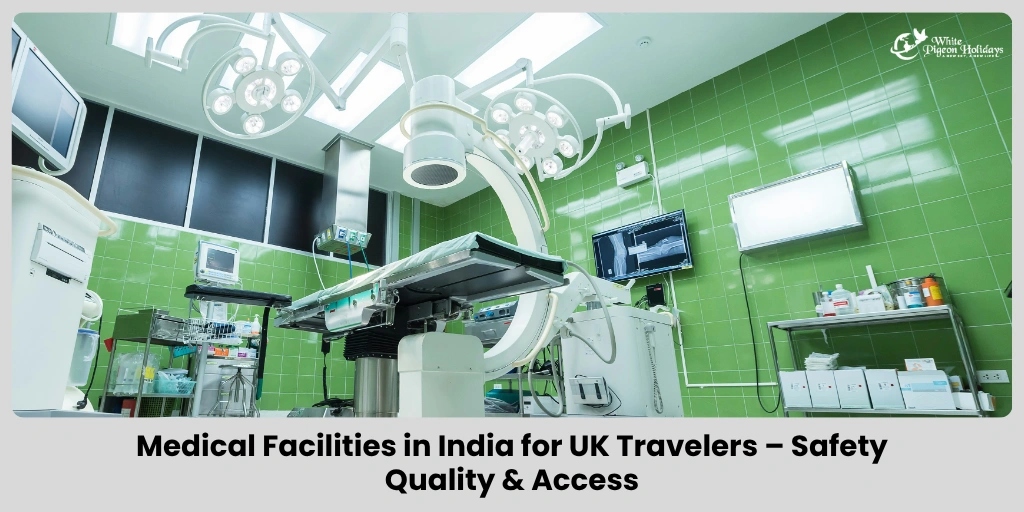
A traveler who walks into a well-regarded private hospital in Mumbai or Delhi will receive care that is, in many cases, equivalent to what they would receive in the UK privately.
A traveler who ends up in a poorly equipped rural facility will have a very different experience.
Where you go matters far more than simply being in India.
Public vs Private Hospitals — Which One Should UK Travelers Use?
Public vs Private Hospitals in India
Both public and private hospitals provide medical care, but the experience can differ significantly for international visitors. Private hospitals are generally the preferred choice for overseas travelers because of shorter waiting times, English-speaking staff, and better support for travel insurance.
| Factor | Government / Public Hospital | Private Hospital |
|---|---|---|
| Queue Times | Very long, often several hours | Usually minimal |
| English-Speaking Staff | Rarely available outside major cities | Common at major private hospitals |
| International Billing Support | Generally unavailable | Available at most leading hospitals |
| Insurance Claim Assistance | Usually unavailable | Dedicated insurance support teams |
| Cleanliness & Hygiene | Varies considerably | Generally high standards |
| Medical Equipment | Basic to moderate | Modern diagnostic and surgical facilities |
| Experience with International Patients | Limited | Good to excellent |
If you need medical treatment during your visit to India, choose a reputable private hospital whenever possible. Most international travel insurance policies work directly with major private hospitals, which usually provide English-speaking doctors, modern facilities, cashless treatment (where eligible), and dedicated teams to assist with insurance claims.
Recommendation: As a UK traveler, always go directly to a private hospital.
Public hospitals in India serve a high volume of local patients with limited resources.
They are not equipped to handle the billing, language, or administrative needs of foreign travelers.
Private hospitals in major cities are set up for exactly this — they have international patient desks, English-speaking doctors, and teams that handle insurance claims daily.
Which Private Hospitals in India Are Trusted by International Patients?
These are the hospital networks that consistently serve foreign travelers and have the infrastructure to manage travel insurance claims, international billing, and English communication.
Apollo Hospitals
One of India’s largest and most recognized hospital chains.
Apollo holds both JCI and NABH accreditation across multiple locations.
They have a dedicated International Patient Services division that manages pre-arrival consultations, visa support, in-hospital coordination, and post-discharge follow-up.
Locations in Chennai, Delhi, Hyderabad, Bangalore, Mumbai, and more.
Fortis Healthcare
Known particularly for cardiac care, cancer treatment, and orthopedics.
Fortis has international help desks at major locations with staff trained to work with foreign travelers.
Strong presence in Delhi, Gurgaon, Mumbai, Bangalore, and Chennai.
Max Healthcare
Max Super Speciality Hospital in Saket, Delhi is well-regarded for robotic surgeries, organ transplants, and complex cancer cases.
Strong for travelers visiting North India, particularly Delhi, Noida, and Gurugram.
Medanta — The Medicity (Gurugram)
Holds dual JCI and NABH accreditation.
Frequently cited in international medical tourism rankings for high-quality care and modern infrastructure.
Good choice for travelers based in or near Delhi NCR.
Kokilaben Dhirubhai Ambani Hospital (Mumbai)
One of Mumbai’s most advanced private hospitals.
JCI and NABH accredited with a strong international patient program.
What Does Medical Treatment Actually Cost in India?
This is where India becomes genuinely different from the UK.
Even as a foreigner paying private rates, medical care in India is substantially less expensive than UK private healthcare.
Private Healthcare Costs: India vs United Kingdom
Private healthcare in India is significantly less expensive than equivalent private treatment in the UK. Even major procedures often cost a fraction of UK private hospital prices.
| Treatment | India (Private) | UK (Private) |
|---|---|---|
| General doctor consultation | £10–£30 | £80–£150 |
| Emergency room visit | £30–£80 | £200–£500 |
| Private hospital stay (per day) | £50–£200 | £400–£1,200 |
| Minor surgery | £200–£600 | £2,000+ |
| Appendectomy | £500–£1,200 | £5,000+ |
| Cardiac bypass surgery | £3,500–£5,000 | £20,000+ |
Although private healthcare in India is considerably more affordable than in the UK, medical treatment can still cost thousands of pounds if you require emergency surgery or hospitalisation. Comprehensive travel insurance with adequate medical cover is strongly recommended before travelling.
Source: Tripoheal cost comparison and Treatment Abroad India
What this means: even if your travel insurance has a significant excess or doesn’t cover certain procedures, paying privately in India is often far less devastating financially than the same situation in the UK.
That said — without any insurance, a serious hospitalization in India can still run to thousands of pounds.
Travel insurance is not optional. It is the single most important thing you need before traveling.
What Travel Insurance Must Cover for India
Not all travel insurance policies are created equal.
Before you travel, verify that your policy includes all of the following:
Essential coverage checklist:
- ✅ Emergency medical treatment (minimum £2 million cover for India)
- ✅ Emergency medical evacuation and repatriation
- ✅ Hospitalization — including room, surgery, ICU, and specialist fees
- ✅ 24/7 emergency helpline with India coverage
- ✅ Cashless treatment facility at network hospitals
- ✅ Pre-existing condition declaration (if applicable)
- ✅ Adventure or activity coverage if trekking, hiking, or watersports are planned
What to watch out for:
- Policies with low medical cover limits (£100,000 is often not enough for serious emergencies)
- Exclusions for “known pre-existing conditions”
- Policies that require you to pay upfront and claim back — cashless treatment is far more convenient
- Fine print that excludes certain adventure activities
Note on pre-existing conditions: If you have a heart condition, diabetes, hypertension, or any chronic illness, you must declare it when buying insurance. Undeclared conditions are a common reason claims are rejected.
Free Travel Insurance Checklist for India
Download our India-specific Travel Insurance Checklist, created for UK travellers. Learn what your policy should include, which medical conditions must be declared, what exclusions to look for, and the details to verify before you travel.
How Do Indian Hospitals Handle UK Travel Insurance?
Most major private hospitals in India deal with international insurance claims regularly.
There are two ways this works:
Option 1 — Cashless treatment Your insurer has a direct arrangement with the hospital.
You present your insurance card at admission.
The hospital contacts your insurer directly.
You receive treatment without paying upfront.
The insurer settles the bill directly with the hospital.
Option 2 — Reimbursement You pay upfront at discharge.
You keep all documentation: bills, prescriptions, lab reports, and discharge summary.
You submit a claim to your insurer after returning to the UK.
Practical tip: Always call your insurer’s 24/7 emergency helpline before or as soon as you reach the hospital.
They will guide you to the nearest network hospital, initiate the cashless process, and begin your claim documentation.
Never walk into a hospital and assume cashless treatment will be available — confirm with your insurer first.
What to Do During a Medical Emergency in India
If you or someone in your travel group faces a medical emergency, follow this sequence:
Step 1 — Call for emergency services India’s national emergency number is 112.
This connects you to ambulance, police, and fire services.
In major cities, ambulance response times from private hospital networks can be 10–20 minutes.
Step 2 — Call your travel insurance helpline Before or as soon as you reach the hospital, call the 24/7 helpline printed on your insurance card.
Inform them of the situation, the hospital you are going to, and your policy number.
Step 3 — Go to the nearest private hospital If you are in a major city, ask your hotel for the nearest Apollo, Fortis, Max, or Medanta hospital.
If you are in a smaller town, ask for the best private hospital locally.
Step 4 — Provide your insurance details at registration Ask specifically for the “international patient desk” or “billing coordinator.”
Provide your insurance card and insurer’s helpline number.
Let the hospital and insurer communicate directly if possible.
Step 5 — Keep all documents Save every receipt, lab report, prescription, and bill.
Even with cashless treatment, you may need these documents later.
Common Health Issues UK Travelers Face in India
Most travelers to India experience minor issues — not emergencies.
Understanding what is common helps you stay calm and respond appropriately.
Traveler’s diarrhea and stomach upsets The most common issue by far.
Usually caused by consuming water or food that the body is not accustomed to.
Manageable with oral rehydration salts, rest, and basic medication.
Carry a small medical kit including ORS sachets, loperamide, and paracetamol.
Dehydration India’s climate, especially between March and June, can cause rapid dehydration.
Drink 2–3 litres of bottled or filtered water daily.
Respiratory issues Air quality in Delhi and several other major cities can be poor, particularly in winter.
Travelers with asthma or existing respiratory conditions should carry inhalers and consult their GP before traveling.
Sunstroke and heat exhaustion Especially relevant in Rajasthan, Gujarat, and North India during summer months.
Wear light clothing, carry water, and limit outdoor activity between 12pm and 4pm.
Insect-borne illnesses Malaria and dengue are present in certain regions.
Consult your GP or a travel health clinic 4–6 weeks before travel.
Depending on your destination, anti-malarial medication and vaccinations may be recommended.
Vaccinations and Pre-Travel Health Preparation
Visit your GP or a travel health clinic at least 4–6 weeks before departure.
Standard vaccinations recommended for India:
- Typhoid
- Hepatitis A
- Hepatitis B (if longer trips or medical exposure)
- Tetanus (if not up to date)
- Rabies (if wildlife exposure expected — trekking, rural areas)
- Yellow fever (only if arriving from an endemic country)
Malaria prevention: Risk varies significantly by region and season.
Your travel health provider will advise based on your specific itinerary.
Pharmacy Access in India
India has an excellent pharmacy network.
In every city and most towns, pharmacies (called “chemists” or “medical stores”) are widely available, many open late hours or 24/7.
Most common medications are available over the counter at very low cost.
What to bring from the UK anyway:
- Any prescription medication you currently take (bring enough for the full trip plus extra)
- Antihistamines
- Ibuprofen or paracetamol
- Oral rehydration salts
- Antiseptic cream and plasters
Some UK prescription medications may not be available under the same brand name in India. Carry the generic drug name (not just brand name) and your prescription.

Speak to a Travel Health Expert Before You Fly
Travelling to India with a pre-existing medical condition, regular medication, or an adventurous itinerary? Speak with Nitin Batra before you travel. We help coordinate with travel health professionals, review practical requirements, and ensure your trip is planned with the right support in place.
Who Should Take Extra Precautions
Seniors (65+) India’s climate, uneven terrain, and food adjustment can be more challenging for older travelers.
Book travel insurance that explicitly covers your age group and any pre-existing conditions.
Consider itineraries that include fewer internal flights and more rest time.
Travelers with heart conditions or diabetes Carry a full medication supply, a medical summary letter from your GP, and confirm hospital availability at every destination on your itinerary.
Pregnant travelers Consult your OB/GYN before confirming the trip.
Ensure your insurance covers pregnancy-related complications abroad.
Travelers with severe allergies Carry an EpiPen and a card explaining your allergy in Hindi if traveling to regions with limited English.
Frequently Asked Questions
Essential information about medical facilities and emergency healthcare for UK travellers visiting India.
Do I need travel insurance to enter India as a UK traveller?
No.
Travel insurance is not a legal requirement for entering India.
However, comprehensive medical insurance is strongly recommended because emergency treatment and medical evacuation can be extremely expensive without cover.
Can I use my GHIC (Global Health Insurance Card) in India?
No.
The UK Global Health Insurance Card (GHIC) only applies in participating European countries.
It does not provide healthcare benefits in India.
What is the fastest way to find a hospital in India?
In an emergency, call 112 for emergency services.
Your hotel concierge can recommend the nearest private hospital, and mapping apps can help you locate reputable medical facilities nearby.
Will doctors in India speak English?
Yes.
Doctors and nursing staff at major private hospitals generally communicate fluently in English.
Many specialists have also completed part of their medical training overseas.
What if I need specialist medical treatment?
Major private hospitals offer specialist services across a wide range of medical fields, including cardiology, orthopaedics, oncology, and neurology.
If necessary, your insurer can help arrange transfer to another hospital with the required expertise.
Is it safe to buy medicines from Indian pharmacies?
Yes, when purchasing from established pharmacy chains and licensed pharmacies.
Check that the generic medicine matches your prescription, particularly if the brand name is unfamiliar.
Avoid buying medicines from unlicensed roadside vendors.
What happens if I need to be flown back to the UK for treatment?
This is known as medical repatriation.
Many comprehensive travel insurance policies include this benefit and coordinate transportation, medical escorts, and hospital transfers when medically necessary.
How long are waiting times at private hospitals?
Emergency patients are treated according to medical priority.
For scheduled consultations, appointments are often seen within 20 to 60 minutes, while walk-in visits may take a little longer depending on demand.
Can I contact a hospital before travelling to India?
Yes.
Many leading private hospitals have dedicated international patient departments that can answer questions before you travel.
This is particularly useful if you have a pre-existing medical condition or ongoing treatment needs.
What medical documents should I carry during my trip?
Keep both printed and digital copies of important medical information.
- Your passport and India visa.
- Your travel insurance policy and 24-hour emergency contact number.
- A list of current medications using generic drug names.
- Details of any allergies or existing medical conditions.
- Your UK GP's contact information.
- An emergency contact person back home.
Contact White Pigeon Holidays
Planning an India tour around your pace, comfort, and peace of mind starts with one conversation.
We specialise in private, personally arranged India holidays for senior travellers from the UK. Every itinerary is planned from scratch around your interests, travel pace, comfort level, and preferred style of travel. Nothing is taken off a shelf.
