

If you’re planning a Golden Triangle trip (Delhi – Agra – Jaipur) and dealing with arthritis or knee pain, this question naturally comes up:
“Will I actually be able to do this comfortably?”
And this is not a small concern.
Because the Golden Triangle includes:
- Walking through large monuments
- Climbing steps in forts
- Standing during sightseeing
- Moving between cities
So the real question is not:
“Can I go?”
It’s:
“Can I enjoy it without pain or stress?”
The honest answer?
Yes — it is practical, but only with the right planning and expectations.
In this guide, I’ll walk you through real mobility challenges, what to expect at each site, and how to plan a golden triangle tour mobility issues-friendly trip that actually works.
What Mobility Challenges Seniors Face on Golden Triangle Tours
Let’s start with reality — not to scare you, but to prepare you.
Common challenges seniors with arthritis or knee pain face:
- Long walking distances
Many monuments require walking across large areas - Steps and uneven surfaces
Forts and palaces were not built for accessibility - Standing for extended periods
During guided tours or queues - Getting in and out of vehicles
Especially during multiple stops - Heat increasing joint discomfort
Warm weather can make stiffness worse
Real examples:
- Walking across the Taj Mahal complex (flat but long)
- Climbing sections of Agra Fort
- Navigating uneven paths at Amber Fort (Jaipur)
Simple truth:
It’s not impossible —
but it’s not effortless either.
How Much Walking Is Actually Required at Key Attractions?
Let’s break this down clearly — because this is where most seniors need clarity.
Mobility Demand by Attraction
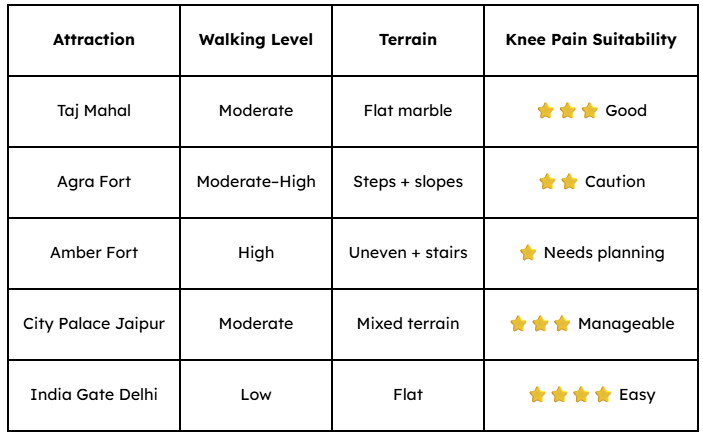
What this actually means:
- ⭐⭐⭐⭐ → Very easy, minimal strain
- ⭐⭐⭐ → Comfortable with pacing
- ⭐⭐ → Needs breaks and support
- ⭐ → Requires modification
Key insights:
- Taj Mahal is easier than most people expect
- Amber Fort is the most challenging
- Many places are manageable with adjusted pacing
Download Mobility Impact Map
To visualize everything:
Golden Triangle Mobility Impact Map (PDF)
Download My Mobility Impact Map
City-by-City Mobility Insights & Practical Solutions
Let’s go deeper — because each city feels different.
Delhi — Easier Mobility Overall
What it’s like:
- Urban layout
- Wide roads and open areas
- Many flat walking zones
Challenges:
- Some historic sites with steps
- Larger spaces requiring walking
Solutions:
- Use vehicle drop-offs close to entrances
- Focus on flat-access attractions
- Take frequent breaks
Agra — Mixed but Manageable
What it’s like:
- Taj Mahal → flat and structured
- Agra Fort → more physically demanding
Challenges:
- Steps inside forts
- Walking distance in open areas
Solutions:
- Visit Taj Mahal early morning
- Use wheelchair services if needed
- Limit time inside forts
Jaipur — Most Demanding City
What it’s like:
- Elevated sites
- Uneven terrain
- Longer walking paths
Challenges:
- Amber Fort requires uphill access
- Stone pathways
Solutions:
- Use jeep or assisted access at Amber Fort
- Skip difficult sections if needed
- Focus on easier attractions
Real insight:
Jaipur needs the most planning —
but it’s still doable with the right support.
Senior-Friendly Modifications That Make It Practical
This is where everything changes.
Because the trip becomes comfortable when you adjust how you travel, not where you go.
1. Adjust Your Itinerary
- Limit to 1 major attraction per day
- Include half-day schedules
- Add rest time
2. Use Private Transport
- AC vehicles
- Easy entry/exit
- Flexible stops

3. Use Mobility Aids
- Walking sticks
- Knee braces
- Wheelchairs where available
4. Travel With a Guide
- Adjusts pace
- Avoids difficult routes
- Plans rest breaks
5. Manage Climate Smartly
- Morning sightseeing
- Afternoon rest
- Stay hydrated
Key idea:
You don’t need to push your body —
you need to work with it.
Get Your Pain-Friendly Plan
Want a plan built around your comfort?
Senior Golden Triangle Pain-Friendly Tour Planner
When It Might Not Be Practical Without Support
Let’s be honest — this helps build trust.
It may be difficult if:
- You rely fully on a wheelchair without assistance
- You’ve had recent knee or joint surgery
- Walking even short distances causes pain
- You need constant medical supervision
In such cases, better options:
- Shortened itineraries
- Partial sightseeing (vehicle-based visits)
- More relaxed destinations
Important note:
This is not about “can or can’t” —
it’s about what will feel comfortable and enjoyable.
Get Your Mobility Health Toolkit
To prepare better:
Golden Triangle Joint & Motion Health Toolkit
FAQs Seniors Search About Mobility on Golden Triangle Tours
Yes, with proper planning, pacing, and support.
Yes, by using jeep access and limiting walking areas.
Yes, especially at the Taj Mahal and some major attractions.
Moderate, but mostly flat and manageable.
Highly recommended — it makes the experience much easier.
Final Thought
The Golden Triangle is not about physical strength —
It’s about smart planning and realistic pacing.
I’ve seen travelers with arthritis and knee pain complete this trip comfortably.
Not by pushing themselves…
But by adjusting the journey to fit their body.
And that’s the difference between a tiring trip and a memorable one.
