

For most travelers from the USA, the Golden Triangle is the first route they hear about when planning an India trip. It links Delhi, Agra, and Jaipur—three cities that show India’s history, color, food, and daily life in one loop.
That popularity creates excitement, but also worry.
You may be thinking:
- Will this feel too busy?
- Will I spend more time driving than enjoying?
- Will I feel tired instead of inspired?
These are fair questions. The Golden Triangle is designed to show a lot in a short time. For some travelers, that feels efficient. For others, it feels rushed.
This guide helps you judge the Golden Triangle tour pace honestly, based on how the trip is usually done and how it can be adjusted for comfort.
If you want a clear visual before going deeper, you can download our free Golden Triangle Pace Explained Guide. It shows real sample schedules and where travelers usually slow things down.
Deconstructing the Classic Golden Triangle Itinerary
When people say “the Golden Triangle is rushed,” they are almost always talking about the standard 6–7 day version sold by most tour operators.
Let’s look at what that really means.
What a Typical 6-Day Golden Triangle Tour Looks Like
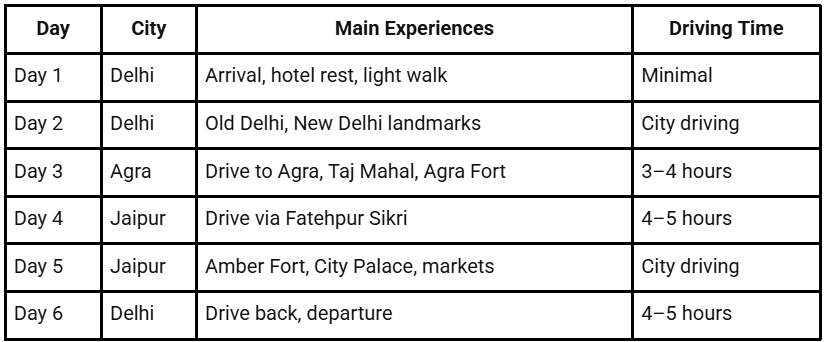
This classic Golden Triangle itinerary is built for travelers who:
- Have limited vacation time
- Want guided structure
- Want to see major highlights without extending the trip
There is nothing wrong with it. But it is intense.
Why This Pace Feels Fast for Many Travelers
- Long drives happen every 1–2 days
- Sightseeing days start early
- Free afternoons are rare
- Jet lag is still present for USA travelers
This is where the idea of a golden triangle rushed itinerary comes from. It is not about poor planning. It is about compression.
Who the Standard Pace Often Does Not Suit
The Golden Triangle itself is not the problem. The mismatch between pace and traveler expectations is.
You may find the standard pace uncomfortable if:
- You enjoy slow travel in India rather than packed days
- You prefer sitting at a site instead of moving quickly
- You need frequent rest due to heat or mobility
- You are traveling with children who need flexibility
- You want time to absorb culture, not just photograph it
For these travelers, a relaxed Golden Triangle tour is not about luxury hotels. It is about breathing space.
How to Slow Down the Golden Triangle Without Missing the Magic
This is the most important section. Because the Golden Triangle does not need to be skipped. It just needs to be shaped better.
Below are proven ways experienced travelers make it comfortable.
Add More Days (The Single Biggest Improvement)
Adding days changes everything.
- 6 days: fast and structured
- 7–8 days: comfortable
- 9–10 days: calm and immersive
An extended Golden Triangle itinerary allows:
- Three nights in each city
- Midday breaks
- Late starts when needed
For example, an extra night in Agra lets you visit the Taj Mahal at sunrise and rest afterward instead of rushing out.
Choose a Private Golden Triangle Tour
If pace matters, private travel is essential.
A private Golden Triangle tour gives you:
- Control over start times
- Ability to skip sites
- Extra stops during long drives
- No waiting for groups
Group tours follow a fixed clock. Private tours follow your energy.
Be Selective, Not Exhaustive
You do not need to see everything.
Most travelers enjoy the Golden Triangle more when they:
- Choose 2–3 key sites per city
- Skip repetitive forts or museums
- Spend more time at fewer places
Quality time beats quantity every time.
Plan Blank Afternoons
This sounds simple, but it works.
Leave some afternoons free for:
- Hotel rest
- Pool time
- A slow walk without a guide
- Processing what you’ve seen
India is intense. Downtime improves the experience.
Stay in Hotels That Feel Like Destinations
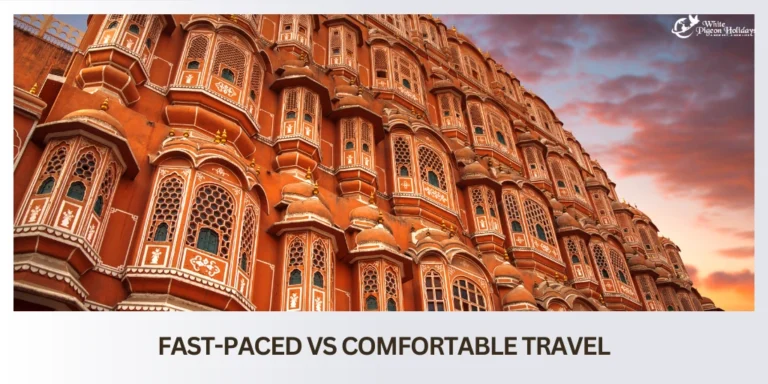
Heritage hotels in Jaipur or calm gardens in Delhi are not just places to sleep. They are part of the trip.
When your hotel is enjoyable:
- Rest feels intentional
- You don’t feel guilty slowing down
- The pace balances naturally
Is the Golden Triangle Actually Too Rushed? The Honest Answer
The standard, one-size group version can feel rushed for many foreign travelers, especially those coming from the USA.
But the Golden Triangle route itself is not flawed.
With:
- Added days
- Private transport
- Smart prioritization
It becomes one of the best introductions to India, offering history, color, food, and daily life without exhaustion.
If you want to understand how this looks in real schedules, you can read the details in our complete Golden Triangle Tour guide.
Alternatives If Pace Is Your Top Priority
If even a slower Golden Triangle feels like too much, you still have great options.
Focus on One Region
Instead of three cities, explore just Rajasthan or just North India with fewer long drives.
Single-Base Travel
Stay in Delhi and take guided day trips to Agra and Jaipur, returning to the same hotel each night.
These options reduce movement while still showing India’s highlights.
Conclusion: Your Journey, Your Rhythm
A successful Golden Triangle tour is not about surviving the pace. It is about designing one that fits you.
With the right structure, this classic route does not feel rushed. It feels rich, balanced, and memorable.
If you want help shaping it correctly, explore our customizable Golden Triangle Tours and build a trip that moves at your speed.
FAQs
What is the minimum time needed for the Golden Triangle?
Six days covers the basics but feels fast. Seven to eight days is far more comfortable.
Are the drives long?
Yes. Delhi–Agra is 3–4 hours, Agra–Jaipur 4–5 hours, Jaipur–Delhi 4–5 hours.
Can trains save time?
Trains work well for specific routes, but private cars offer better flexibility.
Where
should the tour start?
Delhi → Agra → Jaipur → Delhi is the most efficient route.
Best time of year?
October to March offers the most comfortable weather.
