

Four people can agree that they want to see the Taj Mahal and still have very different ideas about the rest of the day.
One couple may want a leisurely lunch and an afternoon at the hotel.
The other may be keen to visit Agra Fort before leaving for Jaipur.
Neither preference needs to become a problem.
It simply needs to be discussed before the itinerary is booked.
The same applies when parents travel with adult children or three generations take an India vacation together.
You may agree on the destinations but have different interests, room preferences, and ideas about how much to do each day.
A private luxury India family tour should account for those differences from the beginning.
For two travelers, planning is often straightforward.
With four to six people, the hotel rooms, vehicle, dining arrangements, and daily schedule deserve closer attention.
The aim is to enjoy India together without requiring everyone to spend every hour doing the same thing.
What Changes When You Plan an India Tour for More Than Two People?
The route may stay the same.
Delhi, Agra, and Jaipur work for a couple, two couples, or a family of six.
What changes is how the trip operates.
A couple might book one room and travel comfortably with their luggage in a private sedan.
A group of six could need three rooms, a larger vehicle, and more coordination around meals and sightseeing.
There may also be different expectations within the group.
One person wants to see every major fort.
Another enjoys architecture but prefers an afternoon at the pool.
Someone else has come to India primarily for food and traditional crafts.
Discuss these interests before selecting the hotels.
A useful planning question is:
“Which experiences do we want to share, and where would we appreciate some time apart?”
The answer helps shape a vacation that works for everyone.
Planning a Private Luxury India Vacation for a Couple
For a couple, the biggest advantage of private travel is control over the day.
You can spend longer at the Taj Mahal if you are enjoying the visit.
You can return early from sightseeing in Jaipur or add a craft workshop if it interests you.
There is no group departure time to consider.
Choose Hotels You Will Have Time to Enjoy
A palace hotel in Jaipur or Udaipur can be a highlight of a couples’ vacation.
If you are celebrating an anniversary, you may want a particular suite, a room with a view, or a special dinner.
Give the hotel enough time in the itinerary.
Three nights in Udaipur allow you to visit City Palace, enjoy a lake experience, and still spend an afternoon at the property.
An expensive suite adds less to the vacation when you check in late and leave early the following morning.
Keep the Sightseeing Personal
Choose experiences you both enjoy and leave space for spontaneous moments.
Traveling With Two Couples or Close Friends
Four adults can enjoy private travel together without sharing every decision.
Perhaps both couples want to explore Old Delhi, see the Taj Mahal, and visit Amber Fort.
After lunch in Jaipur, one couple may head back to the hotel while the other wants to browse textile shops.
That is a reasonable request.
The arrangements just need to be clear.
Plan Shared Activities and Separate Time
A simple approach is to reserve the main sightseeing for the morning.
Everyone visits the major attraction together, with the same private guide.
The afternoon can remain flexible.
Some days, the group may split up for a few hours.
On others, everyone may prefer to stay together.
If both couples want different excursions at the same time, ask whether an additional vehicle or guide would be required.
One private car cannot serve two separate routes simultaneously.
Allow Different Room Preferences
Two couples may want the same hotel but different accommodation categories.
One may prefer a standard luxury room.
The other may want a suite or a lake-facing villa.
There is no reason to make both couples pay for the same upgrade unless they want it.
Ask for a quotation showing each room category separately.
That makes the cost clear and avoids awkward discussions later.
For friends sharing a vacation, it is also worth agreeing beforehand on how separately charged activities, meals, and room upgrades will be paid for.

Planning a Multigenerational India Journey
A family vacation involving parents, adult children, and perhaps grandchildren needs a different conversation.
Start with interests, not ages.
An active grandparent may be the person most excited about walking through Jodhpur’s old city.
A younger family member may prefer a relaxed hotel afternoon.
There is no useful reason to assume otherwise.
Ask each traveler what they most want from India.
One person may name the Taj Mahal.
Another may be interested in Rajasthan’s textiles.
Someone else may be looking forward to a private houseboat in Kerala.
You will probably find several experiences everyone wants to share.
Build the Day Around One Main Activity
For a family of six, a full day at Amber Fort, City Palace, a market, and a cultural performance may sound manageable when written on a page.
In practice, everyone needs time for meals, breaks, and travel between sites.
Plan one main visit in the morning.
Add a second activity when the group wants it, rather than making every afternoon compulsory.
For example, a Jaipur day could look like this:
| Time | Family Arrangement |
|---|---|
| Morning | Visit Amber Fort together with a private guide |
| Lunch | Eat together at a selected restaurant |
| Afternoon | Optional textile visit for interested travelers; hotel time for others |
| Evening | Dinner together, if everyone wishes |
Ask About Walking and Steps Without Making Assumptions
Some travelers enjoy long heritage walks.
Others prefer shorter visits or need to avoid certain staircases.
Ask everyone privately about their preferences.
This can help determine whether the itinerary should include a shorter old-city walk, a particular hotel room location, or extra time at a fort.
A private guide can often adjust the pace of a visit.
Physical access at historic monuments, however, depends on the site itself.
Choosing Hotels and Room Arrangements
For a couple, one room category may be enough to settle the accommodation.
For a family, the hotel discussion is more detailed.
You may need two rooms, three rooms, a suite with an additional bedroom, or rooms near one another.
Do not assume that three rooms booked in the same hotel will be located together.
Connecting Rooms vs. Adjoining Rooms
These terms are worth checking carefully.
Connecting rooms have an internal door between them.
Adjoining rooms are next to one another but may not have that internal connection.
A hotel may also offer rooms on the same floor without placing them side by side.
For example, Rambagh Palace in Jaipur lists interconnecting rooms among its facilities, subject to availability.
That does not mean every room category connects to every other category. (Taj Hotels’ official Rambagh Palace information )
Ask the operator to confirm the exact configuration.
If an internal connecting door is essential, make that clear before paying the deposit.
Should You Book a Suite for the Whole Family?
Not automatically.
A spacious suite may have a separate living room but only one bedroom.
It may also have an occupancy limit that prevents the whole family from staying there.
Three comfortable rooms could be more practical than one elaborate suite.
For a family of four, a genuine two-bedroom suite or villa may be appealing.
For six adults, three separate rooms may provide better privacy.
Compare the floor plan, bed types, bathrooms, and maximum occupancy rather than relying on the word suite.
Transportation for Four to Six Travelers
A vehicle that is comfortable for two people may not work for four adults with large suitcases.
The number of passenger seats is only part of the decision.
You also need to consider luggage capacity, legroom, access to the rear seats, and the length of the journeys.
Four adults traveling with international luggage may prefer a larger vehicle than the smallest option that technically seats everyone.
For six travelers, discuss a suitable van or minibus arrangement rather than assuming that a standard multipurpose vehicle will provide enough room.
Ask the operator to confirm the proposed vehicle category and practical luggage capacity.
Long Transfers Matter More With a Larger Group
On a Golden Triangle itinerary, Delhi to Agra and Agra to Jaipur are usually planned as road journeys.
If the group continues through Rajasthan, Jaipur to Jodhpur and Jodhpur to Udaipur involve longer drives.
Build in suitable stops and avoid scheduling major sightseeing immediately after every transfer.
The same applies in Kerala.
The road to Munnar is winding, and a group may appreciate a relaxed arrival afternoon after the drive.
A comfortable vehicle helps, but it does not shorten the distance between cities.
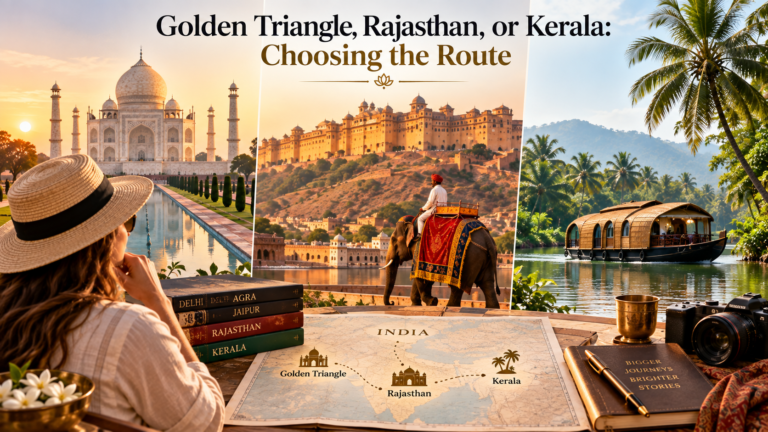
Golden Triangle, Rajasthan, or Kerala: Choosing the Route
The destination choice should reflect the time available and what everyone wants from the trip.
Option 1: Golden Triangle and Udaipur — 10 Days
This is a practical first India journey for a couple, two couples, or a family who wants historic architecture and distinctive hotels.
| Destination | Nights | Main Experiences |
|---|---|---|
| Delhi | 2 | Arrival, Old and New Delhi |
| Agra | 1 | Taj Mahal and optional Agra Fort |
| Jaipur | 3 | Amber Fort, City Palace, traditional crafts |
| Udaipur | 3 | City Palace, Lake Pichola, palace hotel time |
| Total | 9 | 10-day vacation |
The group can travel privately through Delhi, Agra, and Jaipur.
For the Jaipur–Udaipur connection, compare a suitable flight with the longer road journey.
Three nights in Jaipur and Udaipur provide opportunities to split up for an afternoon without disrupting the main sightseeing.
Explore the Golden Triangle tour options and private Rajasthan journeys when considering this combination.
Option 2: Golden Triangle and Kerala — 14 Days
This arrangement suits a group that wants historic sightseeing followed by hills and backwaters.
| Destination | Nights | Main Experiences |
|---|---|---|
| Delhi | 2 | Arrival and private sightseeing |
| Agra | 1 | Taj Mahal |
| Jaipur | 3 | Forts, palaces, crafts, and hotel time |
| Kochi | 2 | Fort Kochi, Mattancherry, regional cuisine |
| Munnar | 2 | Tea estates and hill scenery |
| Kumarakom | 2 | Backwater resort and private cruise |
| Kochi | 1 | Final night before departure |
| Total | 13 | 14-day vacation |
Travel from Jaipur to Kochi by air, allowing for a connection if needed. Continue through Kerala with private road transfers.
The backwater stay can include a private day cruise.
If your family wants an overnight houseboat, compare the bedroom layout and capacity before replacing a resort night.
Kerala Tourism explains the accommodation and cruising concept, although facilities vary by vessel.
For this route, explore White Pigeon Holidays.
How to Request a Quotation for Your Group
An accurate quotation needs more than the number of travelers.
Share how many rooms you need, whether anyone wants a suite, and whether connecting rooms matter.
Mention your preferred vehicle size and the amount of luggage you expect to carry.
You should also say whether everyone wants the same sightseeing schedule.
If some travelers are interested in additional activities, request those as options rather than compulsory inclusions for the entire group.
For four to six travelers, ask for the total group cost and a clear breakdown of hotel rooms, transportation, guides, domestic flights, and separately priced experiences.
Some private services can be shared across the group.
Additional rooms, a larger vehicle, or separate guides may increase the total.
Do not assume that every larger group automatically pays less per person.
Frequently Asked Questions
Can we book a private luxury India tour for just two people?
Yes. A couple can request private transportation, guided sightseeing, and accommodation selected around their preferences.
Is a private vehicle comfortable for four adults and their luggage?
It can be, provided the vehicle is appropriately sized. Confirm luggage capacity and seating before booking.
Can two couples stay at the same hotels but choose different room categories?
Yes, subject to availability. Ask for each room category to be listed separately in the quotation.
Are connecting rooms available at luxury palace hotels?
Some properties offer them. Confirm the specific room configuration and availability for your dates.
Can different family members follow different sightseeing schedules?
Yes, with suitable arrangements. Separate activities may require an additional guide or vehicle.
Is the Golden Triangle suitable for a multigenerational family?
Yes. Delhi, Agra, and Jaipur can be planned around shared interests, preferred walking distances, and free afternoons.
Should we add Kerala if our family prefers a slower vacation?
Kerala can work well when you allow enough nights in Munnar and at a backwater resort. Do not add it to an already crowded itinerary.
Can we include activities for adults with different interests?
Yes. Consider optional craft visits, food experiences, heritage walks, or hotel time.
Is it better to arrange one complete itinerary for the whole group?
One coordinated itinerary can simplify hotels, transportation, flights, and shared activities. Check that individual preferences are reflected in the plan.
Can White Pigeon Holidays customize a luxury India journey for our family size and preferences?
You can request a private proposal for two to six travelers. Share the group composition, room requirements, interests, and preferred travel pace.
Plan Around Your Group
Share who is traveling, your room requirements, and the experiences each person wants most.