

If you are over 60 and looking at Golden Triangle tours, the real decision is not Delhi versus Agra or Jaipur.
The real decision is how fast your days move.
Most seniors tell us the same thing.
“It’s not the sightseeing that worries me.”
“It’s the constant moving.”
This blog is written for seniors who want to choose the right Golden Triangle tour style before committing to any itinerary.
Not the cheapest.
Not the busiest.
The one that actually feels comfortable.
A Slow-Paced Golden Triangle Tour — Day by Day for Seniors
Here’s what a 9-day senior-friendly Golden Triangle itinerary looks like in practice.
Not in principles — in actual days.

Written by
Nitin Batra
Founder & Travel Expert · White Pigeon Holidays
With 25+ years in the tourism industry — from Airport Concierge to Vice President — Nitin founded White Pigeon Holidays in 2021 to help international travellers explore India with confidence. His hands-on experience across Asia, Europe, the Middle East, and the West shapes every journey he crafts.
| Day | Location | Morning | Afternoon | Evening |
|---|---|---|---|---|
| Day 1 | Delhi (Arrive) | Land, transfer to hotel and rest. | Take a light walk near the hotel or continue relaxing. | Easy dinner at the hotel. |
| Day 2 | Delhi | Visit Old Delhi including Jama Masjid and Chandni Chowk (about 2 hours). | Return to the hotel for rest. | Optional cultural show or quiet dinner. |
| Day 3 | Delhi | Visit Humayun's Tomb and India Gate (around 2.5 hours). | Relax at the hotel. | Free evening. |
| Day 4 | Drive to Agra | Depart Delhi around 8:00 AM and arrive in Agra by noon. | Optional visit to the Baby Taj or relax. | Stay at a hotel near the Taj Mahal. |
| Day 5 | Agra | Visit the Taj Mahal around 7:00 AM. | Lunch followed by hotel rest. | Optional sunset visit to Mehtab Bagh. |
| Day 6 | Agra | Explore Agra Fort (2–2.5 hours). | Afternoon rest at the hotel. | Free evening. |
| Day 7 | Drive to Jaipur | Leave Agra at 8:00 AM and stop at Fatehpur Sikri. | Arrive in Jaipur and check in. | Rest. |
| Day 8 | Jaipur | Visit Amber Fort viewpoint and City Palace. | Lunch and hotel rest. | Optional market visit. |
| Day 9 | Jaipur → Delhi | Free morning and check out. | Fly (30 mins) or drive (5 hrs) to Delhi. | Fly home or overnight in Delhi. |
A few things to notice in this schedule:
- No day has more than one major monument in the morning
- Every afternoon from Day 5 onward is protected rest time
- Travel days (Day 4 and Day 7) have no sightseeing pressure beyond one optional stop
- Day 1 is pure arrival — no sightseeing on landing day
This is what “slow-paced” actually means in hours and decisions, not just in words.
Is a Slow-Paced Golden Triangle Tour Worth It?
Often Yes For:
 Travelers over 60 Couples seeking a relaxed experience Travelers who prefer comfort over busy schedules
A slower itinerary usually means less rushing and more time to enjoy each destination.
Why Tour Style Matters More Than Attractions for Seniors
Changing hotels sounds harmless on paper.
In reality, it is one of the most tiring parts of travel after 60.
Packing and unpacking drains energy.
Early starts disrupt sleep.
Constant movement leaves little time to recover.
This is why golden triangle tour pace seniors matters more than how many monuments are listed.
How you travel shapes the experience more than what you see.
What “Slow” vs “Fast” Golden Triangle Tours Really Mean
Tour labels can be misleading.
So let’s clarify them plainly.
Fast Golden Triangle tours usually mean:
- Short stays in each city.
- Early mornings most days.
- Long sightseeing hours.
Slow Golden Triangle tours usually mean:
- Two or more nights per city.
- Later starts when possible.
- One main activity per day.
This is the real difference behind the slow vs fast Golden Triangle tour decision.
Fast-Paced Golden Triangle Tours — What Seniors Should Know
What a Fast Tour Typically Looks Like
Fast tours aim to cover everything.
Days start early.
Schedules are tight.
There is little margin for rest.
Travel days often blend into sightseeing days.
This is why many seniors later ask, is Golden Triangle tour rushed.
Who Fast Tours May Suit
Fast tours may suit:
- Very active seniors with high stamina.
- Travelers who are comfortable with long days.
- Those who prioritise “seeing everything” over comfort.
This group exists.
It is just smaller than most people think.
Why Fast Tours Often Disappoint Seniors
Most seniors do not regret missing a monument.
They regret feeling tired all the time.
Common feedback includes:
- Stiffness by mid-trip.
- Feeling constantly on the move.
- Little time to enjoy hotel comfort.
This is not about age.
It is about recovery time.
How Many Attractions Should Seniors Visit Per Day?
Comfortable Pace
- 2 to 3 major attractions
- Regular breaks
- Free time in the evening
More sightseeing does not always mean a better experience.
What Do Seniors Regret Most About Fast-Paced Tours?
Common Feedback
- Early starts every day
- Limited rest time
- Feeling rushed at major attractions
- Spending too much time packing and moving hotels
Many travelers prefer seeing fewer places at a more comfortable pace.
What You Actually Get By Going from 7 Days to 9–10 Days on the Golden Triangle
The difference between a 7-day and a 9–10-day Golden Triangle tour isn’t just two extra days.
It’s what those days let you stop doing.
| What Changes | 7-Day Tour | 9–10-Day Tour |
|---|---|---|
| Arrival Day | Sightseeing starts on Day 1. | Full rest day on arrival. |
| Delhi | 1.5–2 days with 2–3 sites each day. | 2.5–3 days with only 1–2 sites per day. |
| Agra | About 1.5 days. Taj Mahal and Agra Fort are usually combined into one busy day. | 2.5–3 full days with each major attraction visited on its own day. |
| Jaipur | About 1.5 days with Amber Fort and City Palace often combined. | 2 full sightseeing days with a relaxed pace. |
| Travel Days | Driving days often include sightseeing stops. | Travel days are mainly for driving and hotel check-in. |
| Rest Time | Minimal. Afternoons are often used for extra sightseeing. | Built-in afternoon rest from Day 4 onward. |
| Buffer Days | None. | 1–2 flexible days if you feel tired or want to revisit a place. |
The real cost of a 7-day itinerary for seniors isn’t the extra distance — it’s that there’s no margin.
If you feel tired on Day 3, you still have to get up and go because the schedule has no slack.
On a 9–10-day tour, a slow morning doesn’t derail anything.
For most seniors, the extra 2 days cost less energy than trying to recover from the pace of a 7-day tour.
Slow-Paced Golden Triangle Tours — Why Seniors Prefer Them
What a Slow Tour Feels Like Day-to-Day
A slow-paced tour feels different immediately.
Mornings are calmer.
Days have breathing room.
Usually there is:
- One major visit in the morning.
- A proper lunch break.
- Light or optional evenings.
This is what people mean by a Golden Triangle slow paced tour.
Key Advantages for Seniors
Slow tours offer:
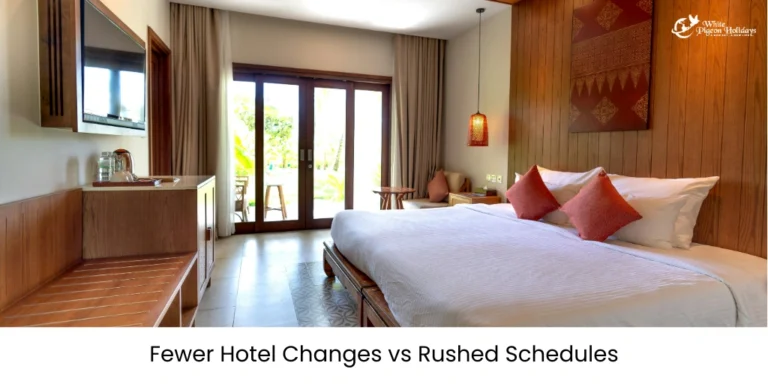
- Fewer hotel changes.
- Less physical strain.
- Better sleep and energy.
This is why most seniors end up preferring a senior friendly Golden Triangle itinerary, even if it costs slightly more.
Hotel Changes — The Biggest Difference Seniors Feel
This is where the difference becomes very clear.
| Tour Style | Hotel Changes | Senior Impact |
|---|---|---|
| Fast Tour | Frequent | More fatigue |
| Slow Tour | Fewer | Better comfort |
Slow vs Fast — Side-by-Side Comparison for Seniors
| Factor | Slow-Paced Tour | Fast-Paced Tour |
|---|---|---|
| Daily Pace | Relaxed | Busy |
| Hotel Changes | Fewer | More |
| Fatigue Level | Low | Higher |
| Senior Comfort | ✅ High | ⚠️ Moderate |
Which Golden Triangle Tour Style Is Right for You?
Ask yourself honestly:
- How do you feel after long days?
- Do you enjoy downtime at hotels?
- Is rest as important as sightseeing to you?
Your answers matter more than reviews or prices.
Can a Golden Triangle Tour Be Customized for Seniors?
Usually Yes
Later start times Additional rest breaks Fewer attractions per day Private transportation
Small adjustments can make the journey much more enjoyable.
Common Mistake Seniors Make When Choosing a Golden Triangle Tour
The most common mistake is choosing based on sight count or cost alone.
Another is assuming all Golden Triangle tours move at the same pace.
They do not.
Ignoring pacing often leads to disappointment, even on well-rated tours.
So, What Is the Best Golden Triangle Tour Style for Seniors?
For most seniors, slow-paced tours work best.
They allow the body to recover.
They reduce mental and physical strain.
Fast tours suit only a small group of very energetic travelers.
Comfort leads to better memories.
This is why searches for best Golden Triangle tour for seniors usually end with one answer.
Slower is better.
What “Later Starts” Actually Means on a Slow Golden Triangle Tour
“Later starts” is the phrase every senior-friendly tour mentions.
But what does it mean in clock time?
On a standard Golden Triangle tour, days often start at 6–7am.
The Taj Mahal at sunrise means a 5am–5:30am hotel departure.
On a slow-paced senior tour, here’s what a typical morning looks like:
- 7:00am — Wake up naturally, no alarm pressure
- 7:30–8:30am — Breakfast at the hotel (unhurried, seated, proper)
- 8:30–9:00am — Depart for the morning’s one site
- 9:00–11:30am — Sightseeing (2–2.5 hours max)
- 11:30am–12:00pm — Back to vehicle, drive to lunch
- 12:30pm — Lunch, then return to hotel
- 1:30–4:30pm — Rest, nap, hotel pool, or room time
- 4:30–6:00pm — Optional light activity (a market, a walk, a cultural show)
- 7:00pm — Dinner
The exception is the Taj Mahal.
A 7am entry is still strongly recommended — not because it opens at 6am, but because after 9am the crowds build and the heat starts.
For the Taj Mahal specifically, a slightly earlier start is worth it.
Every other site on the tour can comfortably wait until 9am.
The other thing worth knowing: medication schedules, breakfast needs, and morning stiffness are real factors for most travelers over 65.
A slow-paced tour is designed around these — not as an afterthought, but as the baseline.
Want Help Choosing a Senior-Friendly Golden Triangle Tour?
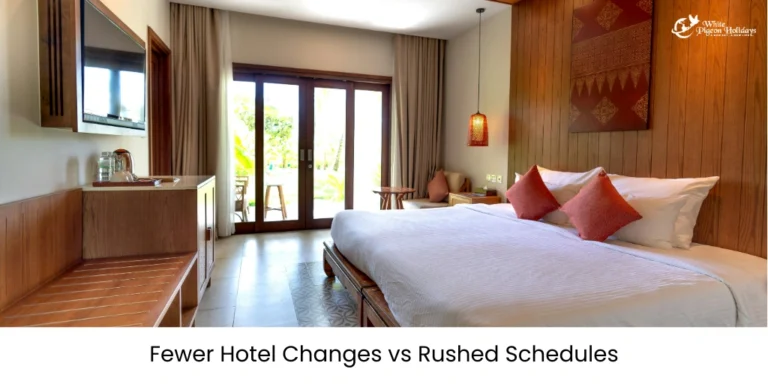
If you want to see Golden Triangle tour options designed with fewer hotel changes, realistic sightseeing days, and senior comfort in mind, you do not need to guess.
We have already filtered out rushed itineraries.
Fewer Moves. Better Rest. Better Experience.
Travel should feel steady.
Not exhausting.
When the tour style fits your energy, everything else falls into place.
See senior-friendly Golden Triangle tour options.
Talk With Us About the Right Golden Triangle Pace for You