
If you are considering the Golden Triangle, you are not doing anything wrong.
Most foreign travelers choose this route for a reason.
It looks simple, compact, and well-connected on paper.
What usually causes stress is not the route itself.
It is the small assumptions people carry into it.
This guide is written for you if you are from the USA or UK and want to avoid learning lessons the hard way.
Every point below comes from real traveler experiences.
Not theory.
The Taj Mahal Is Closed Every Friday — Here’s What to Do If Your Itinerary Lands on One
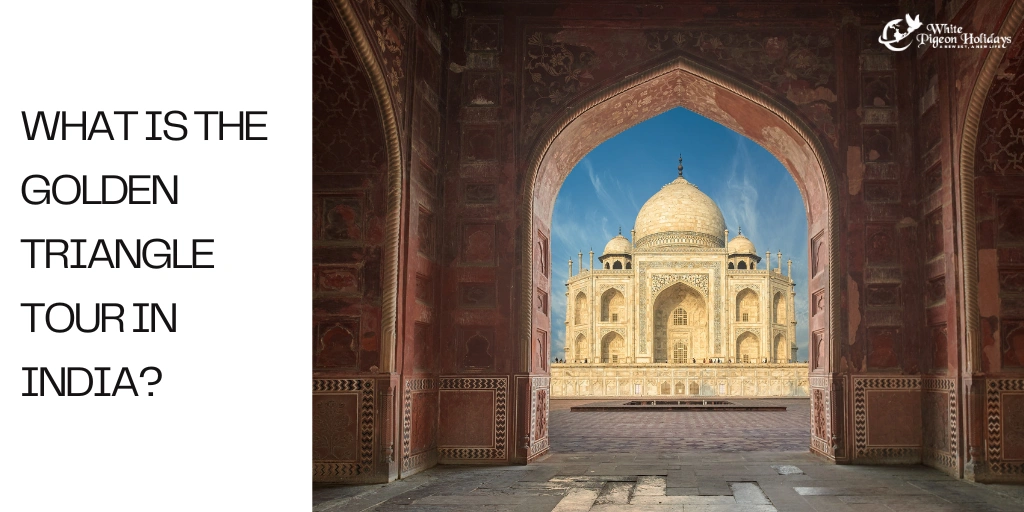
The Taj Mahal is completely shut every Friday for prayers. No exceptions, no early entry, no evening access.
This catches more first-time visitors than you’d expect — especially those who booked Delhi to Agra on a Thursday evening thinking they’d visit the next morning.
How to check before you book:
Count the days from your arrival date.
If Day 3 of your Golden Triangle itinerary falls on a Friday, your Agra day falls on a Friday.
Fix it before you leave home, not after you check in to your Agra hotel.
What to do if you realize the mistake late:
Swap your Agra and Jaipur days. Visit Jaipur on Day 3, come back to Agra on Day 4 or 5.
This works well because Agra to Jaipur and Jaipur to Agra are roughly the same drive — 4 to 5 hours either way.
If your dates are completely fixed and Friday in Agra can’t be avoided:
Spend Friday at Agra Fort, Mehtab Bagh, and the Baby Taj (Itmad-ud-Daulah).
None of these close on Friday.
You can still get a view of the Taj Mahal from Mehtab Bagh across the river — for free — even when the Taj gates are shut.
Visit the Taj Mahal itself on Saturday morning before you head to Jaipur.
Written by
Nitin Batra
Founder & Travel Expert · White Pigeon Holidays
With 25+ years in the tourism industry — from Airport Concierge to Vice President — Nitin founded White Pigeon Holidays in 2021 to help international travellers explore India with confidence. His hands-on experience across Asia, Europe, the Middle East, and the West shapes every journey he crafts.
| Situation | Solution |
|---|---|
| Realized before booking | Rearrange your itinerary so Agra falls on a day other than Friday. |
| Already booked but your dates are flexible | Swap your Agra and Jaipur days to avoid visiting the Taj Mahal on Friday. |
| Friday in Agra cannot be changed | Visit Agra Fort and Mehtab Bagh on Friday, then see the Taj Mahal early on Saturday morning. |
💡 Key Takeaway: The easiest way to avoid disappointment is to check your itinerary before booking. If Friday in Agra is unavoidable, simply adjust your sightseeing order and visit the Taj Mahal on Saturday morning instead.
What Most Tourists Regret Skipping at the Taj Mahal
Most first-time visitors spend 1.5 to 2 hours at the Taj Mahal, take their photos, and leave.
They find out later that they missed three things that would have made the visit genuinely different.
1. The mausoleum entry ticket
The standard foreign visitor ticket (₹1,300) gets you into the grounds and gardens.
It does not get you into the main mausoleum building — the white dome itself.
That requires an extra ₹200 ticket, sold at the entrance.
Most tourists don’t realize this until they walk up to the door and get turned away.
Inside the mausoleum is where Shah Jahan and Mumtaz Mahal are actually buried. The marble inlay work up close is completely different from what you see from the gardens.
If you’re visiting the Taj Mahal once in your life, spend the extra ₹200.
2. Mehtab Bagh at sunset
Mehtab Bagh is a garden directly across the Yamuna River from the Taj Mahal.
From here, you get a full frontal view of the Taj — no crowds blocking your frame, no entry queue, and the reflection in the river when conditions are right.
At sunset, the marble turns a warm orange-pink. It’s a completely different view from anything you’ll see inside the gates.
Entry is ₹300 for foreigners. Tripods are allowed here, unlike inside the Taj.
Most Golden Triangle itineraries don’t include this because it’s positioned as “optional.” That is a mistake.
3. The Baby Taj (Itmad-ud-Daulah)
The Tomb of Itmad-ud-Daulah is often called the Baby Taj — it predates the Taj Mahal by 20 years and is considered its architectural predecessor.
The marble inlay detail here is finer than the Taj Mahal itself. The crowds are a fraction of the size.
It costs ₹310 for foreign visitors and takes about 45 minutes.
Most people skip it because they’re tired after the Taj. The ones who go almost always say it was their favourite part of Agra.
| What People Skip | Why It Matters | Cost |
|---|---|---|
| Mausoleum Entry | Lets you enter the white marble mausoleum where the decorative cenotaphs and the historic burial chamber are located. | ₹200 extra |
| Mehtab Bagh | Offers one of the best sunset views of the Taj Mahal from across the Yamuna River and allows tripod photography. | ₹300 |
| Baby Taj (Itmad-ud-Daulah) | Known for its intricate marble inlay work, peaceful atmosphere, and far fewer crowds than the Taj Mahal. | ₹310 |
Why Even Well-Planned Golden Triangle Trips Go Wrong
The Golden Triangle connects Delhi, Agra, and Jaipur.
On a map, this looks straightforward.
In real travel conditions, the difference between seeing places and experiencing them well becomes clear very fast.
Most golden triangle tour planning mistakes happen because travelers assume India works like other destinations.
The intent is good.
The expectations are just off.
Why mistakes usually happen:
- Days are planned without buffers.
- Travel time is taken too literally.
- Comfort and recovery are underestimated.
Mistake: Trying to Cover Too Much
Many first-time visitors attempt to add multiple destinations beyond Delhi, Agra, and Jaipur.
Better Option
✔ Focus on the Golden Triangle in 7–10 days
✔ Add other regions only if you have extra time
A relaxed itinerary is usually more enjoyable than a rushed one.
Mistake #1 – Trying to Do Too Much in Too Few Days
This is the most common of all golden triangle travel mistakes.
It usually starts with a packed itinerary that looks impressive.
Back-to-back sightseeing days feel manageable at home.
On the ground, they add up quickly.
What this often looks like:
- Two cities covered in one day.
- Late nights followed by early starts.
- No time to pause or adjust.
A common scenario:
You arrive late.
You still try to sightsee.
By day three, you are tired but pushing through.
This mistake causes exhaustion, not fear.
Mistake #2 – Travel Time Between Cities
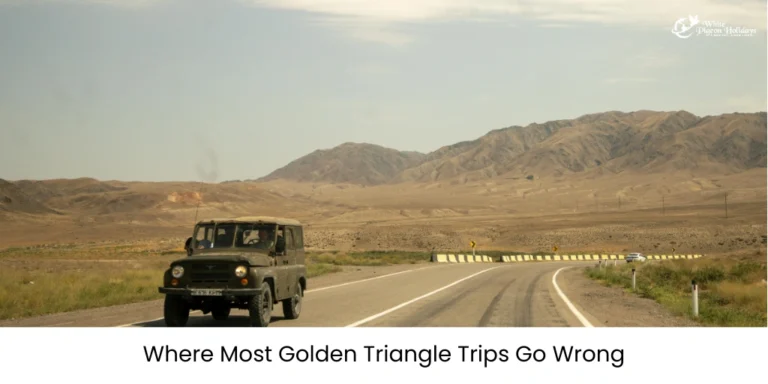
This is one of the biggest golden triangle travel problems for first-time visitors.
Online maps may show four hours.
Reality rarely matches that exactly.
Expectation vs reality:
- Expectation: Smooth highway drive.
- Reality: Traffic, checkpoints, and urban congestion.
Roads are improving, but unpredictability still exists.
Rail travel is faster, but it requires planning.
Assuming travel time will be precise leads to rushed days.
Mistake #3 – Choosing Hotels Based Only on Price or Brand
This is one of the most expensive mistakes to avoid on a Golden Triangle tour, even when the hotel is cheap.
A famous brand does not always mean the right location.
A low price often means long daily drives.
What usually goes wrong:
- Hotel is far from main sights.
- Traffic eats into sightseeing time.
- Early mornings become unavoidable.
What to look for instead:
- Central or well-connected location.
- Quiet surroundings for rest.
- Easy access for vehicles.
Hotel location affects every single day of your trip.
Mistake #4 – Skipping Guides to “Save Money”
Many travelers believe guides are optional.
This assumption backfires more often than not.
This is where good Golden Triangle India travel tips for foreigners matter.
Without guides:
- Sites feel crowded and confusing.
- You miss context and pacing.
- You spend more time figuring things out.
With guides:
- Visits move faster and smoother.
- You avoid queues and wrong entrances.
- The experience feels calmer.
Guides save time before they save information.
Avoid Golden Triangle Mistakes Before You Book
This guide brings together the lessons, planning tips, and common oversights that many travellers only discover after they arrive in India.
Learn what experienced travellers wish they had known earlier.
Mistake #5 – Treating India Like Any Other Country
This falls under common India travel mistakes first timers make without realising it.
India has a different rhythm.
Crowds move differently.
Time works differently.
What usually surprises travelers:
- Popular sights are busy even early.
- Meal timing matters more than expected.
- Dress comfort affects energy levels.
This is not about rules.
It is about adapting expectations.
Mistake #6 – Not Planning for Fatigue, Heat, or Sensory Overload
This mistake shows up quietly.
Usually around day three or four.
Cities are loud.
Colors are strong.
Heat can be draining.
Warning signs to watch for:
- Feeling irritated without knowing why.
- Losing interest in sightseeing.
- Wanting to rush through experiences.
Rest is not wasted time in India.
It is what keeps the trip enjoyable.

Mistake #7 – Booking Without Clear Inclusions & Exclusions
This is one of the most frustrating golden triangle tour mistakes foreigners make.
The itinerary looks fine.
The details are vague.
Always confirm:
- What transport is included.
- Whether guides are private or shared.
- Which meals are covered.
- Entry tickets clarity.
Clear inclusions prevent disappointment later.
Mistake: Underestimating Travel Times
Typical Travel Times
- Delhi → Agra: 3–4 hours
- Agra → Jaipur: 4–5 hours
- Jaipur → Delhi: 5–6 hours
Always allow extra time for traffic and sightseeing stops.
How the Photography Scam at the Taj Mahal Works — and How to Actually Handle It
Every Taj Mahal guide says “be careful of photography scammers.” None of them explain exactly what happens.
Here’s how it actually works:
You’re standing at the iconic reflecting pool trying to get the classic symmetrical Taj photo.
Someone approaches — friendly, helpful, often wearing something that looks semi-official.
They offer to take your photo. You say yes. They position you, take a few shots, hand back your phone.
Then they say the “really good angle” is over there, and they lead you to another spot and take more photos.
After a few minutes, they tell you the fee.
It’s usually much higher than you expected — ₹500 to ₹2,000 is common.
You’re now in an awkward position because you didn’t agree to a price upfront and they have your attention in the middle of a crowded monument.
How to handle this without being rude or dismissive:
If someone approaches to take your photo, the first thing you say is: “What’s your price?”
If they say “as you wish” or “whatever you like” — that’s the setup for a dispute at the end.
Agree on a number before they touch your phone.
₹100–₹200 is a fair rate for a few shots. Some will refuse at that price, which is fine.
A simpler approach:
Many visitors bring a small tripod — but tripods are not allowed inside the Taj Mahal.
The workaround is to use a small phone stand that clips onto the railing or sits on the ground. These are allowed.
Alternatively, ask another tourist to take your photo. This is completely normal and how most people handle it.
What if you already handed over your phone and they want an unreasonable amount?
Stay calm and offer what you consider fair — ₹100–₹200.
Do not escalate. Do not create a scene.
Most will accept a reasonable amount rather than draw attention to themselves.
How to Avoid All These Mistakes in One Go
The solution is not complicated.
It is just structured.
What works consistently:
- Right duration, not shortest duration.
- Balanced pacing instead of packed days.
- Hotels chosen for location, not labels.
- Local support that anticipates problems.
This is how experienced travelers move through the Golden Triangle smoothly.
Who This Mistake-Free Golden Triangle Guide Is For
- First-time foreign travelers to India.
- USA and UK visitors.
- Travelers who want clarity, not chaos.
If you want confidence instead of guesswork, this applies to you.
Mistake: Visiting During Extreme Heat
Best Months
- October to March
Most Challenging Months
- May and June
Comfortable weather can significantly improve your sightseeing experience.
Mistake: Wearing the Wrong Shoes
Popular attractions often involve more walking than expected.
Pack
✔ Comfortable walking shoes
✔ Lightweight clothing
✔ Sun protection
A little preparation goes a long way on the Golden Triangle route.
Want a Mistake-Free Golden Triangle Plan?
Most travel problems are avoidable.
They just need foresight.
Learning from other travellers’ experiences can save time, money, and unnecessary stress.
Clear planning leads to smoother travel days, better hotel choices, and fewer surprises along the way.
There is absolutely no pressure to book anything.