

India is entirely possible for senior travellers from the UK.
The concern is never really India itself — it is how the trip is put together.
A poorly planned India tour exhausts anyone.
A well-planned one feels smooth, comfortable, and genuinely enjoyable, even at a relaxed pace.
This guide tells you exactly what to expect, what to ask for, and how to plan a trip to India that works for the way you actually travel.
QUICK ANSWER — Is India suitable for UK seniors?
Yes, absolutely.
India is one of the most rewarding long-haul destinations for senior travellers when planned correctly.
The key factors are: the right regions, a relaxed pace, private transport, and fewer hotel changes.
Get those right and most UK seniors return saying it was nothing like they expected — in a very good way.
Planning an India Trip from the UK? Let’s Make It Comfortable for You
Quick Facts: India for UK Senior Travellers
| Flight time from London | ~8.5–9 hours direct to Delhi (British Airways, Air India, Virgin Atlantic) |
| Best months to visit | October–March (north); November–April (Kerala/south) |
| Visa required? | Yes — UK citizens need an Indian e-Visa (apply online, 3–5 days processing) |
| e-Arrival Card | Mandatory — complete online within 72 hours before arrival |
| Return flights (economy) | Broadly £500–£1,200 depending on airline and dates |
| Land tour cost (per person) | £1,800–£7,000+ depending on comfort tier |
| Currency | Indian Rupee (INR) — ATMs widely available |
| Tap water | Not safe to drink — bottled or filtered water only |
| Time difference | UK to India: +4.5 hours (IST) in winter; +5.5 hours during UK summer |
| Specialist insurance | AllClear — senior-focused, covers pre-existing conditions, no upper age limit |
Flight Time from London
Best Months to Visit
Visa Required?
e-Arrival Card
Return Flights (Economy)
Land Tour Cost (Per Person)
Currency
Tap Water
Time Difference
Specialist Insurance
Can UK Seniors Actually Travel Comfortably in India?
Yes — but comfort in India is not about the destination.
It is almost entirely about how the trip is structured.
India is a large, varied country. Some parts are calm, unhurried, and surprisingly easy to move around.
Others are chaotic, crowded, and genuinely tiring.
The difference between a stressful trip and a relaxed one comes down almost entirely to planning.
When a senior-focused itinerary is built correctly, these things happen automatically:
- Travel days are short and never back-to-back
- Hotels are selected specifically for accessibility and quietness
- All transfers are private — no shared coaches or public transport
- A local guide handles logistics so you focus only on the experience
- Rest days are built in, not squeezed out for “more sightseeing”
Most UK seniors who come back from India say the same thing: “It was nothing like we expected — in a good way.”
What they’re reacting to is how manageable India becomes when the right structure is in place.
The noise, the colour, the warmth of the people, the food — all of it lands as an experience rather than an ordeal.
What Makes a Tour Genuinely Senior-Friendly (vs. Just Labelled That Way)
Many tours use the phrase “senior-friendly” in their marketing.
Very few actually design around how seniors travel.
Here is a simple test.
Ask the operator these questions before booking:
- How many hours per day will we be in the vehicle?
- How often do hotels change during the trip?
- Is transport private or shared?
- How much free time is built into each day?
- Do you know which hospital is closest to each hotel on the itinerary?
Clear, specific answers to all five mean they have actually thought about senior travel.
Vague or general answers usually mean you are looking at a standard tour with different marketing
Generic Tour vs Genuinely Senior-Friendly Tour
| Feature | Generic Tour | Genuinely Senior-Friendly Tour |
|---|---|---|
| Daily start time | 7:00–8:00 AM departures | Flexible 9:00–10:00 AM starts |
| Daily travel time | 5–7 hours on the road | 2–4 hours with comfort breaks |
| Hotel changes | New hotel every 1–2 nights | Fewer changes, longer stays |
| Transport | Shared coach | Private air-conditioned vehicle |
| Sightseeing pace | Rush to cover everything | Selective, plenty of time at each site |
| Rest time | Minimal | Built into every day |
| Medical planning | None in advance | Nearby clinics and hospitals identified |
| Guide | Shared group guide | Dedicated private guide |
Daily Start Time
Daily Travel Time
Hotel Changes
Transport
Sightseeing Pace
Rest Time
Medical Planning
Guide

Best Regions in India for Senior Travellers from the UK
Not every part of India suits every traveller.
For seniors, some regions are significantly more manageable than others.
The Golden Triangle — Delhi, Agra, Jaipur
Quick Answer: The Golden Triangle is the classic starting point for first-time senior visitors.
Three well-connected cities, iconic landmarks, manageable road distances, and strong hotel infrastructure make it the easiest introduction to India.
This is the most popular route for a reason.
The three cities are well-connected, the roads between them are manageable, and the sights are India’s most iconic.
What works well for seniors here:
- The Taj Mahal offers electric golf carts for mobility-limited visitors, reducing the walking requirement significantly
- Amber Fort in Jaipur has jeep rides to the top and elevator access for those who cannot climb
- Delhi’s major landmarks are spread across the city — private transport makes them comfortable and unhurried
What to plan for:
- Delhi traffic can be intense. Build buffer time between spots and don’t try to cover too much in one day
- Agra is dusty and busy near the Taj. Stay slightly outside the city centre for a quieter overnight experience
- Fog can blanket Delhi and Agra in late December and January, which can affect Taj Mahal views. Factor this in if you’re visiting in peak winter
Kerala — South India’s Most Senior-Friendly Region
Quick Answer: Kerala is the easiest region in India for senior travellers.
The pace is slower, the climate is gentler, and a backwater houseboat cruise lets you experience India beautifully without walking anywhere at all.
Kerala is the easiest region in India for seniors.
The pace is slower, the environment is greener, the food is gentler on digestion, and the climate (outside of monsoon) is kinder than the north.
Backwater houseboat stays are particularly popular with UK senior couples.
The boat moves slowly through narrow canals, the scenery is peaceful, meals are cooked on board, and there is nothing to rush.
For many seniors, it ends up being the highlight of their entire India trip.
Ayurvedic wellness is also widely available here.
Kerala is home to some of India’s most respected Ayurvedic resorts, with programmes ranging from a few relaxing treatments to multi-day wellness stays.
Many UK travellers add 2–3 days at an Ayurvedic resort at the end of a sightseeing trip — it is a genuinely restorative way to finish.
Rajasthan Beyond the Golden Triangle — Udaipur, Jodhpur, Pushkar
For travellers who have already done Delhi-Agra-Jaipur, extending into Rajasthan offers more of what works: magnificent forts, palace hotels, and manageable road trips through landscapes that feel unlike anywhere else on Earth.
Udaipur is particularly well-suited to seniors.
Smaller and calmer than Jaipur, built around a lake, and with some of India’s most beautiful palace hotels right on the water.
Jodhpur has the extraordinary Mehrangarh Fort — imposing from the outside, surprisingly manageable inside.
What to Avoid (or Plan Carefully)
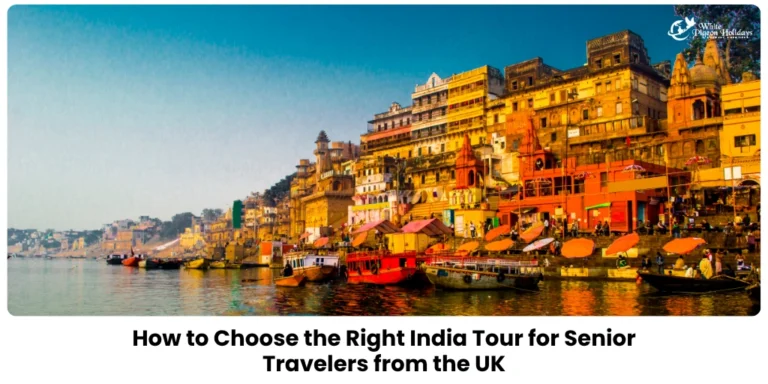
Varanasi — culturally extraordinary and unlike any other city on Earth. But it is physically demanding.
The ghats require walking on uneven steps, the lanes of the old city are narrow and crowded, and the overall intensity is high.
Include it only if you genuinely want this experience, and plan extra support around it.
Mumbai as a base — heavy traffic and dense crowds make it exhausting as a hub for seniors.
If you want to see Mumbai, a day or two as part of a wider trip is fine.
Using it as your main arrival point for an extended itinerary is not.
Any itinerary covering more than 3–4 cities in 10 days — pace collapse is the single biggest problem in senior travel to India.
Less is almost always more.
Spending three nights somewhere feels completely different from one.
The Best Time to Visit India for UK Seniors — Month by Month
| Month | North India (Delhi, Agra, Jaipur, Rajasthan) | South India (Kerala) | Verdict for Seniors |
|---|---|---|---|
| October | Warm and clear, ~30°C days. Post-monsoon fresh. | Pleasant and sunny | ✅ Excellent |
| November | Ideal. ~25°C days, cool evenings. | Start of peak season, beautiful | ✅ Excellent |
| December | Cool and lovely. ~20°C days, ~8°C nights. Fog possible late month | Peak season. Warm days | ✅ Excellent (fog watch) |
| January | Cold nights (~8°C), warm days (~20°C). Dense fog can affect Taj views | Warm and dry, lovely | ✅ Good (pack layers) |
| February | Warming up. ~25°C days. Ideal for outdoors | Perfect weather | ✅ Excellent |
| March | Getting warm. ~30°C. Still manageable | Good, slight humidity building | ✅ Good |
| April | Hot. 38–40°C. Tiring for seniors | Pleasant still | ⚠️ North not ideal |
| May–June | Very hot. 40–45°C. Not recommended | Monsoon approaching | ❌ Avoid north India |
| July–September | Monsoon season | Monsoon season | ❌ Avoid |
October
South India (Kerala): Pleasant and sunny
✅ Excellent
November
South India (Kerala): Start of peak season, beautiful
✅ Excellent
December
South India (Kerala): Peak season. Warm days
✅ Excellent (fog watch)
January
South India (Kerala): Warm and dry, lovely
✅ Good (pack layers)
February
South India (Kerala): Perfect weather
✅ Excellent
March
South India (Kerala): Good, slight humidity building
✅ Good
April
South India (Kerala): Pleasant still
⚠️ North not ideal
May–June
South India (Kerala): Monsoon approaching
❌ Avoid north India
July–September
South India (Kerala): Monsoon season
❌ Avoid
A Realistic 10-Day India Itinerary for UK Seniors (Well-Paced)
| Day | Location | What You're Doing |
|---|---|---|
| Day 1 | Delhi — Arrival | Land, transfer to hotel, rest. No sightseeing today. This day is non-negotiable recovery time after a long-haul flight. |
| Day 2 | Delhi | Humayun's Tomb, India Gate, gentle walk through Lodhi Garden. Unhurried. |
| Day 3 | Delhi | Qutb Minar. Optional: Old Delhi visit (only if you feel comfortable with the pace). |
| Day 4 | Delhi → Agra | Private drive (3–3.5 hours). Visit the Taj Mahal in late afternoon when light is golden and crowds thin. |
| Day 5 | Agra → Jaipur | Optional sunrise Taj visit, then drive to Jaipur (4–4.5 hours with comfort stops). |
| Day 6 | Jaipur | Amber Fort (jeep ride up), City Palace, afternoon at leisure. |
| Day 7 | Jaipur — Free Day | Rest day. Optional: local markets, cafés, or theDera Amer Elephant Sanctuary for something different. |
| Day 8 | Fly to Kochi (Kerala) | Morning flight. Hotel check-in. Relaxed evening walk around Fort Kochi. |
| Day 9 | Alleppey Backwaters | Full-day private houseboat cruise. Overnight on board. Traditional Kerala meals. Quiet canals. |
| Day 10 | Kochi — Departure | Easy morning, transfer to Kochi International Airport for UK flight. |
Day 1 — Delhi: Arrival
Day 2 — Delhi
Day 3 — Delhi
Day 4 — Delhi → Agra
Day 5 — Agra → Jaipur
Day 6 — Jaipur
Day 7 — Jaipur: Free Day
Day 8 — Fly to Kochi (Kerala)
Day 9 — Alleppey Backwaters
Day 10 — Kochi: Departure
Get Your 10-Day Senior-Friendly India Itinerary
Free Planning Worksheet: Not Sure How Many Destinations Fit Into Your Trip Comfortably?
Request the Senior-Friendly India Itinerary Planner — a free worksheet that helps you build an itinerary around your pace, covering sightseeing days, transfer distances, rest time, and overnight stops, so you never feel rushed or stretched thin.
Get Your Free Senior-Friendly India Itinerary Planner
Health, Medical Support & What to Actually Prepare
This is the section most travel websites skip — and it is the one that matters most.
6–8 Weeks Before You Travel
See your GP at least 6–8 weeks before departure. The NHS Fit for Travel guidance recommends considering vaccinations for:
- Hepatitis A — recommended for all travellers to India
- Typhoid — recommended, especially if eating outside of top hotels
- Tetanus and diphtheria — check your boosters are current
- Rabies — worth discussing if you plan time outside major cities
- Flu — routine, but worth being current before long-haul travel
Some of these require multiple doses spread over several weeks, which is why 6–8 weeks of lead time matters.
Medications and Documentation
Carry all prescriptions in their original packaging. India’s customs can flag unmarked medication.
Bring more than you need — allow for delays of up to 4–5 days beyond your planned return, just in case.
Make a typed list of all your medications (generic name, not just brand name), dosage, and prescribing doctor.
Carry multiple copies — keep one in your bag, give one to your travel companion, and email one to yourself.
Travel Insurance — This Is Not Optional
Standard travel insurance almost always excludes pre-existing medical conditions.
For UK seniors, this is the most important thing to get right.
AllClear specialises in senior travel insurance and covers over 1,300 pre-existing conditions with no upper age limit.
Staysure is another well-known option for seniors, though coverage varies by condition — always declare everything accurately.
Book your insurance as soon as you confirm your trip, not on the day of departure.
This ensures you’re covered for cancellation from day one.
With air ambulance costs running into six figures for serious emergencies abroad, travel insurance is not a cost to cut.
Medical Facilities at Each Destination
India's private healthcare in major cities is genuinely strong. Hospitals like Apollo, Fortis, and Max are internationally accredited and used to treating international patients.
| City | Major Private Hospitals |
|---|---|
| Delhi | Apollo Hospital (Sarita Vihar), Max Super Speciality (Saket), Fortis Escorts Heart Institute |
| Agra | Pushpanjali Hospital & Research Centre; S.N. Medical College (public emergency) |
| Jaipur | Fortis Escorts Hospital, Santokba Durlabhji Memorial Hospital (SDMH), Eternal Hospital |
| Kochi | Aster Medcity, Amrita Institute of Medical Sciences, Rajagiri Hospital |
Delhi
Agra
Jaipur
Kochi
Common Health Concerns for UK Seniors in India
Stomach upset. India’s food is not inherently dangerous — but the bacteria in the local water supply are different from what your gut is used to.
Stick to bottled water for everything, including brushing your teeth.
Avoid ice in drinks at smaller restaurants (top hotels use filtered ice).
Start with simple, well-cooked food on day one rather than diving straight into street food. Carry oral rehydration salts.
Heat. Rajasthan and Delhi can be extreme between April and June and in September.
Stick to October–March and you largely avoid the worst of it.
Carry a wide-brimmed hat, high-SPF sunscreen, and a refillable water bottle.
Stay hydrated through the day, not just when you feel thirsty.
Jet lag and fatigue. The time difference between the UK and India is 4.5–5.5 hours depending on the season.
Plan your first 24 hours purely for rest and adjustment.
Do not schedule sightseeing on your arrival day — you will not enjoy it and it will slow your recovery.
Mobility. Not all heritage sites are wheelchair-accessible.
Some temple complexes and forts require climbing uneven steps.
Discuss specific mobility requirements with your operator in advance so they can plan alternatives and set realistic expectations.
Free Checklist: Health Prep, Packing & Documents for Your India Trip as a Senior
Request the India Senior Pre-Travel Health & Packing Checklist — a practical guide covering GP appointments, vaccinations, medication prep, and everything you need to pack for a comfortable, worry-free trip.
Get Your Free India Senior Pre-Travel Health & Packing Checklist
Visa, Arrival Card & Entry — What UK Seniors Need to Know
Quick Answer: UK citizens need an Indian e-Visa applied for online at indianvisaonline.gov.in. Processing takes 3–5 working days.
Apply at least 2–3 weeks before travel.
You also need to complete India’s mandatory e-Arrival Card within 72 hours of landing.
Step-by-Step: Getting Your India e-Visa from the UK
- Go to the official portal: indianvisaonline.gov.in — do not use third-party sites that charge extra fees
- Choose your visa type: e-Tourist Visa for leisure travel. e-Medical Visa if you’re combining travel with Ayurvedic or medical treatment
- Choose your validity: 30-day (single/double entry), 1-year, or 5-year visa available. For a standard holiday, the 30-day e-Visa is fine
- Upload documents: passport photo page, recent passport photo, and a return/onward flight booking
- Pay the fee: Fees vary by duration — roughly $25 for 30-day, $40 for 1-year, $80 for 5-year (paid in USD)
- Wait for approval: 3–5 working days typically. Apply at least 2–3 weeks before travel to have buffer time
- Print your approved e-Visa: carry a printed copy along with your passport at immigration
e-Arrival Card — Don’t Miss This
Since 2024, India requires all international visitors to complete a digital e-Arrival Card before landing. Complete it online within 72 hours before your arrival.
You receive a QR code which is checked at immigration.
Your tour operator or travel agent should remind you about this — but make sure you do not forget it.
How Much Should a Senior India Tour Cost from the UK?
Quick Answer: For a 10-day India tour from the UK, land arrangements (accommodation, private transport, guides, and sightseeing) typically cost £1,800–£2,800 per person at the 4-star level, rising to £4,200–£7,000+ for luxury heritage hotels. Flights are separate.
Here is a realistic cost breakdown:
Get Your Free India eVisa & Arrival Checklist
What Does a 10-Day India Trip Cost for UK Seniors?
| Travel Style | Typical Cost Per Person (Land Only) | What's Included |
|---|---|---|
| Comfort (4-star) | £1,800–£2,800 | Quality 4-star hotels, private airport transfers, private vehicle and driver, sightseeing, English-speaking guides, relaxed itinerary |
| Premium (4–5 star) | £2,800–£4,200 | Higher-quality hotels, greater flexibility, slower pace, enhanced dining, upgraded experiences throughout |
| Luxury (5-star + Heritage) | £4,200–£7,000+ | Palace and heritage hotels, dedicated host, private guides, premium vehicle, wellness experiences, fully personalised |
Comfort (4-star)
Quality 4-star hotels, private airport transfers, private vehicle and driver, sightseeing, English-speaking guides, relaxed itinerary
Premium (4–5 star)
Higher-quality hotels, greater flexibility, slower pace, enhanced dining, upgraded experiences throughout
Luxury (5-star + Heritage)
Palace and heritage hotels, dedicated host, private guides, premium vehicle, wellness experiences, fully personalised
Want a Custom Quote for Your India Senior Tour?
Free Cost Estimate: Not Sure What Your India Senior Trip Will Cost?
Share your dates, number of travellers, preferred comfort level, and destinations to receive a personalised, itemised estimate covering accommodation, transport, sightseeing, and other expected costs — with no sales pressure and no obligation.
Not Sure What Your India Senior Trip Will Cost? Get a Free Estimate
Kerala vs. Rajasthan: Which Is Better for UK Seniors?
Honestly, the best India holiday for seniors often includes both. But if you have to choose, here is how they compare:
| Kerala | Rajasthan (Golden Triangle) | |
|---|---|---|
| Pace | Slow and relaxed | Moderate — more ground to cover |
| Walking required | Minimal (especially on houseboat) | Some — fort and palace visits |
| Weather (Oct–Mar) | Warm and sunny, 28–33°C | Cool days 20–30°C, cold nights |
| Cultural experience | Living tradition, backwaters, Ayurveda | Historic forts, palaces, Mughal heritage |
| Most memorable for seniors | Houseboat stay, peaceful canals | Taj Mahal at sunrise, Amber Fort |
| Physical demands | Low | Low–moderate |
| Ideal for | Those wanting peace and slow immersion | Those wanting iconic India highlights |
Pace
Walking Required
Weather (Oct–Mar)
Cultural Experience
Most Memorable for Seniors
Physical Demands
Ideal For
Which India Tour Is Right for You? Explore Senior-Friendly Packages
Common Mistakes UK Seniors Make When Planning India Trips
- Trying to see too much. India is vast and the instinct is to squeeze in as much as possible on a first trip. This is the fastest way to exhaust yourself. Three destinations done properly beats six destinations done hurriedly.
- Booking tour-style transport rather than private. Shared vehicles mean departing when others are ready and stopping when others want to stop. For seniors, private transport is not a luxury — it is a necessity.
- Not building a rest day. Even the most energetic seniors feel the cumulative effect of sightseeing in India by day four. A planned rest day in the middle of the trip makes the second half significantly more enjoyable.
- Getting insurance wrong. Standard policies often exclude pre-existing conditions. Discover this when you try to claim, not when you’re booking. Use a specialist like AllClear and declare everything.
- Arriving and sightseeing on day one. The flight from London to Delhi is 8.5+ hours, landing into a significant time difference. Day one is for rest, settling in, and adjusting. Many seniors who go straight to sightseeing from the airport end up spending day two recovering anyway.
- Not telling the operator about mobility or health needs. Tour operators cannot plan for what they don’t know about. If you have a mobility concern, a dietary need, or a health condition that affects how you travel, say so upfront. A good operator will adapt; a poor one will be exposed as not actually senior-focused.
- Underestimating how cold it gets in north India at night in January. January nights in Delhi, Agra, and Jaipur can drop to 8°C. Pack a proper warm layer — hotels are warm, but outdoor evenings are genuinely cold.
Who Is This Style of India Travel Best Suited For?
This approach works particularly well for:
- Retired couples who want a meaningful trip without the exhaustion of group tours
- Adult children accompanying elderly parents — when one person in the group needs more support
- First-time India travellers in their 60s and 70s who want structured, reassuring support
- Travellers with managed medical conditions who want to travel but need confidence that support is in place
- Solo senior women wanting a well-organised private tour with a dedicated guide and 24-hour ground contact
Honest answer on solo senior women: India has a mixed reputation, and some of it is deserved.
But on a well-planned private tour with trusted transport, an experienced guide, and a direct contact number for your operator, solo senior women from the UK travel very comfortably and safely.
The key is not travelling independently at random — it is travelling with structure.
It is probably not the right fit for:
- Those expecting fast-moving adventure or trekking
- Travellers who prefer complete independence with no guidance
- Anyone unwilling to adapt to the pace and texture of India’s cultural sites
Practical Questions UK Seniors Actually Ask Before Booking
Do UK citizens need travel insurance that covers India specifically? Yes — India is covered under most worldwide travel insurance policies, but make sure your policy explicitly includes your pre-existing conditions.
Standard policies and annual multi-trip policies often exclude or limit pre-existing condition cover.
Use a specialist like AllClear or Staysure and declare your full medical history when you apply.
Is the food manageable for seniors with dietary requirements? India has enormous food variety. Vegetarian options are widely available and very good.
Most 4–5 star hotels and quality restaurants will prepare milder food on request.
Gluten-free options are available at better restaurants in major cities.
Always communicate dietary requirements to your guide before the first meal.
What currency should I carry? Indian Rupees (INR). ATMs are widely available in cities and accept UK debit and credit cards.
Notify your UK bank before you travel to avoid cards being blocked.
Carry some cash for smaller shops, tips, and temple entrance fees.
Can I drink tap water? No. Always use bottled or filtered water for drinking, including when brushing your teeth.
This applies to ice in drinks at smaller restaurants — at top hotels, ice is typically filtered, but ask if unsure.
Is India suitable for someone with limited mobility? Yes, with the right planning. Mention specific mobility needs before the itinerary is finalised.
Your operator can arrange extra assistance at airports, select hotels with lifts and accessible bathrooms, and modify sightseeing so that difficult terrain is avoided or alternatives are arranged.
What if something goes wrong while I’m there? With a properly organised private tour, you should have a local ground contact reachable 24 hours a day.
Ask for this number before you leave the UK.
A professional operator will give it to you without hesitation.
How far in advance should I book? 4–6 months before travel is ideal, especially for October–March peak season.
Early booking gives you access to the best rooms at your preferred hotels and time to arrange visas, insurance, and vaccinations comfortably.
Is there anything special about the India–UK relationship I should know about? The India–UK Free Trade Agreement, signed in July 2025, has improved commercial ties significantly, and there is strong historical connection between the two countries.
Many Indians across Delhi, Jaipur, and Kochi speak excellent English and are welcoming to British visitors. You are unlikely to feel like a stranger.
Free Senior Travel Consultation: Plan Your India Holiday Around Your Pace, Not Just Your Destinations
Speak with a specialist with 25+ years in Indian tourism for a complimentary consultation covering your mobility needs, travel pace, medical considerations, comfort expectations, and sightseeing priorities — practical, honest advice with no sales pressure.
Plan Your India Holiday Around Your Pace, Not Just Your Destinations
India Travel FAQs for UK Seniors
Everything UK senior travellers need to know before visiting India — from the best time to go and visa requirements to health precautions, accessibility, and what to expect on tour.
What is the best time of year for UK seniors to visit India?
October to March is the most comfortable period for touring northern India, including Delhi, Agra, and Jaipur. Kerala in the south is excellent from November through April. These months offer pleasant daytime temperatures, minimal rain, and clear skies across most destinations.
How long is the flight from the UK to Delhi?
Direct flights from London Heathrow to Delhi (Indira Gandhi International Airport) take approximately 8.5–9 hours. British Airways, Air India, and Virgin Atlantic all operate direct routes. Flights to Kochi for Kerala are typically indirect and take 11–13 hours including the connection.
How much does it cost to fly from the UK to India return?
Economy class return flights from London to Delhi currently range from approximately £500 to £1,200 depending on airline, season, and how early you book. Booking 8–12 weeks in advance typically offers better availability and pricing.
Do UK citizens need a visa to visit India?
Yes. British citizens require an Indian e-Visa applied for online through the official Indian government portal. Processing typically takes 3–5 working days. Apply at least 2–3 weeks before departure. You also need to complete the mandatory India e-Arrival Card online within 72 hours of your arrival.
Can seniors with pre-existing conditions travel to India?
Yes, provided your healthcare needs are planned for in advance. Carry sufficient medication in original packaging, copies of prescriptions, and ensure your travel insurance covers your pre-existing conditions. Specialised insurers like AllClear cover over 1,300 conditions with no upper age limit.
What vaccinations are recommended for UK seniors visiting India?
NHS guidance recommends considering hepatitis A, typhoid, and ensuring tetanus/diphtheria boosters are current. Some seniors should also discuss rabies vaccination with their GP, particularly if visiting rural areas. Consult your GP or a travel health clinic at least 6–8 weeks before departure.
Is Kerala or Rajasthan better for a senior first trip to India?
Most first-time senior visitors benefit from including both — the Golden Triangle (Delhi, Agra, Jaipur) for iconic heritage and Kerala for peaceful recovery and backwater experiences. If only one is possible, Kerala is the physically easier choice; Rajasthan delivers more of the classic "India moments" most people imagine.
Can I visit the Taj Mahal with limited mobility?
Yes. The Taj Mahal complex offers electric golf carts that reduce the walking distance significantly. Your guide can arrange this. Discuss your mobility requirements with your operator in advance so the right access is confirmed.
Are single supplements available for solo senior travellers?
Yes. Most tour operators offer single-room accommodation for solo travellers, though an additional supplement usually applies. Confirm the exact cost before booking.
What happens if I need to cancel due to illness?
This depends entirely on your travel insurance policy and the tour operator's cancellation terms. Arrange comprehensive travel insurance as soon as you book — this ensures cancellation cover begins immediately, not just from the week before departure.
Is it safe for a senior woman to travel alone in India?
Yes, on a well-planned private tour. Dedicated private transport, an experienced guide, and a 24-hour ground contact number make solo travel significantly more comfortable and secure. India is not the right destination for completely independent, unstructured travel for most senior solo women — but a structured private tour with a trusted operator is a very different experience.
Will there be a lot of walking on a senior India tour?
Not necessarily. The itinerary can be planned to minimise unnecessary walking. Many key sites offer alternative access — golf carts at the Taj Mahal, jeep rides at Amber Fort, boat access at Kerala's backwaters. Discuss your comfort level with walking before the itinerary is finalised.

