If you are over 60 and considering a Golden Triangle tour, this is probably the question you care about most.
Not how famous the monuments are.
Not how many photos you will take.
You want to know what your body will be asked to do each day.
You want facts before you commit.
And you are right to ask now, not later.
This guide is written specifically for seniors who want a clear, site-by-site explanation of walking, steps, and standing time on a Golden Triangle tour.
No minimising.
No vague reassurance.
How Far You Actually Walk at Each Golden Triangle Monument (Site-by-Site Breakdown)
The honest answer is that walking varies a lot by monument — not by city.
Most guides say “5–8 km per day” but that number means nothing without knowing where the effort comes from.
Here’s the actual breakdown by site:

Written by
Nitin Batra
Founder & Travel Expert · White Pigeon Holidays
With 25+ years in the tourism industry — from Airport Concierge to Vice President — Nitin founded White Pigeon Holidays in 2021 to help international travellers explore India with confidence. His hands-on experience across Asia, Europe, the Middle East, and the West shapes every journey he crafts.
| Monument | Walking Distance | Terrain | Steps? | Time on Feet |
|---|---|---|---|---|
| Taj Mahal Grounds | ~0.8 miles / 1.3 km | Smooth marble and stone paths | Optional (mausoleum interior only) | 60–90 mins |
| Agra Fort | ~0.5 miles / 0.8 km | Cobblestones at entrance, then paved | Some inside palaces | 60–75 mins |
| Baby Taj (Itmad-ud-Daulah) | ~0.3 miles / 0.5 km | Flat, paved paths | 2–3 steps at the entrance | 30–45 mins |
| Fatehpur Sikri | ~0.6 miles / 1 km | Stone paths, mostly level | Some steps in mosque area | 60–90 mins |
| Amber Fort | ~0.4 miles / 0.6 km | Cobblestone courtyards | Many stairs (upper levels optional) | 45–75 mins |
| City Palace, Jaipur | ~0.3 miles / 0.5 km | Flat, paved | Minimal | 45–60 mins |
| Humayun's Tomb | ~0.4 miles / 0.6 km | Gravel paths and some steps | Yes, to enter the tomb | 45–60 mins |
| Qutub Minar | ~0.3 miles / 0.5 km | Paved, mostly flat | You cannot climb the minar | 30–45 mins |
These are walking distances inside the site, not including the walk from the vehicle drop-off to the entrance.
At the Taj Mahal specifically, the drop-off to the main gate adds about 0.3 miles each way.
The total per day usually adds up to 2–4 miles, spread across 3–4 sites.
It never happens all at once — there are car rides between every stop.
Why Walking Matters More Than Sightseeing for Seniors
After 60, walking tolerance varies from person to person.
What feels easy one day can feel tiring the next.
Unexpected walking is what causes stress.
Not the walking itself.
Many seniors tell us the same thing.
“If I had known how much walking was involved, I would have planned differently.”
That is why questions around golden triangle walking difficulty are not hesitation.
They are smart, experience-based planning.
What “Walking Required” Really Means on a Golden Triangle Tour
Before we talk distances, it helps to define terms.
On a Golden Triangle tour, effort usually comes from four things:
- Short stretches of flat walking.
- Standing time at monuments.
- Occasional steps inside forts or complexes.
- Heat and crowds, which make standing feel harder.
This is not a walking-tour destination like European city centres.
Sightseeing is vehicle-based.
Walking happens in short, controlled segments.
This is important for seniors with golden triangle mobility concerns.
Which Attraction Requires the Most Walking?
Expect More Walking At
- Taj Mahal
- Amber Fort
- Fatehpur Sikri
- Old Delhi heritage areas
These attractions often involve uneven surfaces, stairs, and extended sightseeing.
Can the Walking Be Reduced?
Yes, in Many Cases
✔ Private vehicles can minimize walking between sites
✔ Rest breaks can be added to the itinerary
✔ Golf cart services may be available near some attractions
✔ Guides can adjust the sightseeing pace
Many travelers comfortably complete the Golden Triangle without extensive physical strain.
The Part Nobody Warns You About: Standing Time Is Harder Than the Walking
Most people focus on walking distance before a Golden Triangle tour.
What actually tires them out is standing.
At the Taj Mahal, you’re not walking constantly.
You’re stopping every few minutes to look, photograph, listen to your guide.
That on-and-off standing — often in sun and humidity — is what drains energy faster than the steps.
Here’s what a typical Agra morning looks like in real time:
- 5:45am — Arrive at Taj Mahal gate, walk to main entrance (15 mins)
- 6:00am–7:30am — Slow walk and standing across the grounds (90 mins)
- 7:30am–8:00am — Walk back to vehicle (15 mins)
- 9:00am–10:30am — Agra Fort visit (90 mins walking + standing)
That’s roughly 3.5 hours on your feet before lunch.
Not all of it is walking, but most of it is upright.
The fix for this is early morning starts.
The Taj Mahal at sunrise is cooler, quieter, and less crowded — which means less standing in queues and more moving at your own pace.
By mid-morning at most Agra sites, heat and crowds make standing feel twice as hard.
If you’re planning with knee or fatigue concerns, ask your operator to build in a 2-hour midday break at the hotel between morning and afternoon sites.
That rest period makes the difference between a good day and an exhausted one.
Walking Breakdown by City
Delhi – How Much Walking Is Involved
In Delhi, most attractions are spread out and reached by car.
At places like India Gate, Humayun’s Tomb, or Qutub Minar:
- Paths are mostly flat.
- Walking is broken into short segments.
- You stop frequently to rest or observe.
Typical effort:
- 5 to 15 minutes of walking at a time.
- Plenty of benches and shaded areas.
This is why a Golden Triangle tour for seniors walking is usually manageable in Delhi.
Agra – Taj Mahal Walking Reality
This is the site most seniors worry about.
At the Taj Mahal, walking is straightforward.
From the parking area to the entrance:
- The walk is flat.
- Pathways are wide and smooth.
Inside the complex:
- Walking is slow and unhurried.
- Viewing the interior is optional.
There are benches inside the complex.
No one forces continuous walking.
When people ask how far do you walk at Taj Mahal, the honest answer is:
Short, flat walking spread over time.
Jaipur – Forts & Palaces Walking Expectations
In Jaipur, walking varies by site.
At Amber Fort:
- Vehicles can drive close to the entrance.
- Courtyards involve short walking loops.
Steps exist in some sections.
Upper levels are optional.
City Palace and other sites:
- Mostly flat.
- Walking in short loops, not long routes.
This is where golden triangle tour steps involved comes into play.
Steps exist, but they are avoidable with good planning.
Which Golden Triangle City Involves the Least Walking?
Delhi involves the least walking of the three cities — but it depends on which sites you visit.
Here’s how the three cities compare on physical effort:
| City | Walking Effort | Why |
|---|---|---|
| Delhi | Low to Moderate | Sites are spread out and reached by car. Most paths are flat, and you'll usually visit only two or three attractions in a day. |
| Agra | Moderate | The walk to the Taj Mahal entrance is fairly long, while Agra Fort has some cobblestones. Battery-operated vehicles help reduce walking. |
| Jaipur | Moderate to High | Amber Fort has the most uneven ground and optional stair climbs. City Palace is much easier with mostly flat walkways. |
🚶 Walking Effort
Low to Moderate
📍 Why
Sites are spread out and reached by car. Most paths are flat, and you'll usually visit only two or three attractions each day.
🚶 Walking Effort
Moderate
📍 Why
The Taj Mahal entrance walk is longer, and Agra Fort begins with cobblestones. Battery vehicles help reduce walking distances.
🚶 Walking Effort
Moderate to High
📍 Why
Amber Fort has uneven ground and optional stair climbs, while City Palace is largely flat and easy to explore.
If you want to reduce walking without skipping the highlights, the adjustment is simple:
- In Delhi: prioritize Humayun’s Tomb and skip Qutub Minar (saves 45 minutes on your feet)
- In Agra: use the battery vehicle at the Taj Mahal and skip Fatehpur Sikri (25 miles out of the way)
- In Jaipur: do City Palace and Hawa Mahal instead of Amber Fort interior if stairs are a concern
You won’t miss the essence of the tour by making these swaps.
You’ll just arrive at each hotel with energy left over.
How Much Walking Per Day Should Seniors Expect Overall?
This is the summary most people want.
On a typical Golden Triangle day:
- Walking is not continuous.
- It is spread across the day.
- Standing time often exceeds walking time.
Think of it as several short walks, not one long one.
The effort adds up gently, not suddenly.
This is why the route is rarely described as walking-heavy when planned correctly.
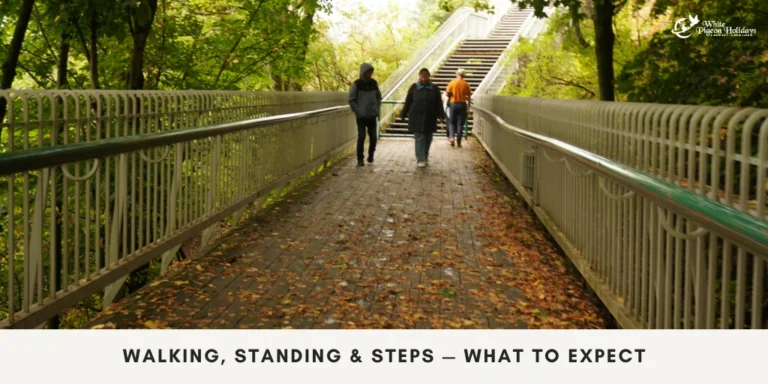
What Should You Wear for Comfortable Sightseeing?
Recommended
- Cushioned walking shoes
- Lightweight clothing
- Sun hat or cap
- Reusable water bottle
Comfortable footwear often makes the biggest difference during a Golden Triangle trip.
Are There a Lot of Steps on a Golden Triangle Tour?
Steps exist mainly inside forts and elevated sections.
They are not unavoidable.
- Adjust routes for seniors.
- Skip upper levels if needed.
- Focus on accessible viewpoints.
If you are asking are there steps in Golden Triangle monuments, the honest answer is yes.
The more important answer is that you do not have to climb them all.
Can Walking Be Reduced on a Golden Triangle Tour?
Yes.
And this is where planning makes the biggest difference.
Walking can be reduced by:
- Using vehicle drop-offs close to entrances.
- Skipping optional upper fort sections.
- Choosing hotels close to attractions.
- Planning fewer sites per day.
This directly answers can walking be reduced on Golden Triangle tour concerns.

When Walking May Be Challenging for Some Seniors
It is important to be clear here.
Walking may feel challenging if:
- There are severe knee or balance issues without support.
- Standing in crowds causes discomfort.
- Heat sensitivity is high and travel is in peak summer.
This does not mean the Golden Triangle is impossible.
It means planning must be more cautious and comfort-focused.
So, Is the Golden Triangle Walking-Heavy for Seniors?
No.
It is not a walking-heavy tour.
Sightseeing is vehicle-based.
Walking is moderate and adjustable.
Comfort depends more on planning than age.
This is why even seniors with concerns ask is Golden Triangle suitable for seniors with knee problems, not “should I avoid it entirely.”
Concerned About Walking & Pace During Your India Trip?
Many seniors feel unsure because they do not know how physically demanding the journey will be.
A Short Consultation Can Help You Understand
- Which Golden Triangle routes involve less walking and fewer stairs.
- Which attractions and sightseeing stops can be skipped without missing the essence of the trip.
- How the itinerary pace can be adjusted to match your comfort level.
Comfort Comes From Knowing What to Expect
There is no pressure to book anything.
There is no need to push your limits.
When expectations are clear, travel feels manageable.
When walking is planned realistically, enjoyment increases.