
Holi Special, India

Sample Itinerary
DAY 1
ARRIVE DELHI
You land at New Delhi’s international airport and after clearing Immigrations and Customs our representative will assist you on arrival and check-in.
New Delhi is the capital of India and a microcosm of the country. It is a modern metropolis which still preserves its traditional values and manages its multiple personalities effortlessly, making it a perfect gateway city to any North India journey.
Historians believe that through Delhi’s 1000 years old history, the city has been destroyed and rebuilt eight times, each time built by a new dynasty/ruler. As a result, Delhi grew and evolved, absorbing different religions, diverse cultures, both foreign and indigenous, and yet functioning as one organic entity and becoming the culturally secular city you see today.
EVENING VISIT AT AKSHARDHAM TEMPLE
Visit Akshardham Temple and witness the essence of Hinduism at Akshardham Temple one of the biggest and most intricate religious places of worship ever constructed. A visit to this monument is a journey through the gateway to the essence of ancient India and the best of Hindu culture and Vedic civilization. The monument is a fusion of pink stone and pure white marble, where pink stone symbolizes bhakti in eternal bloom and white marble that of absolute purity and eternal peace. (Closed on Mondays)
Overnight at the hotel
DAY 2
IN DELHI
Breakfast at hotel.
Proceed for guided sightseeing tour of Delhi. Your tour starts in Old Delhi, the former Imperial capital. Here, you trade your vehicle for cycle rickshaws and enjoy a ride through the crowded streets of the 300 years’ old Chandni Chowk market. It is said that the moonlight reflecting on the canal, earned it its name, ‘Chandni (Moonlit) Chowk (square). Today it is a busy market selling an extraordinary variety of items – silver, jewelry, aromatic spices, leather, fruit and vegetables. Apothecaries sell home grown medicinal items, and roadside dentists display their bizarre array of equipment and false teeth. It is a wonderful introduction into the world of organized chaos of India!
Disembark at Jama Masjid, believed to be the largest in India and Shah Jahan’s last architectural legacy. Originally it was called Masjid-I-Jahanum which means “The mosque commanding a view of the world”. Begun in 1644, the mosque was not completed until 1658. It has three great gateways, four angle towers and two minarets standing 40m high constructed of alternating vertical strips of red sandstone and white marble.
Later drive to Raj Ghat. A simple square platform of black marble marks the spot where Mahatma Gandhi was cremated following his assassination in 1948. It is surrounded by a beautiful park with labelled trees planted by notables like Queen Elizabeth II, USA President Eisenhower, Ho Chi Minh and various others.
In the afternoon drive past Lutyens New Delhi. Known as ‘Rajpath’ or ’Kings Way’- the wide tree lined avenues served as the capital city for the former British Empire. Among the buildings you drive past are the Secretariat buildings, Parliament House, Presidential Palace (Rashtrapati Bhawan), and India Gate, a memorial to 82,000 soldiers of the undivided Indian Army who died in the period 1914–21.
Continue to the Qutab Minar complex which has many historic monuments. The first mosque in India – The Quwwat-Ul- Islam – built from the dressed and carved stones of demolished temples lies in this complex. It establishes the political victory of Islam in Northern India. The Qutab Minar itself began in 1199 by Qutab ud din Aibak and was completed by his successors. This fluted elegant tower is decorated with elegant balconies and carvings.
Overnight at the hotel
DAY 3
DELHI – AGRA; (210 KMS/04-05 HRS. BY SURFACE)
Breakfast at hotel.
Check out and drive to the city of 07th wonder of the world.
Meeting on arrival and assisted with check-in to your hotel.
Later proceed to visit Agra Fort.
Agra Fort: After Taj Mahal proceed for sightseeing of Agra Fort. It represents first major building project of Akbar, though remains of only a few buildings built by him now survive. Built on the site of an earlier castle in AD 1565-75, the fort, apart from other important units, contains Jahangiri Mahal, Khass Mahal, Diwan-i-Khass, Diwan-i-Aam, Machchhi Bhawan and Moti Masjid. Many extant buildings were erected by Shah Jahan (AD 1630-55). Irregularly triangular on plan, it is enclosed by a double battlemented massive wall of red sandstone which is about 2 km in perimeter and interrupted by graceful curves and lofty bastions. Of its four gates, the most impressive is the Delhi Gate on the west.
EVENING MOHABBAT THE TAJ SHOW
Mohabbat the Taj – A show which has taken seven years of chiseling and carving by 28 craftsmen and designers. Made in pure white Makrana marble like the original 17th century monument, a Taj Mahal replica.
This programme has exciting and innovative presentation of a song and drama spectacle involving 60 artists, they have tried to merry the traditional media with the latest gadgetry, audio visual technology, including laser. The Taj will be presented in 10 different moods, representing varying seasons and hours of the day.’ The show will a love story set in the 17th century ambience and woven around the Taj. Timings: 06:15 PM.
Overnight at the hotel
DAY 4
AGRA – JAIPUR; (240 KMS/05-06 HRS; BY SURFACE)
This early morning you visit the stunning Taj Mahal at sunrise.
When the Mughal Emperor Akbar established his supremacy in Northern India, he began his first architectural venture, rebuilding the fort as a beautiful fort palace. The work was completed by his son and grandson, highlighting the Mughals’ ability to blend defensive and decorative architecture. Richly decorated with marble and mosaic, it was in a part of this fort that Shah Jahan spent the last years of his life, imprisoned by his son Aurangzeb. His private quarters, where he was confined, have a magical view of the Taj Mahal across the river Yamuna.
Post a late breakfast you continue your journey to the Pink City of Jaipur.
An hour and a half outside Agra is your first stop, Fatehpur Sikri. A typical visit to Sikri takes about an hour and is worth the time. A UNESCO World Heritage Site, Fatehpur Sikri was temporarily the capital of the Mughal Empire under Akbar the Great. Built by Emperor Akbar to honor the Saint Salim Chisti who foretold the birth of Akbars’ son and heir, this structure is constructed entirely in vibrant red sandstone, architecturally it draws its inspiration from Hindu, Persian and Islamic styles.
Sikri was the first planned city of the Mughals. The sloping levels of the city, connected into terraces, were utilized for various complexes such as Jami masjid, Buland-Darwazah and tomb of Sheikh Salim Chishti; Khwabgah, Diwan-i-Khass, and Diwan-i-Am. The efficient system of drainage and water-supply adopted here suggest an extremely intelligent town-planning by the Mughal emperor but eventually, a lack of adequate water supply for a whole city lead to its abandonment 14 years later.
After visiting Fatehpur Sikri take straight drive to Jaipur. Transfer directly to your hotel and check-in.
Overnight at the hotel
DAY 5
IN JAIPUR
Breakfast at hotel.
This day engage yourself for full day of sightseeing of Pink City.
Morning Amber Fort with Elephant ride failing by jeeps. Amber is a classic, romantic Rajasthani fort Palace. The rugged, time-ravaged walls of the Fort may not look beautiful from the outside, but the interior is a virtual paradise. Miniatures painted on the walls depict hunting and war scenes, apart from festivals.
Precious stones and mirrors are embedded into the plaster. Inside the Fort visit the Jag Mandir or the Hall of Victory. Inside the Jag Mandir is the famed Sheesh Mahal – a room with all the four walls and ceiling completely embedded with glittering mirror pieces, which were specially imported from Belgium during that period. Enroute to Amber Fort, you will have a brief photography stop at Hawa Mahal – the Palace of Winds.
Afternoon city tour begins with a visit to the Maharaja’s City Palace, the former Royal residence, part of it converted into a museum. A small portion is still used by the Royal family of Jaipur. Built in the style of a fortified campus, the palace covers almost one-seventh in area of the city.
One of the major attractions in the museum is the portion known as Armory Museum housing an impressive array of weaponry-pistols, blunderbusses, flintlocks, swords, rifles and daggers. The royal families of Jaipur once used most of these weapons. Later visit the Jantar Mantar, which is the largest stone and marble crafted observatory in the world. Situated near the gate of the city palace, the observatory has 17 large instruments, many of them still in working condition. Later continue to visit Lakshmi Narayan temple which is also known as Birla Mandir.
Overnight at the hotel
DAY 6
JAIPUR – UDAIPUR (BY FLIGHT) – HOLI CELEBRATION (Holika Dahan)
Breakfast at hotel.
Transfer in time to airport to board flight to Udaipur.
Meeting and assistance on arrival at Udaipur airport and transfer to your pre booked hotel. (early check in subject to availability)
Check in at hotel.
We will enjoy a leisurely boat ride on Lake Pichola. With its main attractions being the two palaces on the islands in the lake, Jagniwas and Jagmandir. Lake Pichola is about 4 KM in length and 3 KM wide.
Evening you will be taken to City Palace to experience and enjoy the HOLIKA DAHAN ceremony. Program will be followed as under:
- Assembly of Invitees at the Manek Chowk, the City Palace Complex 6.00 pm
- Arrival of the members of the Royal Family 6.20 pm
- Royal Procession starts from the Shambhu Niwas Palace 6:30 pm
- Maharana Salute on arrival of Shriji at The Manek Chowk by The Guard of Honour 6.40 pm
- Holika Poojan 6.45 pm
- Holika Dahan 7.00 pm
- Blessing from Sadhus 7.10 pm
- Gair Dance by folk artist from Jalore 7.15 pm
- Fire Works display 7.25 pm
- Refreshments at The Zenana Mahal, The City Palace Complex 7.30 pm
(Above suggested timing is subject to change depending upon procession timing)
Overnight at the hotel
DAY 7
UDAIPUR (HOLI CELEBRATION)
Breakfast at hotel.
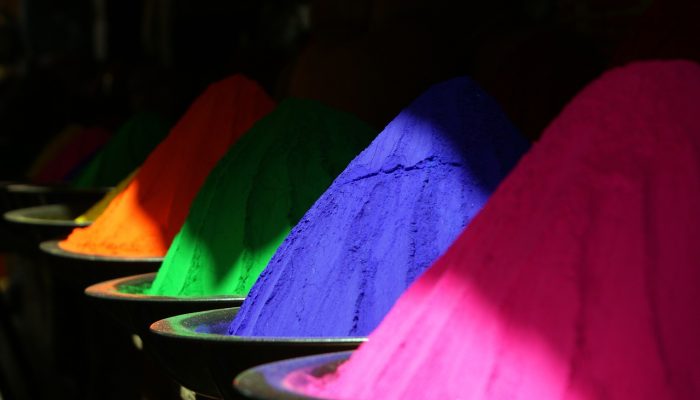
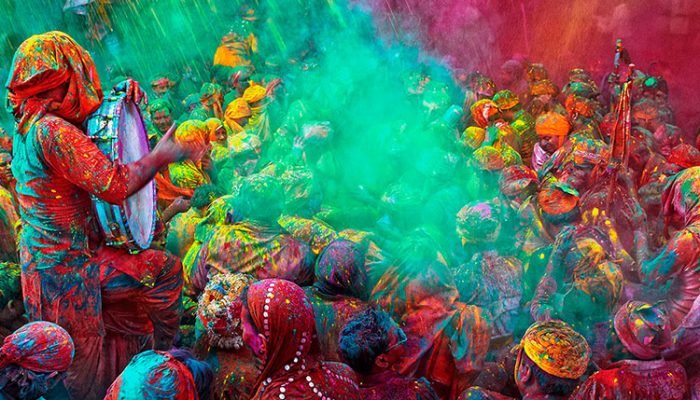
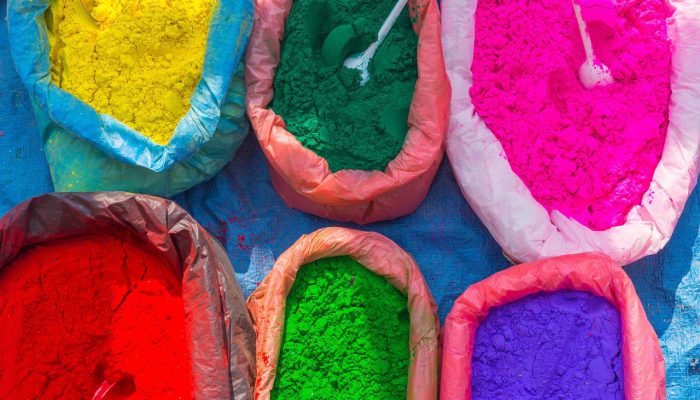
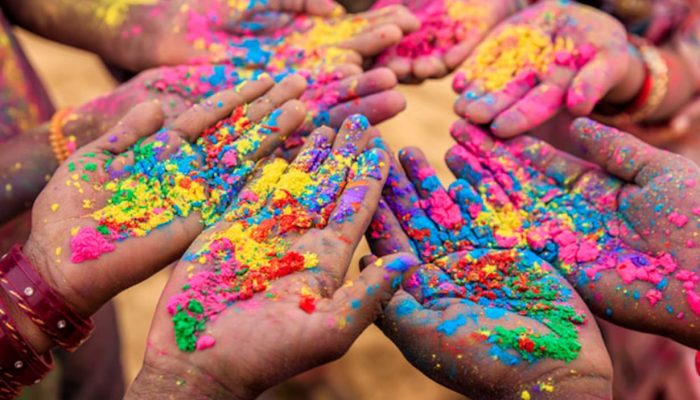
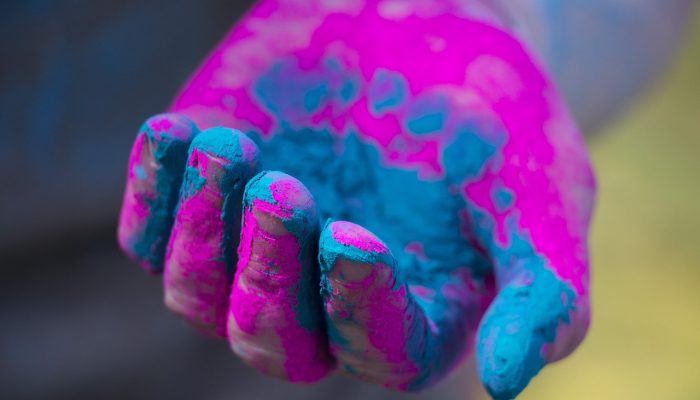
This day engage yourself with festival of colour i.e. Holi.
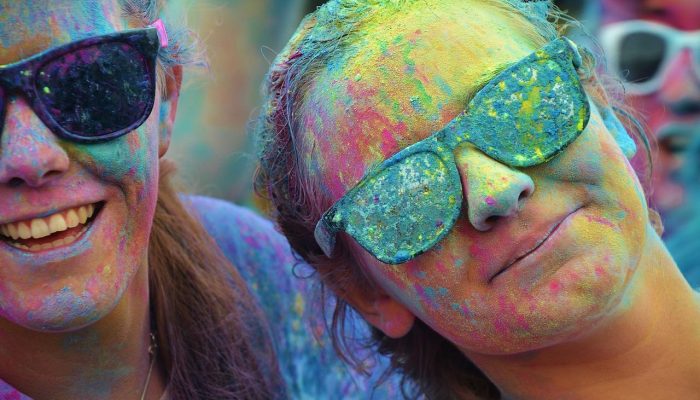
Transfer at local Indian’s family home to celebrate & enjoy Holi, one of the most popular of Indian festivals, is celebrated when winter gives way to spring. Come with us as we take you away from the noise and crowds of the streets outside…in through the majestic wooden doors…and enter the vast, lovely lawns of the quietly elegant local residence. As the doors shut behind you, the garden is transformed into a riot of brilliant colours!
So come celebrate the real HOLI by living in local and enjoy the eternal bliss of the soul.
Overnight at the hotel
DAY 8
UDAIPUR - – MUMBAI (BY FLIGHT)
Breakfast at hotel.
Proceed for a guided Udaipur city tour. We will explore the City Palace a fusion of Medieval European and Chinese unique, lavish, artistic, and elegant architecture. The City Palace was built by Maharaja Udai Singh. This marble monument is situated on the eastern banks of Lake Pichola. Numerous balconies, towers and cupolas of the palace provide a marvelous view of the lake and the city below. A triple arched gate called Tripolia, built in 1725, provides the entry to the palace. Then we will visit Saheliyon Ki Bari, the garden of maidens, which was built by Maharana Sangram Singh in the mid-18th century. Pools with elegant kiosks, flowerbeds, lawns, pools, fountains, along with an array of trees make this garden eye-catching. There is also a sitting room decorated with paintings and glass mosaics in the garden. Fateh Sagar Lake originally built in 1678 by Maharana Jai Singh; Fateh Sagar was rebuilt by Maharana Fateh Singh after the rains destroyed the dam.
Evening take flight to Mumbai
Meet & Greet at Mumbai Airport, formerly called Bombay) is a densely populated city on India’s west coast. A financial center, it’s India’s largest city. On the Mumbai Harbour waterfront stands the iconic Gateway of India stone arch, built by the British Raj in 1924. Offshore,
Overnight at the hotel
DAY 9
In Mumbai
After Breakfast, proceed for sightseeing of Mumbai including, Chhatrapati Shivaji Maharaj Vastu Sangrahalay (formerly known as the Prince Wales Museum) of Western India, is the main museum in Mumbai & Mani Bhawan. It was owned by the Mani family who were the friends and the host of Mahatma Gandhi while he stayed in Mumbai. Later Visit Elephanta Caves are a UNESCO World Heritage Site and a collection of cave temples predominantly dedicated to the Hindu god Shiva. They are located on Elephanta Island, or Gharapuri in Mumbai Harbour, 10 kilometres to the east of the city of Mumbai in the Indian state of Mahārāshtra.
Afternoon Visit Gateway of India is an arch monument built during the 20th century in Mumbai, Chhatrapati Shivaji Terminus (previously known as the Victoria Terminus), Crawford Market, market houses a wholesale fruit, vegetable and poultry market & Visit Dhobi Ghat was an open air laundromat in Mumbai, India. The washers, known as dhobis, work in the open to clean clothes and linens from Mumbai’s hotels and hospitals. It was constructed in 1890.
Overnight at the hotel
DAY 10
Depart Mumbai
In time transfer to airport for your flight for your hometown

CREATE AN EXPERIENCE
Let's Make Memories Together
The voyage does not finish once you have left. We’ll transport you to a world of wonders and create amazing memories that will last long after you’ve returned home.
Away from the regular tourist traps, you’ll have a one-of-a-kind, authentic experience. A sensation created in an energizing setting that will be yours and yours alone. We will make this happen because old travels are great ones. The world’s wonders are within your grasp.