
 Common Mistakes
- Trying to cover too many places
- Only one night in Munnar or Alleppey
- Ignoring driving times
- Not planning for monsoon weather
- Choosing hotels based only on price
 What Experienced Travelers Do
- Stay 2–3 nights in major destinations
- Keep travel days reasonable
- Balance sightseeing and relaxation
- Include a backwater or beach stay
- Use private transportation
Quick Takeaway: Kerala is best enjoyed at a slower pace. Fewer destinations and more time in each location usually create a much better travel experience.
Kerala has a reputation for being calm and easy.
That reputation is mostly true.
But it also hides a few planning traps that catch foreign travelers off guard.
I’ve seen travelers arrive expecting everything to feel slow and effortless.
Then leave tired, confused, or disappointed.
Not because Kerala failed them.
But because small planning mistakes quietly added up.
This guide exists so you don’t learn those lessons the hard way.
Written by
Nitin Batra
Founder & Travel Expert · White Pigeon Holidays
With 25+ years in the tourism industry — from Airport Concierge to Vice President — Nitin founded White Pigeon Holidays in 2021 to help international travellers explore India with confidence. His hands-on experience across Asia, Europe, the Middle East, and the West shapes every journey he crafts.
What Foreigners Get Wrong About Kerala’s Dress Code (And It’s Not Just Temples)
Most international travelers know to “dress modestly” — but they don’t know the specifics, and the specifics matter.
Here’s what actually catches foreigners off guard:
At temples:
- Many major Kerala temples — including Guruvayur and Padmanabhaswamy — are closed to non-Hindus entirely. You can’t talk your way in.
- Men are required to enter bare-chested in several temple inner sanctums. Western men in t-shirts get turned away at the door.
- Shoes off before you reach the entrance — not at the doorway, but at the outer gate. This covers the whole temple grounds.
- Photography is prohibited inside most temples. Not frowned upon. Prohibited.
At beaches:
- Varkala and Kovalam are more relaxed about beachwear than other parts of Kerala.
- Bikinis are acceptable on tourist-facing beach strips, but the moment you step off the sand to a restaurant or shop, cover up. This isn’t optional — it’s just how it works here.
General:
- Carry a lightweight scarf or stole at all times. It works as a shoulder cover, a head covering at certain sites, and a layer when you enter air-conditioned temples.
- Shorts and sleeveless tops are fine for daily travel. They’re not appropriate for religious sites, local markets, or rural areas.
One thing nobody says clearly: you won’t always be turned away for dressing wrong. Sometimes you’ll just be stared at, photographed without permission, or followed. Dressing modestly in non-tourist areas isn’t just about respect — it improves your actual experience.
Why Even “Relaxing” Kerala Trips Go Wrong
Kerala looks gentle on Instagram.
But gentle doesn’t mean effortless.
Most problems start with assumptions.
Assuming distances are short.
Assuming you can “add one more place.”
Assuming relaxation will happen automatically.
Here’s why mistakes happen so often.
- Kerala travel time is underestimated.
- Travelers try to replicate fast-paced itineraries from other destinations.
- Hotels and locations are chosen without understanding daily flow.
These are classic Kerala itinerary planning mistakes.
Mistake #1 – Trying to Cover Too Many Places in One Trip
This is the most common Kerala trip mistake.
On paper, this sounds reasonable.
Munnar.
Thekkady.
Wayanad.
Backwaters.
Beach.
In reality, this becomes constant packing, long drives, and no recovery time.
A typical scenario looks like this.
Three nights in the hills.
Two nights somewhere else.
One night on a houseboat.
One night near a beach.
What travelers remember later isn’t the beauty.
It’s the fatigue.
Fewer regions create a better experience every single time.
Mistake #2 – Underestimating Travel Time & Road Conditions
Kerala distances look short on a map.
They don’t feel short in real life.
Mountain roads slow everything down.
Traffic near towns builds unpredictably.
Weather changes pacing without warning.
Expectation.
“A three-hour drive.”
Reality.
Five hours with breaks, traffic, and curves.
This is one of the most common problems faced by tourists in Kerala.
And it affects mood more than sightseeing does.
Mistake #3 – Choosing the Wrong Area to Stay
Hotels in Kerala vary wildly by location.
And location matters more than star rating.
Common errors include.
- Staying too far from the places you’ll actually visit.
- Booking busy town-center hotels when outskirts are quieter.
- Choosing views over access.
Wrong location affects mornings and evenings the most.
And that quietly drains energy.
This is a key mistake to avoid in a Kerala trip.
Mistake #4 – Treating Kerala Like a Fast-Paced Sightseeing Destination
Kerala doesn’t reward speed.
It rewards space.
Trying to tick attractions every hour creates stress.
Overplanning removes the very calm people come for.
Kerala travel tips for foreigners often miss this point.
Downtime isn’t wasted time here.
It’s part of the experience.
Slowing down isn’t laziness in Kerala.
It’s alignment.
What Actually Happens When You Book Kerala During Monsoon (June–September)
Visiting Kerala during monsoon isn’t automatically a disaster — but going in with wrong expectations will make it feel like one.
Here’s what actually changes:
| What You Planned | What Monsoon Does to It |
|---|---|
| Outdoor Treks and Hill Walks | Landslide warnings can temporarily close trails and trekking routes, sometimes for several days. |
| Houseboat Cruise on Calm Backwaters | During rough weather, houseboats may remain moored for safety, reducing or cancelling cruises. |
| Beach Days in Kovalam or Varkala | Strong waves, rough seas and dangerous currents often make swimming and water sports unsafe. |
| Munnar Sightseeing | Heavy rainfall can cause local flooding, low visibility and temporary closure of some viewpoints. |
| Thekkady Wildlife Safari | Wildlife activities may be shortened, postponed or cancelled depending on weather conditions. |
What actually stays good during monsoon:
- Ayurveda treatments and wellness retreats — this is actually considered the best season for Ayurveda
- Indoor cultural experiences in Kochi
- Misty, dramatic viewpoints (when the weather cooperates)
- Hotel and package prices drop 30–40%
The real issue: Monsoon in Kerala isn’t just “some rain.” June and early July bring Kerala’s heaviest annual rainfall. Flooding is common. Landslides happen. If an activity gets cancelled due to weather, there’s no refund from most operators.
If your dates fall in June–September and you can’t change them, build in extra buffer days and focus on wellness and Kochi rather than outdoor sightseeing.
Worst months to travel: June and July. Best monsoon months if you must go: late August and September — rain is lighter and prices are still low.
Breakthrough Faqs
What is the biggest mistake tourists make in Kerala?
Is Kerala easy for first-time international travelers?
How many destinations should I include in a 7-day Kerala trip?
Should I book Kerala hotels in advance?
Is private transportation worth it in Kerala?
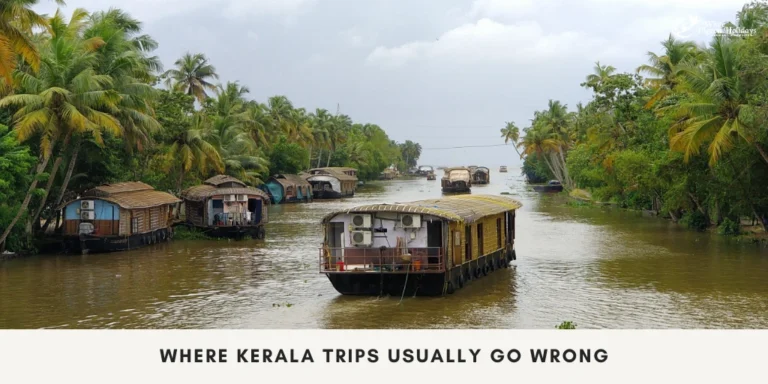
Mistake #5 – Spending Too Much Time on Houseboats
Houseboats are iconic.
They’re also misunderstood.
One night feels novel and relaxing.
Two nights often feel repetitive.
More than that can feel restrictive.
Many travelers assume more nights equals more relaxation.
In reality, backwater resorts often offer better rest.
This is one of the most common mistakes tourists make in Kerala.
Mistake #6 – Ignoring Weather, Humidity & Energy Levels
Humidity changes everything.
Especially for first-time visitors.
Midday sightseeing feels harder than expected.
Heat amplifies fatigue.
Crowds feel heavier.
Warning signs to watch for.
- Irritability earlier in the day.
- Loss of interest in sightseeing.
- Wanting to skip evenings entirely.
These are classic Kerala tour mistakes first timers experience.
And they’re preventable with better pacing.
Mistake #7 – Booking Without Clear Daily Flow & Inclusions
Vague itineraries sound flexible.
They often aren’t.
Problems usually show up as.
- No clarity on drive times.
- Assumptions about meals or guides.
- Surprise costs added mid-trip.
Always confirm.
- Daily start and end rhythm.
- What’s included and what isn’t.
- How rest days are handled.
Clear planning prevents disappointment later.
How to Spot a Bad Kerala Houseboat Operator Before You Book
Not all Kerala houseboats are equal — and the cheap ones have a real track record of problems.
Most foreigners book based on photos and price. Neither tells you much about what the experience will actually feel like.
Red flags to watch for before booking:
- Website uses only stock photos with no actual pictures of the boat
- No physical office address (just a WhatsApp number and a website)
- Price is significantly lower than comparable boats in the same category
- They can’t tell you when the boat was last certified by the Kerala Port Authority
- Payment required entirely in cash or via bank transfer — no card accepted
- Reviews are all recent, all five stars, and all sound weirdly similar
What a legitimate operator looks like:
- Listed on the official Kerala Tourism registered operator database at keralatourism.org
- Can answer: “When was this boat last dry-docked for inspection?”
- Has a mix of real reviews over multiple years — including a few honest 3-star ones
- Sends you a written booking confirmation with the itinerary, inclusions, and emergency contact before you pay
The honest truth about cheap houseboats:
The boats that have had accidents or serious safety issues in Alleppey are almost always the budget-rate boats.
Cheap prices come from somewhere — usually skipped maintenance, minimal crew, or very little actual cruising time (the boat stays anchored most of the day).
A mid-range overnight houseboat in Alleppey runs ₹13,000–₹18,000 for two people.
If someone’s quoting you ₹5,000–₹7,000 for the same thing, ask why.
How to Avoid These Kerala Travel Mistakes Completely
Avoiding mistakes doesn’t require expert knowledge.
It requires restraint.
Smart Kerala planning usually means.
- Choosing fewer regions.
- Respecting travel time.
- Picking quiet, well-located hotels.
- Letting rest be intentional, not accidental.
This is how calm stays calm.

Kerala’s Alcohol Rules — What Foreigners Assume (And What’s Actually True)
This is one of the most commonly misunderstood things about Kerala for international travelers.
What most foreigners assume: you can buy a beer at a restaurant or pick up a bottle from a supermarket.
What’s actually true:
- Most restaurants and hotels in Kerala do not have liquor licenses.
- You cannot buy alcohol at convenience stores, supermarkets, or petrol stations.
- Public drinking — including on beaches and roadsides — is banned.
- To buy alcohol, you go to a state-run outlet called a Bevco (Kerala State Beverages Corporation). These are licensed shops that sell beer, wine, and spirits.
Where you can drink in Kerala:
- Licensed hotel bars (usually 4-star and above)
- Select restaurants with a beer-and-wine license
- Inside your houseboat (operators usually allow guests to bring their own)
- In your hotel room
Practical tips:
- If drinking with dinner matters to you, confirm the restaurant’s license before you sit down — not after ordering.
- Bevco shops have long queues in the evening. Go before 5pm if you’re buying for the night.
- Tourist areas like Varkala and Fort Kochi have more licensed spots than rural areas.
This isn’t something that’ll ruin your trip — but finding out your beach restaurant doesn’t serve alcohol at 8pm after a long day is an unnecessary surprise.
Who the Mistake-Free Kerala Planning Guide Is For
This guide is built for travelers who want clarity.
It’s ideal for.
- First-time foreign travelers.
- USA and UK visitors.
- Anyone who wants calm, not chaos.
Want to Plan Kerala Without Regret?
Most Travel Regrets Come From Things Others Already Experienced.
There’s No Need To Repeat Them.
Instead Of A Generic Guide, We Can Walk You Through What Actually Fits Your Pace, Comfort Level, And Travel Style—So You Make The Right Choices From The Start.
Discuss Mistake-Free Kerala Planning In A Consultation