
Spend Smarter, Not More
Managing money in India catches many US travelers off guard, not because the system is difficult, but because everyday habits from home do not always work the same way abroad.
Fortunately, once you understand a handful of practical tips, paying for meals, transport, shopping, and attractions becomes straightforward.
Knowing where to exchange money, when to use cash, and when digital payments are accepted can save both time and unnecessary fees throughout your trip.
Everything You Need in One Place
This guide explains the latest USD to INR exchange rate, the best places to get Indian Rupees, which cards and payment methods are widely accepted, and the common mistakes that quietly increase travel costs from the moment you arrive.
Free India Trip Budget Consultation
Not sure how much cash to carry or which payment methods work best? Book a free 15-minute call with Nitin Batra. We will review your itinerary and help you build a practical spending plan for your trip.

Written by
Nitin Batra
Founder & Travel Expert · White Pigeon Holidays
With 25+ years in the tourism industry — from Airport Concierge to Vice President — Nitin founded White Pigeon Holidays in 2021 to help international travellers explore India with confidence. His hands-on experience across Asia, Europe, the Middle East, and the West shapes every journey he crafts.
The USD to INR Rate Right Now
As of mid-July 2026, 1 USD = approximately ₹95–96 INR, based on exchange rate data from the Federal Reserve and market sources.
The 2026 average so far has been approximately ₹93 INR per dollar.
This is a notably favorable rate for US travelers compared to previous years.
But here’s the thing — the rate you actually receive will differ from this figure depending on where and how you exchange.
The Gap Between the “Google Rate” and What You Actually Get
When you search “USD to INR” on Google, you see the interbank rate — the rate at which banks trade with each other.
No individual traveler gets this rate.
What you actually receive depends on where you exchange:
Compare Currency Exchange Methods in India
| Exchange Method | Typical Rate vs Interbank | Notes |
|---|---|---|
| Airport Currency Counter (US) | 5% to 8% worse | Usually the most expensive option and best avoided unless absolutely necessary. |
| Airport Currency Counter (India) | 3% to 6% worse | Generally slightly better than exchanging money before departure in the US. |
| Hotel Currency Exchange Desk | 4% to 7% worse | Convenient for emergencies but typically offers poor exchange rates. |
| Bank ATM in India | 0.5% to 2% worse | One of the best widely available options, especially when using a low-fee debit card. |
| Wise or Zero-Markup Travel Card | Near Interbank Rate | Usually provides the most competitive exchange rate with minimal markup. |
| Authorized Forex Exchange Bureau | 1% to 3% worse | A good alternative in major cities when comparing rates before exchanging. |
Typical Rate vs Interbank
5% to 8% worse
Notes
Usually the most expensive option and best avoided unless absolutely necessary.
Typical Rate vs Interbank
3% to 6% worse
Notes
Generally slightly better than exchanging money before departure in the US.
Typical Rate vs Interbank
4% to 7% worse
Notes
Convenient for emergencies but typically offers poor exchange rates.
Typical Rate vs Interbank
0.5% to 2% worse
Notes
One of the best widely available options, especially when using a low-fee debit card.
Typical Rate vs Interbank
Near Interbank Rate
Notes
Usually provides the most competitive exchange rate with minimal markup.
Typical Rate vs Interbank
1% to 3% worse
Notes
A good alternative in major cities when comparing rates before exchanging.
On a USD 2,000 cash exchange, the difference between an airport counter and a bank ATM can easily be USD 100–160.
That’s a meal, a hotel night, or a day activity in India — gone to a bad exchange before you’ve even left the airport.
Where to Get Rupees: Ranked From Best to Worst
Option 1 — Bank ATMs in India (Best for Most Travelers)
Withdrawing from an ATM in India connected to a major bank (HDFC, ICICI, SBI, Axis) gives you a rate very close to the interbank rate.
Your US bank may charge a flat withdrawal fee (typically USD 2–5 per transaction) and a foreign transaction fee (often 1–3%).
To minimize these:
- Use ATMs belonging to major Indian banks rather than standalone cash machines at airports or tourist spots
- Withdraw larger amounts less frequently rather than small amounts many times
- Tell your US bank before you travel so your card isn’t blocked on the first transaction
One important note: Indian ATMs frequently have a per-transaction withdrawal limit of ₹10,000–25,000 (approximately USD 100–260 at current rates), which is lower than the US equivalent.
Factor this into your plan if you need larger amounts.
Option 2 — A Zero-Markup Travel Card (Best Rate Available)
Cards like Wise offer exchange rates at or very near the interbank rate with transparent, low fees.
If you’re going to India and want the best possible rate at every transaction, loading a Wise card before you leave is worth considering.
It works as both an ATM card and a payment card, and the conversion rate is consistently better than any bank-backed credit card.
Option 3 — Authorized Forex Bureaus in Major Indian Cities
Licensed currency exchange counters in city centers — not at airports, not at hotels — offer reasonable rates.
In Delhi’s Connaught Place, Mumbai’s Fort area, or near major tourist districts, authorized forex dealers typically offer rates 1–3% below interbank.
Always ask for the rate before handing over your cash.
Negotiate on larger amounts — it’s standard practice.
Option 4 — Airport Exchange Counters in India (Acceptable for Arrival Cash)
If you need rupees the moment you land — for your taxi, SIM card, or first meal — the airport counter is fine for a small amount.
Exchange USD 50–100 at the airport for immediate needs.
Get the bulk of your money from ATMs or forex bureaus once you’re in the city.
Option 5 — Airport Counters in the US (Avoid)
The USD to INR rate at US airport counters is typically 5–8% below the actual market rate.
There’s almost never a good reason to exchange money before you leave the US.
Your US dollars are worth more in India than the rate you’ll get at a US airport counter.
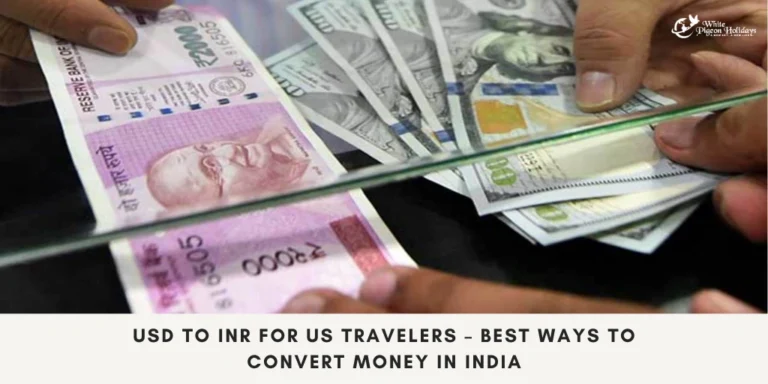
Cash vs. Card vs. UPI: How Payments Actually Work in India
India’s payment landscape in 2026 is layered.
Understanding what works where prevents you from being stuck.
Credit and Debit Cards
Visa and Mastercard are accepted at most hotels, larger restaurants, malls, travel agencies, and supermarkets in major cities.
American Express acceptance is patchy — don’t rely on it outside five-star hotels.
Cards are your safest payment method for larger transactions because:
- No need to carry large amounts of cash
- Transaction records for disputed charges
- Protection under your US card’s fraud policies
Important: Most US bank cards charge a foreign transaction fee of 1.5–3% on every purchase abroad.
If you’re spending USD 3,000 on your India trip, that’s USD 45–90 in fees you don’t need to pay.
Cards with no foreign transaction fee — Charles Schwab debit card, Chase Sapphire, Capital One Venture — are worth using for India.
The Consumer Financial Protection Bureau maintains guidance on card fees that’s useful to review before any international trip.
Cash (Indian Rupees)
Cash remains essential in India.
Outside major city centers, many transactions are cash-only.
Small restaurants and dhabas, auto-rickshaws, local markets, temple entry fees, tips for guides and hotel staff — all cash.
Even in cities, a significant number of smaller merchants, guesthouses, and roadside vendors prefer or require cash.
Do not rely only on cards.
India will catch you out.
UPI (Unified Payments Interface) for Foreign Tourists
India’s UPI system processed over 21.7 billion transactions in January 2026 alone, making it the dominant payment method for locals.
For foreign tourists, access is more limited — but it’s improving.
In 2023, India’s National Payments Corporation (NPCI) launched UPI One World, a prepaid wallet that lets foreign visitors use UPI via QR codes at merchants — without an Indian bank account or Indian phone number.
As of 2026, UPI One World is expanding, and some international travelers are using it successfully at markets, restaurants, and local shops.
However, setup requires effort and the experience varies by merchant.
Don’t build your payment strategy around UPI as a foreign tourist.
Treat it as an interesting option if you want to try it, not a core method.
How Much Cash Should You Actually Carry?
What to Bring From the US
The honest answer: bring very little US cash.
USD 100–200 is enough for comfort.
Your dollars will be worth more exchanged from a bank ATM in India than from any US exchange counter.
If you want a backup for emergencies, USD 50–100 in clean, undamaged bills is a reasonable reserve.
Indian money changers and hotels sometimes refuse old or damaged notes.
How Much Rupees to Have on Hand
This depends on your itinerary, but a practical starting point for most US tourists:
How Much Cash Should You Carry in India?
| Trip Stage | Suggested Rupee Cash on Hand |
|---|---|
| Arrival (First 1 to 2 Days) | ₹3,000 to ₹5,000 (approximately USD 30 to 50) for taxis, tips, snacks, and small purchases. |
| Active Travel Days in Cities | ₹2,000 to ₹4,000 per day is usually enough because cards and UPI are widely accepted in major cities. |
| Rural Areas or Heritage Towns | ₹4,000 to ₹6,000 per day is recommended, as ATMs and digital payments may be less reliable. |
| Long Train Journeys | Carry an additional ₹2,000 to ₹3,000 for food, station purchases, tips, and unexpected expenses. |
Withdraw from ATMs as you go rather than carrying a large sum.
Petty theft — particularly on trains, at crowded markets, and around airports — is noted in the US State Department’s India safety guidance.
Carrying only what you need for the day reduces your exposure.
Daily Budget in India: What USD Actually Buys You
The INR rate makes India very good value for US dollar holders.
Here’s what different spending levels look like in real terms at the current ~₹95/USD rate:
Budget Traveler — USD 30–60/day
- Guesthouse or budget hotel: ₹800–2,000 (~USD 8–21)
- Meals at local restaurants: ₹200–500 per meal (~USD 2–5)
- Auto-rickshaw rides: ₹50–200 per trip (~USD 0.50–2)
- Entry fees at monuments: ₹100–600 for Indians; up to ₹1,100 for foreigners at major sites like the Taj Mahal (~USD 12)
Mid-Range Traveler — USD 80–150/day
- 3-star or boutique hotel: ₹3,000–8,000 (~USD 30–85)
- Meals at good restaurants: ₹500–1,500 per meal
- Comfortable taxi or Ola/Uber rides
- Private guides and curated experiences
Luxury Traveler — USD 200–600+/day
- Heritage hotels and palace properties: ₹15,000–60,000+/night
- Fine dining and chef’s table experiences
- Private car with driver for the day: ₹3,000–6,000
- Private tours and exclusive access
Insider note: The “foreigner price” exists at many major monuments and tourist attractions in India. The Taj Mahal, for example, charges foreign visitors significantly more than Indian nationals — currently around ₹1,100 (roughly USD 12) versus ₹50 for Indians. This is standard, not a scam. Budget for it when planning major sightseeing.
Free India Trip Cost Estimator
Share your destination cities, travel dates, hotel preferences, and planned activities. We will prepare a realistic cost estimate so you can budget with confidence before you book.
Common Money Mistakes US Travelers Make in India
These are not edge cases.
They happen on nearly every trip where travelers haven’t thought through their money strategy.
Exchanging large amounts at the airport counter.
Five minutes of convenience costs you 5–8% of whatever you exchange. On USD 500, that’s USD 25–40 gone before you leave the terminal.
Not telling your US bank you’re traveling.
Your bank’s fraud detection system will flag overseas transactions — especially the first ATM withdrawal in India — and block your card.
Call your bank or set a travel notice in your banking app before you fly.
Do this for every card you’re bringing.
Relying only on one payment method.
Cards get declined. ATMs run out of cash (it happens in smaller towns). A card reader breaks. Always carry at least two payment options: one card and some cash.
Using the hotel exchange desk without checking the rate.
Hotels offer convenience rates, not market rates. The desk exists for guests who haven’t planned ahead. Check the rate against the current market rate and decide whether the convenience is worth the gap.
Accepting dynamic currency conversion (DCC) at ATMs.
When an ATM in India asks “Would you like to pay in USD or INR?” — always choose INR.
If you choose USD, the ATM applies its own exchange rate (significantly worse than your bank’s rate) and converts for you.
This is called dynamic currency conversion, and it’s one of the most common ways travelers quietly lose money in India.
Always choose the local currency at any overseas ATM or card terminal.
Carrying all your cash and cards together.
Keep cards in one place and emergency backup cash in a separate location — different bag, hotel safe, or money belt.
If your wallet is stolen, your backup survives.
A Practical Note on Tipping in India
Tipping culture in India is more flexible than the US — there’s no equivalent of the automatic 18–20% restaurant tip.
That said, tipping is appreciated and has become more common at tourist-focused establishments.
As a rough guide:
- Restaurants with table service: 5–10% is appreciated; sometimes a service charge is already included — check the bill
- Hotel porters and housekeeping: ₹100–200 per service
- Tour guides: ₹500–1,000 for a half-day, ₹1,000–2,000 for a full day (for a good guide, this is well-earned)
- Taxi and rickshaw drivers: rounding up is customary; specific tips are appreciated but not expected
- Spa and wellness treatments: 10% is generous and well-received
Always tip in cash (rupees), not card.
ATM Availability Across India: What to Expect
In major cities — Delhi, Mumbai, Bengaluru, Chennai, Hyderabad, Kolkata, Jaipur, Kochi — ATMs from major Indian banks are easy to find and generally reliable.
In tier-2 cities and heritage towns like Varanasi, Udaipur, Pushkar, or McLeod Ganj, ATMs are present but less dense and occasionally out of cash during peak tourist season.
In rural areas, hill stations, and remote trekking destinations, ATMs may be absent or unreliable.
Plan for this.
If you’re heading into a rural area, a national park, or a small hill station, withdraw more than you think you’ll need before you leave the last large town.
Running out of rupees in a place with no ATM is one of the most avoidable stressors in India travel.
Free India Itinerary Planner
Tell us where you want to go, how long you have, and your travel style. We will create a practical itinerary that balances sightseeing, travel time, and your budget.
Pre-Departure Money Checklist
Do this before you leave for the airport:
- Notify every bank and credit card you’re bringing that you’re traveling to India and the dates
- Enable international transactions on your debit and credit cards
- Note your bank’s international customer service number (not the 1-800 number — those don’t work from India)
- Download your bank’s app so you can manage cards while traveling
- Identify cards in your wallet that charge no foreign transaction fee — those go to the front
- Carry at least two payment methods
- Have ₹3,000–5,000 available for the first day (from an India airport ATM)
- Know the ATM withdrawal limit on each of your cards
- Set your phone to receive transaction alerts for all cards
Frequently Asked Questions
Everything US travelers commonly ask about money, cards, ATMs, and using Indian rupees.
What is the USD to INR exchange rate for travelers right now?
As of mid-July 2026, the market exchange rate is approximately ₹95–96 per US dollar.
The actual rate you receive depends on where you exchange money. Indian bank ATMs usually provide rates close to the market, while airport exchange counters and hotels often charge considerably more.
Should I exchange US dollars before leaving the United States?
Not in large amounts.
US airports and many bank branches usually offer weaker exchange rates than ATMs in India.
Carrying around USD 50 to 100 as a backup is reasonable, but most travelers save money by withdrawing rupees after arrival.
Which US banks or cards work best in India?
Cards with no foreign transaction fee provide the best value.
Many travelers use Charles Schwab debit cards for worldwide ATM fee reimbursement, while travel credit cards such as Chase Sapphire Preferred and Capital One Venture are popular for purchases abroad.
Always verify your own card's fees before departure.
Can I use Apple Pay or Google Pay in India?
Sometimes, especially in larger malls, hotels, and modern retail stores.
However, acceptance is inconsistent because most local merchants rely on India's UPI payment system.
Carry a physical credit card and some cash instead of depending on mobile wallets.
Are there currency import restrictions when entering India?
You may bring any amount of foreign currency into India.
Cash exceeding USD 5,000 (or its equivalent) must be declared at customs.
You may carry up to ₹25,000 in Indian currency when entering or leaving India unless special permission has been obtained.
Which denominations of Indian rupees are most useful?
A combination of ₹500 and ₹200 notes works well for everyday expenses.
Carry a few ₹100 and ₹50 notes for taxis, tips, and smaller purchases.
If exchanging cash, request a mix of denominations.
Can I pay in US dollars at hotels or tourist attractions?
Only occasionally.
A few luxury hotels may accept US dollars, but most businesses and tourist attractions require payment in Indian rupees.
Do not rely on USD for everyday spending.
What happens if my card gets blocked while I am in India?
Contact your bank immediately using its international customer service number or mobile banking app.
Many blocks can be removed quickly after identity verification.
Travel with at least two cards from different banks or payment networks to avoid being left without access to funds.
Is it safe to carry cash in India?
Yes, provided you use normal travel precautions.
Keep cash in separate locations, avoid carrying large amounts unnecessarily, and use your hotel safe whenever possible.
Many travelers carry around ₹5,000 to ₹10,000 for daily expenses rather than larger sums.
How should I handle leftover Indian rupees before leaving India?
You may exchange up to ₹25,000 back into US dollars before departure if you have your exchange receipts.
You can also spend remaining rupees at the airport or keep a small amount for a future visit.
What should I do if an ATM keeps my card in India?
Notify your bank immediately through its emergency number or mobile app.
If the ATM belongs to a major Indian bank, visit the nearest branch with your passport and request assistance.
This situation is uncommon, but carrying a backup card makes it much easier to continue your trip.
Planning Your India Trip?
We help US travelers plan every part of their journey, from visa guidance and custom itineraries to hotels, private transport, and memorable local experiences across India.
Indirapuram, Ghaziabad 201010, India

