What Months Are Actually Safe for Seniors to Visit Rajasthan?
October to March is the safe window for senior travelers.
That’s it. Everything outside that range gets risky — not dangerous, just physically hard.
Here’s what the temperatures actually look like:
Written by
Nitin Batra
Founder & Travel Expert · White Pigeon Holidays
With 25+ years in the tourism industry — from Airport Concierge to Vice President — Nitin founded White Pigeon Holidays in 2021 to help international travellers explore India with confidence. His hands-on experience across Asia, Europe, the Middle East, and the West shapes every journey he crafts.
| Month | Average Temperature | Senior-Friendly? |
|---|---|---|
| October | 33–38°C (91–100°F) | Manageable if sightseeing is limited to mornings and late afternoons. |
| November | 27–32°C (81–90°F) | Yes. One of the best months to visit Rajasthan. |
| December | 23–27°C (73–81°F) | Excellent weather and ideal for most senior travellers. |
| January | 15–25°C (59–77°F) | Excellent, although evenings and early mornings can be chilly. |
| February | 20–28°C (68–82°F) | Very comfortable with pleasant daytime temperatures. |
| March | 25–32°C (77–90°F) | Still suitable if sightseeing starts early in the day. |
| April–June | 40–48°C (104–118°F) | Not recommended due to extreme desert heat. |
| July–September | 35–42°C (95–108°F) | Monsoon season with heat and humidity. Less comfortable for sightseeing. |
The sweet spot for most US seniors flying from the East Coast is November through February.
You get comfortable days, cooler evenings, and crowds that are easier to manage than peak summer chaos.
This question usually comes before any talk of itineraries.
Before hotels.
Before dates.
Sometimes even before booking flights.
And that makes complete sense.
When you’re over 60, safety isn’t just about crime.
It’s about how secure you feel throughout the day.
Let’s talk about Rajasthan honestly.
No exaggeration.
No sugarcoating.
Just what senior travelers from the USA actually experience.
Why Safety Is the First Question Seniors Ask About Rajasthan
As we get older, risk tolerance changes.
Energy is more valuable than excitement.
Predictability matters more than adventure.
It’s smart travel planning.
What “Safety” Really Means for Senior Travelers
For seniors, safety isn’t just crime-related.
It’s layered.
It usually includes:
- Feeling secure while moving around
- Access to medical care if something feels off
- Transport that doesn’t feel chaotic
- Manageable crowds
- Food and hygiene comfort
Rajasthan does fairly well on most of these.
When planned properly.
Personal Safety in Rajasthan for Seniors
Let’s address the biggest worry first.
Tourist areas in Rajasthan are generally safe during the day.
Cities like Jaipur, Jodhpur, and Udaipur are used to international visitors.
Most sightseeing happens at well-known locations.
Forts.
Palaces.
Heritage zones.
Seniors traveling with a driver and guide rarely feel exposed.
You’re not navigating unfamiliar spaces alone.
You’re not guessing where to go next.
Simple awareness goes a long way.
Staying with your group.
Avoiding empty areas late at night.
Dressing respectfully.
For most senior travelers, Rajasthan feels busy—but not threatening.

Health Care & Medical Access in Rajasthan
This is where many seniors feel relieved.
Major Rajasthan cities have strong private hospitals.
Doctors are used to international patients.
English-speaking medical staff is common.
Pharmacies are easy to find.
Most regular prescriptions are available.
Hotel staff and guides know where to take you if needed.
Is it identical to the US healthcare system?
No.
Is it reliable for common senior concerns?
Yes.
Transport & Road Safety for Senior Travelers
This is one of the most important safety factors.
Senior travelers almost always move by private car in Rajasthan.
That changes everything.
You’re not navigating public transport.
You’re not standing for long periods.
You can stop when needed.
Tourist routes are well-traveled.
Drivers are familiar with senior pacing.
Seat belts and AC vehicles are standard on good tours.
The biggest risk isn’t danger.
It’s fatigue from long drives.
That’s a planning issue, not a safety flaw.
Heat Warning Signs Seniors Should Know Before Going to Rajasthan
Rajasthan summers are extreme — temperatures cross 104°F regularly from April to June.
That’s the threshold at which heat stroke becomes a medical emergency.
The problem for seniors is that the body’s warning system gets less reliable with age.
You may not feel thirsty even when you’re dehydrated.
You may not sweat as much, which means heat builds up faster.
Watch for these signs in yourself or your travel partner:
- Confusion or acting disoriented — this is a red flag, not just tiredness
- Dry, flushed skin without sweating — even when it’s very hot
- Strong, rapid pulse
- Dizziness or sudden weakness
- Stopping urinating — a sign of serious dehydration
If any of these happen: get into AC immediately, drink water slowly, and call for help.
Don’t wait to see if it passes.
If you’re visiting between November and February, this risk drops dramatically.
But even in “comfortable” months, drink water before you feel thirsty — that’s the single most important habit.
Is Rajasthan Wheelchair-Accessible for Senior Travelers?
It depends on where you’re going — and who’s planning your trip.
Rajasthan wasn’t built with accessibility in mind. But the tourism industry has done a lot of retrofitting.
Here’s the honest breakdown:
Sites with decent accessibility:
- City Palace (Jaipur) — ramps available, mostly flat
- Albert Hall Museum (Jaipur) — wheelchair accessible, benches throughout
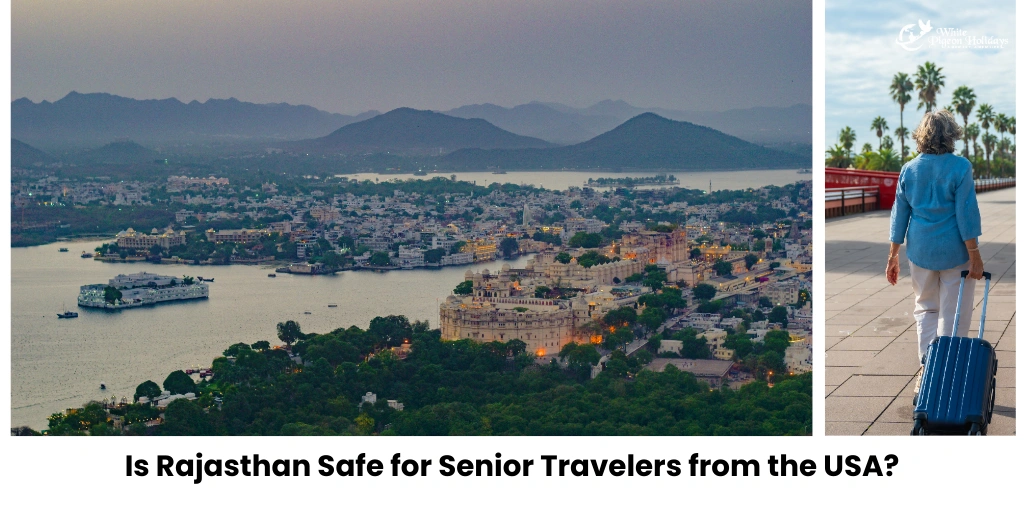
- Udaipur’s lake palaces — accessible by boat, hotel grounds are flat
- Fatehpur Sikri — soft-access ramps installed
Sites that are genuinely difficult:
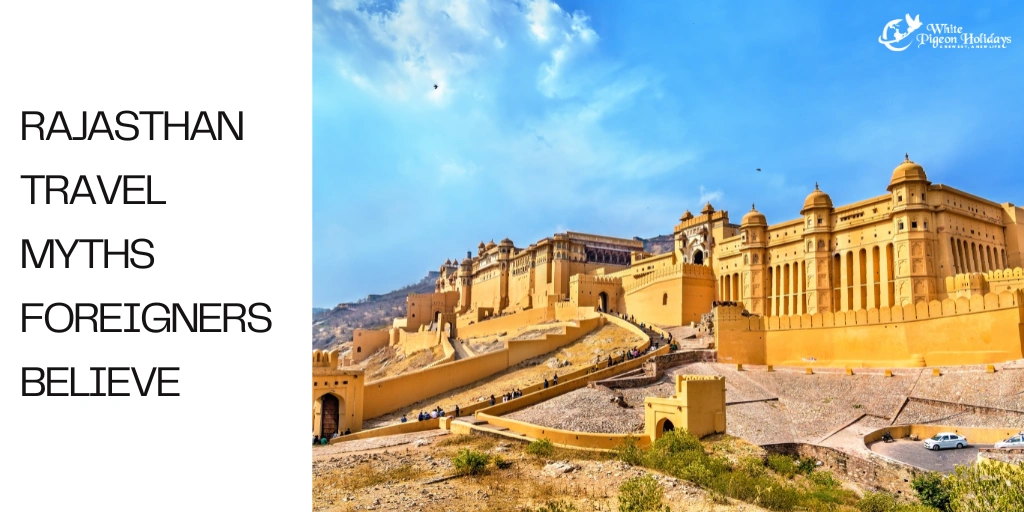
- Amber Fort — steep ramps, uneven cobblestone everywhere (elephant ride option helps)
- Mehrangarh Fort (Jodhpur) — heavy foot traffic, narrow passages
- Most older havelis — steps, no lifts, narrow doorways
The key is telling your tour operator before you book — not after.
Ask specifically: “Is this itinerary wheelchair-friendly or manageable for limited mobility?”
Good operators will redesign the route.
Generic packages often aren’t built with mobility in mind.
Does US Medicare Cover You in Rajasthan? (Most Seniors Don’t Know This)
No. Medicare does not cover medical care in India.
This surprises a lot of US seniors — and it matters a lot in Rajasthan, where a hospital stay or emergency evacuation can cost far more than the trip itself.
Here’s what you’re looking at without coverage:
| Scenario | Estimated Cost Without Insurance |
|---|---|
| Hospital Stay (Per Day) | $200–$500 |
| Emergency Medical Evacuation to the USA | $50,000–$200,000 |
| Serious Cardiac Event + Hospitalization | $10,000–$30,000 |
Some seniors have Medigap plans that offer very limited emergency coverage abroad — but it’s usually not enough.
What you actually need for Rajasthan:
- Minimum $50,000 in medical coverage — ideally $100,000+
- Coverage for pre-existing conditions (look for “acute onset” language in the policy)
- Emergency evacuation coverage included
- Trip cancellation in case health prevents travel
This isn’t optional for seniors traveling from the US.
It’s one of the most important things to sort before you book flights.
Crowds, Noise & Sensory Overload — The Real Challenge
Here’s the honest part.
Rajasthan can feel intense.
Not unsafe.
But stimulating.
Busy forts.
Markets.
Sounds.
Movement everywhere.
This doesn’t suit every senior equally.
Some love the energy.
Others feel drained quickly.
The good news is that crowd stress is manageable.
Early visits.
Alternate viewpoints.
Guided entry routes.
Safety improves dramatically when you’re not navigating crowds alone.
Common Safety Mistakes Seniors Should Avoid in Rajasthan
It rarely rewards rushed itineraries.
When Rajasthan May Not Be Ideal for Some Seniors
Rajasthan isn’t wrong for seniors.
But it isn’t right for everyone.
It may not suit you if:
- You struggle badly with heat
- Crowds cause anxiety
- Mobility is very limited
- You prefer nature and silence over culture
That’s not a weakness.
It’s preference.
How Rajasthan Compares to Other India Destinations for Senior Safety
Here’s a simple way to see it.
| Destination | Senior Safety | Crowd Level | Medical Access |
|---|---|---|---|
| Rajasthan | High (with planning) | Moderate | Strong |
| Golden Triangle | High | High | Strong |
| Kerala | Very High | Low | Strong |
Rajasthan sits in the middle.
More stimulating than Kerala.
Less chaotic than people expect.
So, Is Rajasthan Safe for Senior Citizens Traveling from the USA?
Yes.
With the right structure.
Rajasthan is not unsafe by default.
It becomes stressful only when rushed or poorly planned.
Guided travel.
Comfortable transport.
Balanced pacing.
These three things matter more than the destination itself.
How to Manage Medications During a Rajasthan Trip
Most common medications are available in Indian pharmacies — but not always in the same brand or dosage.
Don’t rely on finding your prescription there.
Bring everything you need, plus a 7-day buffer in case of delays.
A few things that matter for Rajasthan specifically:
- Carry meds in original labeled bottles — Indian customs can flag unlabeled prescription drugs
- Pack medications in your carry-on, not checked luggage — bags get delayed more often on international routes
- Bring a letter from your doctor listing medications, dosages, and conditions — hotels and guides will refer to this if something happens
- Avoid drinking tap water with meds — even if you’re usually fine with it at home, the water change can affect absorption
- Keep a 24-hour emergency pharmacy number saved in your phone for your specific city (your hotel concierge will have this)
Blood pressure medication, heart medication, and diabetes supplies are the three categories to plan most carefully for.
Still Unsure If Rajasthan Is Right for You?
Every traveler has a different comfort threshold.
Some want stimulation.
Some want calm.
You don’t need to decide today.
You just need clarity.
Talk Through Whether Rajasthan Fits You
Speak With a Travel Planner
Feeling Safe Is the Foundation of Enjoyable Travel
A destination can be beautiful.
But if you don’t feel secure, it won’t matter.
Safety-first planning doesn’t limit travel.
It improves it.
Talk Through Safety-Focused Rajasthan Travel Options