Chittorgarh and Kumbhalgarh: The Two Forts Seniors Should Think Carefully About
These two forts are beautiful — and also the most physically demanding in Rajasthan.
Neither one is impossible for seniors, but they need a different approach than Amber or Jaisalmer.
Chittorgarh Fort
This is the largest fort in India — 700 acres, with a 13-kilometre perimeter wall.
You cannot walk the whole thing.
Fortunately, you don’t have to.
Most seniors visit by private car, driving between the main monuments inside.
The key stops — Vijay Stambha (Victory Tower), Rana Kumbha Palace, Meera Temple — are spread across the site, and driving between them is completely normal.
Budget 2–3 hours for the highlights by car.
Walking is mostly just at each monument, not across the entire fort.
If your knees are a concern, Chittorgarh is still worth visiting — just be clear with your driver that you want to drive between stops, not walk the connecting distances.
Kumbhalgarh Fort
Kumbhalgarh is honestly harder.
Getting to the top requires walking more than 1 km uphill, and the path climbs steeply for 40–60 minutes.
For seniors with joint issues, the full climb is not recommended.
The good news: the lower section of the fort — near the Bedi Temple — is manageable and takes about an hour.
There are benches along the way.
You still see the famous wall and get the scale of the place.
If you’re in good shape for your age and knees don’t bother you, the full climb is worth it.
If not, a partial visit gives you most of the experience.

Written by
Nitin Batra
Founder & Travel Expert · White Pigeon Holidays
With 25+ years in the tourism industry — from Airport Concierge to Vice President — Nitin founded White Pigeon Holidays in 2021 to help international travellers explore India with confidence. His hands-on experience across Asia, Europe, the Middle East, and the West shapes every journey he crafts.
| Fort | Size | Car Access Inside? | Best Approach for Seniors |
|---|---|---|---|
| Chittorgarh | 700 acres | Yes | Drive between the major monuments instead of walking the entire fort complex. |
| Kumbhalgarh | Large Hilltop Complex | No | Visit the lower sections and main viewpoints rather than attempting the full fort wall. |
| Amber Fort | Manageable | Jeep to Entrance | Take the jeep to the entrance, then explore the courtyards at a relaxed pace. |
| Mehrangarh Fort | Compact | Road to Base | Use the elevator inside the fort after entering to avoid the steep uphill climb. |
| Jaisalmer Fort | Compact, Mostly Flat | Yes | Drive into the fort area where permitted and explore the lanes at your own pace. |
The Mehrangarh Elevator — The Most Useful Accessibility Feature at Any Rajasthan Fort
Most people who visit Mehrangarh don’t know this exists until they’re already there.
After the ticket counter, there is a working elevator inside the fort.
It takes you up 40 feet — skipping the steep ramp entirely.
This is not a side entrance for wheelchair users only.
Any visitor can use it.
It costs a small extra fee (paid in coins at the lift), and brings you directly to the museum level.
What that means practically:
You bypass the steep entry climb that most people find the hardest part of the fort.
Once you’re up, the museum galleries and palace chambers are mostly flat.
Mehrangarh is the only major fort in Rajasthan with this kind of lift access.
If you or your travel partner has hip or knee issues, Mehrangarh becomes significantly more manageable because of this one feature.
Worth knowing before you assume the fort is too demanding.
Let’s be honest for a moment.
When seniors say they want to see Rajasthan, what they usually mean is the history, the views, the stories.
They don’t mean endless staircases or knee-testing climbs.
So before we talk about beauty or architecture, let’s talk about something far more important.
How your body will actually feel inside these forts.
I’ll walk you through this the same way I explain it to travelers on a call.
Slowly.
Clearly.
Without sugarcoating.
Why Fort Walking Matters More Than the View for Seniors
At 60+, enjoyment is closely tied to comfort.
A stunning view means nothing if you’re worried about the next step.
Many seniors tell me the same thing.
“I’m not scared of walking.”
“I’m scared of not knowing how much walking there is.”
That fear comes from surprises.
Unexpected slopes.
Steps that don’t look bad on photos.
Stone floors that feel different underfoot.
Asking about this early isn’t being negative.
It’s being smart.
What “Walking Difficulty” Actually Means at Rajasthan Forts
Not all walking is the same.
And Rajasthan forts mix several types together.
Here’s how to think about it in simple terms.
• Flat walking inside courtyards and galleries
• Gentle ramps instead of stairs in many sections
• Short staircases, mostly to upper viewpoints
• Standing time while guides explain history
• Optional sections that can be skipped
This matters because most effort is optional, not forced.
Let’s Talk Forts One by One (This Is the Part Seniors Care About Most)
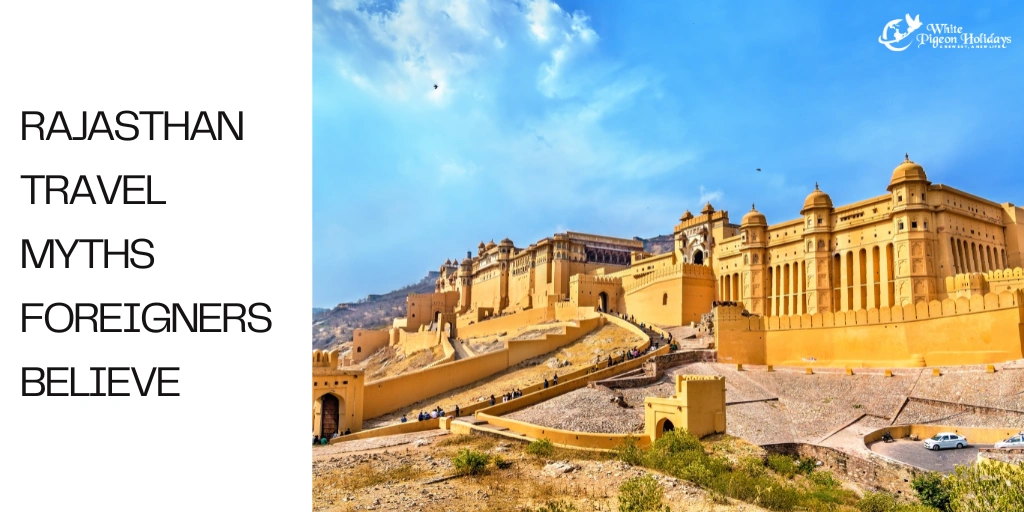
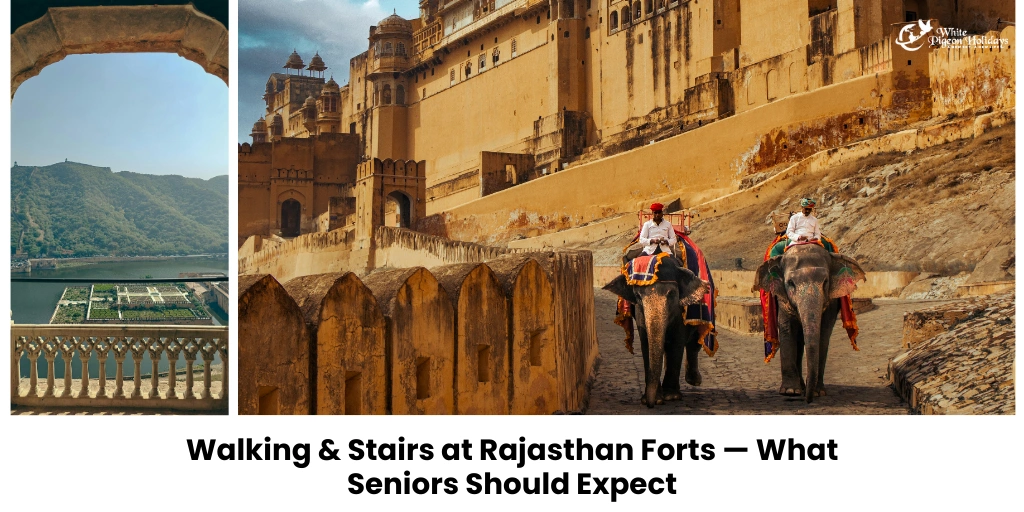
Ambe Fort, Jaipur
And also the biggest relief.
Vehicles go almost all the way up.
You are not climbing the hill yourself.
Inside, most movement happens in wide courtyards.
The main palaces are flat.
Steps appear only if you choose to go higher.
Reality check:
Comfortable for most seniors.
If knees bother you, skip the upper terraces.
You won’t miss the essence of the fort.

What Time Should Seniors Actually Visit Rajasthan Forts?
Arrive between 8 and 9:30 in the morning.
That’s the window. Everything else is a compromise.
Here’s why that specific window matters:
- Forts open around 8am
- Before 10am, stone surfaces haven’t absorbed the day’s heat yet
- Crowds are thin — you’re not navigating groups at every doorway
- Light is better for photos if that matters to you
- You’re done with the main sightseeing before the hardest heat of the day (noon to 3pm)
After 10am, surface temperatures at open-air forts start climbing fast.
Sandstone and marble radiate heat from below, not just above.
Standing on a sun-baked fort terrace at 11am feels very different from the same spot at 8:30am.
The practical rule: one fort per morning, nothing after 11am outdoors.
Most senior-friendly Rajasthan itineraries are built around this — morning fort visit, hotel rest from noon to 4pm, light evening activity.
It’s not laziness. It’s how you actually enjoy the trip without wearing yourself out.
If You Can Only Visit Two or Three Forts, Which Ones?
For seniors, the best combination is Amber Fort + Mehrangarh Fort, with Jaisalmer Fort as a third if the itinerary allows.
Here’s why that pairing works:
Amber Fort (Jaipur) gives you the classic Rajasthan fort experience — grand courtyards, mirror palace, mountain views — with a jeep ride up and mostly flat walking inside. It’s what most people picture when they think “Rajasthan fort.”
Mehrangarh Fort (Jodhpur) is visually the most dramatic fort in India. The views of the blue city below are unlike anything else. And the elevator makes it accessible in a way most people don’t expect.
Jaisalmer Fort adds the desert context — a living fort with streets and shops still inside — and it’s the flattest of the major forts.
What to skip if energy is limited:
- Chittorgarh — best saved if you have extra time and good mobility; the history is extraordinary but the site is vast
- Kumbhalgarh — save for a future trip or a day when you’re feeling particularly strong
The City Palaces of Jaipur and Udaipur aren’t forts in the traditional sense, but they’re easier walking and give you a lot of the same architectural richness — worth adding to any itinerary.
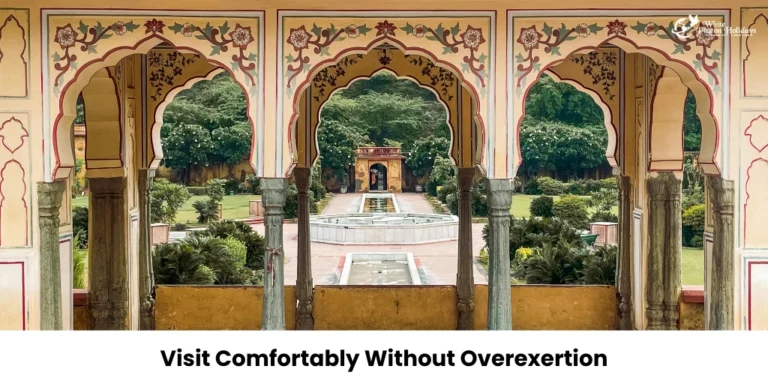
Mehrangarh Fort, Jodhpur
This one needs honesty.
Mehrangarh looks dramatic because it is dramatic.
The good news is the road takes you right up.
Inside, you’ll find ramps mixed with steps.
Nothing extreme.
But it’s more effort than Amber.
There are benches.
There is shade.
And guides pace things well when asked.
Reality check:
Moderate effort.
Very doable with breaks.
Not ideal to rush.
Jaisalmer Fort
This surprises many seniors.
They expect it to be tough.
But once inside, the fort is fairly flat.
It’s a living fort, with shops and homes.
The uphill parts are short and gradual.
You can sit.
You can pause.
You can take it slow.
Reality check:
Easier than it looks.
One of the more senior-friendly forts.
City Palaces (Jaipur & Udaipur)
These are the easiest.
And also very rewarding.
Flat floors.
Short walking loops.
Occasional steps inside museums.
Plenty of shade.
Places to sit.
Reality check:
Very manageable.
Often the most comfortable part of Rajasthan sightseeing.
So… Are There a Lot of Stairs at Rajasthan Forts?
Here’s the straight answer.
Yes, stairs exist.
No, they are not compulsory.
Most stairs lead to viewpoints.
Not to the core experience.
Good guides always ask seniors first.
Routes can be adjusted.
Skipping is normal, not frowned upon.
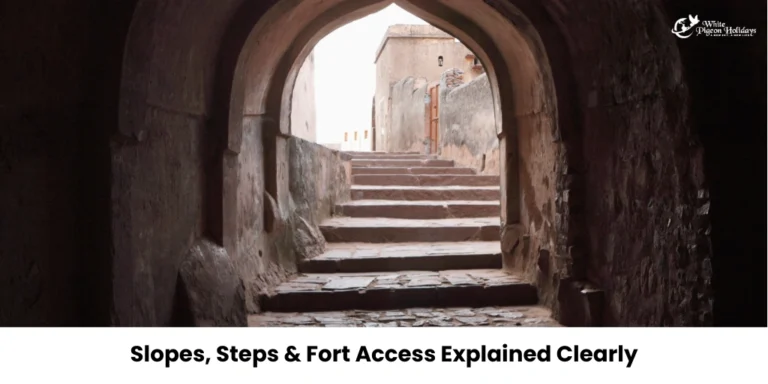
How Seniors Reduce Walking & Strain at Rajasthan Forts
This is where planning makes all the difference.
Small Planning Choices Make Rajasthan Much More Comfortable
• Use vehicle drop-offs whenever available
• Visit forts early, before heat builds up
• Skip upper levels without guilt
• Choose fewer forts, not all of them
• Ask guides to shorten explanations while standing
Talk Through a Comfortable Pace-Based Rajasthan Plan
Common Mobility Surprises Seniors Don’t Expect
Many seniors expect stairs to be the biggest challenge.
Often, it’s the smaller things:
- Uneven stone pathways
- Gentle slopes and ramps
- Long periods of standing
- Occasional steps without handrails
These aren’t usually major obstacles—just details worth knowing before your visit.
What Shoes to Wear at Rajasthan Forts (This Matters More Than Most People Think)
Wear closed-toe shoes with rubber soles and a patterned grip.
That’s it. Everything else is secondary.
Here’s what you’re actually walking on at Rajasthan forts:
- Polished marble in palace courtyards — smooth, can be slippery when slightly damp
- Rough sandstone ramps at fort entrances — grippy but uneven
- Old flagstone in havelis and temple areas — flat but with irregular gaps
- Smooth stone steps with no standard riser height — some short, some tall
What doesn’t work:
- Sandals — no ankle support on uneven surfaces
- Leather soles — dangerously slippery on Indian marble
- Flat canvas sneakers — no cushioning for hours of standing on hard stone
- Flip-flops — you’ll be asked to remove shoes at some temples, and slipping on smooth stone is a real risk
What works well:
- Cushioned walking shoes (New Balance, Hoka, Merrell) with rubber outsoles
- Lightweight trail shoes with textured grip
- Closed-toe travel sandals with ankle straps if you prefer open footwear
One extra tip: many temples and palace inner sanctuaries require removing shoes.
Slip-on styles are easier than lace-ups for this — especially if bending down to tie laces on uneven ground is uncomfortable.
When Rajasthan Forts May Be Challenging for Some Seniors
Some forts may require extra planning if you:
- Have significant knee or hip issues
- Prefer minimal walking
- Feel uncomfortable on uneven surfaces
- Need frequent rest breaks
In these cases, choose forts selectively and travel at a comfortable pace rather than trying to see everything.
So, Are Rajasthan Forts Manageable for Seniors?
Yes.
With realistic expectations.
You don’t need to climb everything.
You don’t need to prove anything.
Rajasthan forts are about atmosphere and stories.
Not endurance.
Comfort comes from pacing.
Enjoyment comes from knowing what to skip.
Want to Visit Rajasthan Forts Without Mobility Stress?
Every senior has a different comfort level.
There’s no one-size-fits-all route.
A well-planned itinerary removes pressure before it begins.
Knowing What to Skip Is Smart Travel
You’re not there to collect staircases.
You’re there to enjoy history without pain.
Rajasthan rewards thoughtful travel.
Not physical toughness.