"How many days should we plan?" is the first question almost every family asks when booking a Rajasthan trip for elderly parents. Most travel websites simply recommend a package length without explaining whether it will actually feel comfortable for a 68-year-old with mild joint pain or for someone visiting India for the first time.
This guide takes a more practical approach. It is based on planning Rajasthan holidays for senior travellers from India and overseas, with a focus on comfort, realistic driving times, and enough rest to enjoy each destination.
For most senior citizens, 9 to 11 days is the ideal Rajasthan trip duration. It comfortably covers Jaipur, Jodhpur, and Udaipur at a relaxed pace with proper rest built in. Jaisalmer becomes a better option on a 12 to 14-day itinerary. A 7-day trip works best for only two cities, provided at least one full rest day is included.
Why Trip Duration Matters More for Seniors Than Anyone Else
A 28-year-old can absorb a rushed itinerary and sleep it off.
Most senior travelers cannot.
The problem isn’t any single activity — it’s the cumulative effect of heat, long drives, unfamiliar food, and daily sightseeing stacking up over 5 or 6 days until it hits hard.
Travel health specialists who work with senior India travelers consistently flag one root cause: poor itinerary design, not the destination itself.
Long driving days paired with sightseeing, back-to-back city visits with no buffer, and hotel standards that aren’t suited to limited mobility — these drain energy faster than the sightseeing does.
Rajasthan is particularly demanding because it’s India’s largest state.
The cities that everyone wants to see — Jaipur, Jodhpur, Udaipur, Jaisalmer — are genuinely far apart.
And the drives between them, even in a comfortable private SUV, are 4 to 7 hours on roads that aren’t always smooth.
That sitting time adds up in ways that surprise travelers, especially those coming from the US or UK with a long-haul flight already in their body.
A well-paced 12-day Rajasthan trip will feel far less tiring than a rushed 7-day trip covering the same cities.
The number of days isn’t just about “seeing everything” — it’s about how you feel on day 7.
FREE: Senior Rajasthan Trip Planner
Tell us your travel dates, cities you want to see, and energy level — we'll send back a day-by-day Rajasthan itinerary built around your pace. Free, no obligation.
Get Your Free Senior Rajasthan Trip Planner
The Distances Most Families Underestimate
Before choosing how many days you need, you need to understand what the distances actually feel like on the ground.
| Route | Distance | Drive Time |
|---|---|---|
| Jaipur → Jodhpur | 335 km | 5–6 hours |
| Jaipur → Udaipur | 418 km | 6–7 hours |
| Jodhpur → Udaipur | 257 km | 4–5 hours |
| Jodhpur → Jaisalmer | 285 km | 4–5 hours |
| Jaipur → Jaisalmer | ~580 km | 9–10 hours |
| Udaipur → Jaisalmer | 528 km | 10–11 hours |
Jaipur → Jodhpur
Drive Time: 5–6 hours
Jaipur → Udaipur
Drive Time: 6–7 hours
Jodhpur → Udaipur
Drive Time: 4–5 hours
Jodhpur → Jaisalmer
Drive Time: 4–5 hours
Jaipur → Jaisalmer
Drive Time: 9–10 hours
Udaipur → Jaisalmer
Drive Time: 10–11 hours
Here’s what that table tells you: every intercity move in Rajasthan costs a half-day or more.
And for senior travelers, that travel day must be treated as a rest day — not a sightseeing day.
We see this mistake constantly. Day 4 in a typical itinerary: drive Jaipur to Jodhpur (6 hours), then visit Mehrangarh Fort.
That combination is wrong for senior travelers.
The drive itself — even in a fully reclined seat in an Innova Crysta — drains energy through sustained sitting, road vibration, and the mental alertness of being in motion.
Arriving at a new city, checking in, getting your bearings, and resting is already a full afternoon.
Mehrangarh Fort deserves a fresh morning, not a tired evening.
That one change — treating every drive day as a rest day — removes the single most common source of exhaustion from senior Rajasthan trips.
How Many Days Is Right for You? Here’s Each Option, Honestly
5–6 Days: Possible for Fit Seniors, Compressed for Everyone Else
Quick Answer: A 5–6 day trip works only if you’re covering two cities, you’ve traveled in India before, and you have no mobility constraints.
For first-timers or anyone with joint pain, skip this option.
At 5–6 days, you’re looking at two cities maximum — Jaipur and Udaipur, or Jaipur and Jodhpur.
There’s almost no buffer.
If you have one bad-sleep night, a stomach upset, or simply want to linger at a fort longer than the schedule allows, the whole plan collapses.
This duration works for seniors who are physically active, have done India before, and specifically want a tight two-city experience.
It doesn’t work for first-time India travelers, anyone with arthritis or heart conditions, or families where one person has lower stamina than the other.
7–8 Days: The Minimum for a Genuinely Comfortable Experience
Quick Answer: Seven days works well for two cities at a relaxed pace.
For three cities in 7 days, the itinerary has to be built very carefully with exactly one rest day baked in — otherwise it feels rushed.
Seven days is where Rajasthan becomes manageable for most senior travelers.
But there’s a big difference between a 7-day trip covering three cities and a 7-day trip covering two cities well.
The first one will feel compressed.
The second will feel satisfying.
If you’re doing Jaipur, Jodhpur, and Udaipur in 7 days, one of those cities is getting shortchanged — and it usually ends up being the city you were most looking forward to.
The better version: choose two cities you really want and do them properly, with a rest day already built in on travel days.
9–11 Days: The Recommended Window for Senior Travelers
Quick Answer: This is the sweet spot.
You can cover Jaipur, Jodhpur, and Udaipur comfortably at a relaxed pace, with Jaisalmer optional.
Rest days don’t feel like wasted days — they feel like part of the trip.
This is where senior Rajasthan travel really works.
You have enough days to include genuine rest afternoons without feeling like you’re missing out.
Travel days between cities don’t compress the schedule around them.
You can linger at a fort for an extra hour, take a boat ride without watching the clock, or simply spend a sunny afternoon at the hotel pool without guilt.
From our own bookings, most senior travelers from the UK, US, and Australia who complete a 9–11 day trip report feeling comfortable and fulfilled by the end — not fatigued.
That’s the bar we’re always aiming for.
A sample structure at 10 days might look like:
- Days 1–3: Jaipur (including one adjustment/rest day)
- Day 4: Drive to Jodhpur (travel/rest day)
- Days 5–6: Jodhpur sightseeing
- Day 7: Drive to Udaipur (travel/rest day)
- Days 8–9: Udaipur sightseeing
- Day 10: Departure
12–14 Days: For Slow Travelers and Anyone Adding Jaisalmer
At 12–14 days, you’re traveling at the pace Rajasthan actually deserves.
Jaisalmer becomes viable — and Jaisalmer is worth it for seniors who can manage a 4–5 hour drive from Jodhpur.
You can add a village homestay, an evening cultural show at Chokhi Dhani near Jaipur, or an extra night at a heritage hotel you loved.
The practical consideration: this duration requires early booking, especially for peak season (October–February).
Heritage hotels like Umaid Bhawan in Jodhpur or Taj Lake Palace in Udaipur fill months in advance.
The more days you’re taking, the more lead time you need for planning.
FREE: City & Duration Matcher
Tell us your total available days and we'll recommend the right combination of Rajasthan cities for a comfortable, well-paced itinerary.
Find the Right Rajasthan City Mix for Your Trip
City-by-City: How Many Nights Per City for Senior Travelers
| City | Minimum Nights | Recommended (Senior Pace) | Notes |
|---|---|---|---|
| Jaipur | 2 | 3 | More to see than expected; first city = adjustment day |
| Jodhpur | 1 | 2 | Fort + old city + Jaswant Thada — 2 nights allows a relaxed visit |
| Udaipur | 2 | 3 | Boat ride, City Palace, lake walks — don't rush this one |
| Jaisalmer | 1 | 2 | Desert experience needs at least an overnight; add second night for dune safari |
| Pushkar | 1 | 1 | Half to full day only; add if it fits your route |
| Ranthambore | 1 | 2 | Safari-based, mornings only; book safari permits in advance |
Jaipur
Recommended (Senior Pace): 3
Notes: More to see than expected; first city = adjustment day
Jodhpur
Recommended (Senior Pace): 2
Notes: Fort + old city + Jaswant Thada — 2 nights allows a relaxed visit
Udaipur
Recommended (Senior Pace): 3
Notes: Boat ride, City Palace, lake walks — don't rush this one
Jaisalmer
Recommended (Senior Pace): 2
Notes: Desert experience needs at least an overnight; add second night for dune safari
Pushkar
Recommended (Senior Pace): 1
Notes: Half to full day only; add if it fits your route
Ranthambore
Recommended (Senior Pace): 2
Notes: Safari-based, mornings only; book safari permits in advance
Get Your Full Senior-Friendly Rajasthan Itinerary
How to Structure Each Day So Nobody Gets Exhausted
Duration is one thing. How you use each day is what actually determines comfort. Here's the daily structure that works consistently for senior travelers across Rajasthan, regardless of fitness level:
| Time | Activity |
|---|---|
| 6:30 – 7:00 AM | Wake up, light breakfast at hotel |
| 7:00 – 10:30 AM | First sightseeing block (coolest hours, fewest crowds) |
| 10:30 – 11:30 AM | Second lighter stop or covered market visit |
| 12:00 – 3:30 PM | Mandatory hotel rest — AC room, no exceptions |
| 3:30 – 5:30 PM | Optional second sightseeing block or cultural experience |
| 6:00 – 8:00 PM | Sunset spot, lake walk, or cultural show |
| 8:00 – 9:30 PM | Dinner, early evening |
Walking time per day in a well-planned senior itinerary should be 45 to 90 minutes, spread across the day in short manageable sections — not a single 2-hour march through a fort.
6:30 – 7:00 AM
7:00 – 10:30 AM
10:30 – 11:30 AM
12:00 – 3:30 PM
3:30 – 5:30 PM
6:00 – 8:00 PM
8:00 – 9:30 PM
Best Time to Visit Rajasthan for Senior Citizens — Month by Month
Not all months work equally for senior travelers. The same 10-day itinerary feels very different in November versus April.
| Month | Senior-Friendliness | Notes |
|---|---|---|
| October | ✅ Excellent | Post-monsoon freshness, manageable heat, Pushkar Camel Fair |
| November | ✅ Best | Perfect temperatures (15–25°C), peak season begins |
| December | ✅ Excellent | Cool and crisp; desert nights cold — carry warm layers |
| January | ✅ Very Good | Coldest month; Jaisalmer desert nights need warm gear |
| February | ✅ Very Good | Jaipur Literature Festival; temperatures warming gently |
| March | ⚠️ Acceptable | Holi season; starting to get warm — mornings still good |
| April | ⚠️ Avoid | Temperatures approaching 40°C in most cities |
| May–June | ❌ Strictly Avoid | Temperatures cross 45°C in desert cities; not suitable for seniors |
| July–September | ⚠️ Monsoon | Humidity high; Ranthambore closed; Udaipur beautiful but roads slippery |
October
Notes: Post-monsoon freshness, manageable heat, Pushkar Camel Fair
November
Notes: Perfect temperatures (15–25°C), peak season begins
December
Notes: Cool and crisp; desert nights cold — carry warm layers
January
Notes: Coldest month; Jaisalmer desert nights need warm gear
February
Notes: Jaipur Literature Festival; temperatures warming gently
March
Notes: Holi season; starting to get warm — mornings still good
April
Notes: Temperatures approaching 40°C in most cities
May–June
Notes: Temperatures cross 45°C in desert cities; not suitable for seniors
July–September
Notes: Humidity high; Ranthambore closed; Udaipur beautiful but roads slippery
What Type of Hotel Should Senior Travelers Book?
Don’t just book “beautiful” — book functional. A stunning heritage property without an elevator can turn a 3-night Udaipur stay into a daily struggle for anyone with knee pain or limited mobility.
When booking for senior travelers, check for:
- Elevator access — confirmed, not just “we’re adding one soon”
- Ground-floor or low-floor room option — always ask even if there’s a lift; lifts break
- Wide doorways and grab bars in bathrooms — especially for travelers with arthritis or limited mobility
- In-house restaurant — walking to a restaurant three times a day adds cumulative fatigue
- Medical assistance availability — a good property will have a doctor on call or a nearby clinic they work with
In Udaipur, the City Palace area and the Fateh Sagar lake zone offer excellent hotel options with elevator access.
In Jaipur, C-Scheme and Civil Lines have properties with the right infrastructure. In Jodhpur, the Ratnada and Shyam Nagar areas give you heritage feel with modern comforts.
Avoid booking heritage properties that exclusively have old buildings with narrow staircases unless you’ve specifically confirmed ground-floor options.
A rooftop view isn’t worth it if getting there is painful.
Accessibility at Key Rajasthan Attractions
Here’s what the major sights actually look like on the ground for senior travelers:
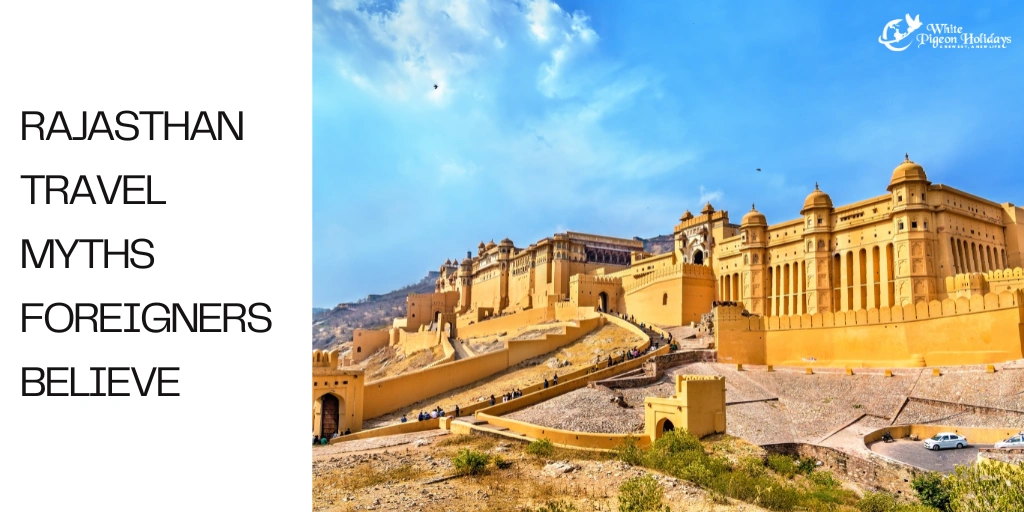
Amber Fort, Jaipur: Ramps lead to the fort’s main courtyards.
Jeep transport from the base is available and strongly recommended — skips the climb.
A good option for seniors even with limited mobility.
City Palace, Jaipur: Elevators and ramps available at key areas.
Manageable for most senior travelers.
Mehrangarh Fort, Jodhpur: Steep in sections — but an elevator has been added.
Most senior travelers can manage the primary viewing areas.
Avoid rushing this one; give it a slow morning.
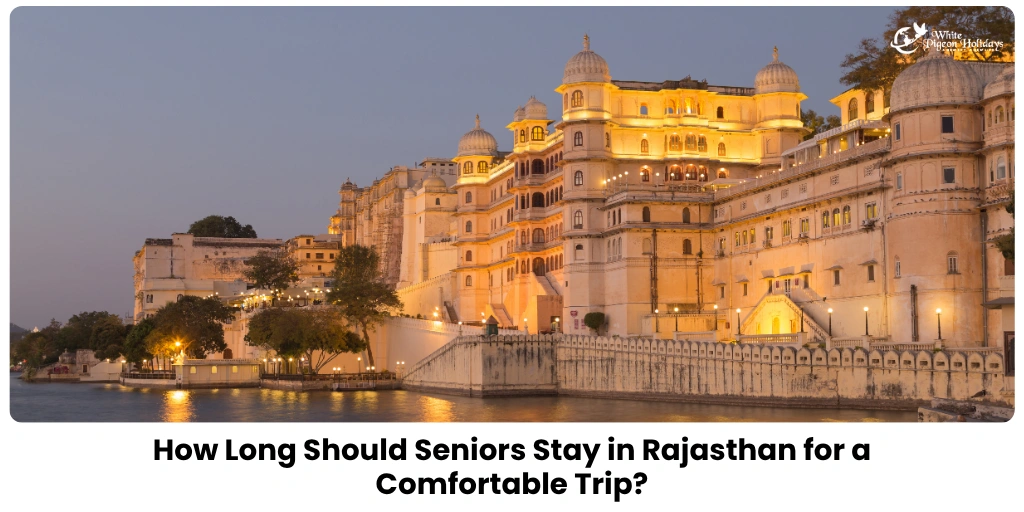
City Palace, Udaipur: Golf carts available for seniors — genuinely useful on a hot day.
The lake-facing terraces are worth every step.
Jaisalmer Fort: The fort itself is largely flat inside once you enter the main gate.
The approach can be managed by car to the entrance.
One of the more senior-accessible forts in Rajasthan.
The Single Most Common Planning Mistake for Senior Rajasthan Trips
It’s not the wrong hotels.
It’s not the wrong cities.
It’s scheduling a long drive on the same day as heavy sightseeing.
Here’s how it plays out: Day 4 — drive Jaipur to Jodhpur (5–6 hours) → arrive → visit Mehrangarh Fort.
This day is structurally wrong.
Even in a fully air-conditioned Innova Crysta, a 5–6 hour drive drains energy through passive fatigue: sustained sitting, road vibration, position changes, and the constant low-level alertness of being in motion on Indian highways.
Arriving at a new city, checking into a hotel, orienting yourself, and eating is already a full afternoon for a senior traveler.
Correct version: Drive day = rest day.
Visit Mehrangarh the next morning, fresh.
Apply this principle across every intercity move in your itinerary and you’ve solved the most common source of exhaustion in one change.
What Does a Senior Rajasthan Trip Cost? (2025 Figures)
Budget planning matters — especially when the trip involves multiple people with different needs. Here's a realistic breakdown:
| Category | Budget | Mid-Range | Comfortable/Luxury |
|---|---|---|---|
| Hotel per night (per room) | ₹4,000–6,000 | ₹7,000–12,000 | ₹15,000–30,000+ |
| Private car (Innova Crysta) | — | ₹7,800/day outstation | ₹7,800–10,000/day |
| Food per day (per couple) | ₹1,500–2,500 | ₹2,500–5,000 | ₹5,000+ |
| Entry fees + guides | ₹500–800/day | ₹800–1,500/day | ₹1,500–3,000/day |
Hotel per Night (per room)
Mid-Range: ₹7,000–12,000
Comfortable/Luxury: ₹15,000–30,000+
Private Car (Innova Crysta)
Mid-Range: ₹7,800/day outstation
Comfortable/Luxury: ₹7,800–10,000/day
Food per Day (per couple)
Mid-Range: ₹2,500–5,000
Comfortable/Luxury: ₹5,000+
Entry Fees + Guides
Mid-Range: ₹800–1,500/day
Comfortable/Luxury: ₹1,500–3,000/day
For a couple doing a 10-day private senior Rajasthan trip with mid-range to good hotels and an Innova Crysta throughout, expect a total trip cost of ₹1,20,000–₹1,80,000 for the two of you, excluding flights.
For international travelers (USD terms), a comfortable private 9–10 day Rajasthan tour runs roughly USD 1,500–USD 3,500 per person depending on hotel category.
The Innova Crysta (₹7,800/day outstation) is the right car for most senior Rajasthan trips — wide doors, high ground clearance, push-back seats, and a smooth ride on longer highways.
Sedans save some cost but the lower seating makes entry and exit harder for anyone with joint pain.
Quick Decision Framework: Which Duration Is Right for You?
Answer these honestly:
Is this your first time in India? → Add 1 extra day to whatever you planned.
First-timers need an acclimatisation day that experienced India travelers don’t.
Do you have joint pain, heart conditions, or respiratory issues? → Plan 10+ days regardless of how many cities you want to see.
Your body will set the pace.
Are you traveling with someone who has lower stamina than you? → Plan to the lower energy level.
The stronger traveler can always add more; the less mobile one cannot subtract from a tight plan.
Is comfort your priority, or coverage? → Comfort = fewer cities, more days per city.
Coverage = more cities, tighter pacing — but only works for physically active seniors.
Will you fly into and out of different cities? → Open-jaw routing (fly into Jaipur, fly out of Udaipur) removes the return drive and saves 1–2 travel days.
Always worth asking your travel consultant about.
Before You Plan, a Few Things Worth Knowing
The most important thing we’ve learned from dozens of senior Rajasthan trips: the itinerary you write on paper will rarely be the itinerary you actually follow — and that’s fine.
Someone will want to linger at a sunset longer.
Someone will need an extra afternoon to rest.
Someone will fall in love with Udaipur and not want to leave.
The goal isn’t to check off every city.
It’s to come home having genuinely loved the trip — not having survived it.
That requires proper pacing, the right car, hotels that actually work for how your body moves, and a plan flexible enough to change when it needs to.
If you’re planning a Rajasthan trip for senior parents or for yourself, and you want someone who’s actually been there to put together an itinerary that fits your pace — reach out to us at whitepigeonholidays.com.
We’ll ask you the right questions, build a plan that makes sense for your specific situation, and handle everything so the trip is something you’ll actually want to come back from.
FAQs: Planning a Rajasthan Trip for Senior Travellers
Everything families and senior travellers need to know before planning a Rajasthan holiday — from pace and mobility to health, hotels, and how many cities to cover.
Is 7 days enough for seniors to see Rajasthan properly?
Seven days is enough to enjoy two or three cities well — but only if one rest day is built in and travel days are not paired with sightseeing. It's not the right choice for a four-city itinerary.
Can I add Delhi before or after Rajasthan without exhausting elderly parents?
Yes, but treat Delhi as a completely separate leg. Allow at least two full days in Delhi, and avoid same-day travel between Delhi and Rajasthan. The combination of city-switching and sightseeing on the same day drains senior travelers more than either activity alone.
Should I fly between Rajasthan cities to save energy?
Flights can reduce long drive times but still involve airport procedures, waiting, and luggage handling. They're most worthwhile on the Jaipur–Jaisalmer route (otherwise 9–10 hours by road). For Jaipur–Jodhpur and Jodhpur–Udaipur, a private car is usually faster door-to-door and more comfortable.
How much walking is involved each day in a well-planned senior itinerary?
A well-planned day involves 45 to 90 minutes of walking spread across the day in short, manageable sections — never a single sustained march. The morning sightseeing block is the most demanding; afternoon rest and evening outings are typically gentle.
What if my parent gets tired and wants to change the plan midway?
This is exactly why private tours work better than group tours for seniors. A private arrangement gives you the flexibility to skip an attraction, extend a hotel stay by a night, or swap sightseeing for a slower afternoon without penalty. Book private, not group.
Is Jaisalmer suitable for senior citizens?
Yes, with the right setup. Jaisalmer Fort is largely flat inside the main gate, and most of the city is manageable by car. The dune safari at Sam Dunes can be done by jeep rather than camel if riding is uncomfortable. At least 2 nights is recommended so you're not rushing.
Is 14 days too long for Rajasthan?
No. Fourteen days lets you travel at the pace Rajasthan genuinely deserves — with extra cultural experiences, village visits, cooking classes, and rest days that feel like part of the experience rather than lost time.
What is the biggest planning mistake seniors make for Rajasthan?
Scheduling a long drive and heavy sightseeing on the same day. Every intercity drive should be treated as a rest day, with sightseeing resuming the following morning.
Should I book hotels with elevators?
Always confirm elevator availability before booking, especially for heritage properties. Many older haveli-style hotels have no lift — and some add lifts that are narrow or unreliable. Ground-floor room options are a good backup to request.
How long does jet lag typically last for international senior travelers to India?
Travelers from the US or UK typically adjust within 4–5 days. Keep the first two days very light — short sightseeing windows, hotel dining, early evenings. The Rajasthan leg ideally shouldn't start until jet lag has passed.
What vaccinations or health precautions should seniors consider?
Consult your doctor before traveling. Common recommendations include being up-to-date on routine vaccinations, considering hepatitis A, and carrying personal medications with sufficient supply plus a letter from your doctor. Travel insurance that covers medical evacuation is strongly advised.
Which is better for seniors — Jodhpur or Jaisalmer?
Both, but for different reasons. Jodhpur is more comfortable for seniors with limited mobility — the Blue City is manageable by car, and Mehrangarh Fort has an elevator. Jaisalmer is more of an experience — the desert, the fort, the evening light. If you can only do one, Jodhpur is the safer choice; if you can do both, do both.