Most Rajasthan trips don’t go wrong because of the destination.
They go wrong because of decisions made three months earlier, sitting at a laptop, trying to pack as much as possible into the time available.
The mistakes below are not beginner errors. They’re the ones smart, well-traveled seniors make — because Rajasthan looks manageable on paper and feels very different on the ground.
Written by
Nitin Batra
Founder & Travel Expert · White Pigeon Holidays
With 25+ years in the tourism industry — from Airport Concierge to Vice President — Nitin founded White Pigeon Holidays in 2021 to help international travellers explore India with confidence. His hands-on experience across Asia, Europe, the Middle East, and the West shapes every journey he crafts.
Catch These Rajasthan Planning Mistakes Before They Cost You
Many Rajasthan travel problems can be avoided before you book, from choosing too many cities to underestimating driving times, selecting unsuitable hotels, or creating a schedule that feels exhausting. Spend 20 minutes with Nitin Batra before finalising your plans. He has helped senior travellers from the US review and improve their Rajasthan itineraries so their journey matches their comfort level, interests, and realistic pace.
Mistake 1: Trying to Visit Too Many Cities in Too Few Days
This is the mistake that causes more tired, disappointed senior travelers than any other single factor.
Rajasthan is large. Jaipur to Jodhpur is 340 km — roughly 6 hours by road. Jodhpur to Udaipur is 260 km — 5 hours. Udaipur to Jaisalmer is 350 km — 6.5 hours.
A typical 8-city Rajasthan itinerary — Jaipur, Pushkar, Ajmer, Jodhpur, Jaisalmer, Bikaner, Udaipur, Chittorgarh — across 10 days means you spend more time in a car than anywhere else.
What happens in practice: You arrive at each city fatigued from the drive. You have half a day to sightsee before the next early morning departure. By Day 5, the trip has stopped being enjoyable and started being something to survive.
The fix: Limit yourself to 3–4 cities maximum for an 8–10 day trip. Spend 2 nights minimum in each city. Treat drive days as rest days — arrive, check in, have a gentle dinner, sleep.
Itinerary Style: How Pace Changes Your Rajasthan Experience
| Itinerary Style | Cities | Days | Senior Experience |
|---|---|---|---|
| Rushed | 6–8 cities | 10 days | Exhausting — driving days dominate the trip. |
| Balanced | 3–4 cities | 8–10 days | Comfortable — enough time to absorb each place. |
| Relaxed | 2–3 cities | 7–8 days | Ideal — immersive, comfortable and energizing. |
6–8 cities
Duration10 days
Senior ExperienceExhausting — driving days dominate the journey.
3–4 cities
Duration8–10 days
Senior ExperienceComfortable — enough time to absorb each destination.
2–3 cities
Duration7–8 days
Senior ExperienceIdeal — immersive, comfortable and energizing.
For senior travellers, the best itineraries usually come from fewer city changes and more time in each destination. Rajasthan rewards a slower rhythm.
Mistake 2: Booking a Group Tour Instead of a Private Vehicle
This is the most common structural mistake senior travelers make — and the one with the most impact on daily comfort.
Group tours operate on fixed schedules. Breakfast at 7 AM sharp. Depart at 8 AM. Fort visit from 9 to 11. Drive to next city by noon.
If you need more time at the fort, you wait at the vehicle. If you’re not feeling well at 8 AM, the group still leaves. If you want a rest stop on the highway, the driver follows the tour schedule.
For younger travelers this is a minor inconvenience. For senior travelers with health conditions, medication schedules, or energy that varies day to day, it’s genuinely limiting.
The fix: A private air-conditioned vehicle with a dedicated driver changes the entire experience.
You leave when you’re ready. You stop when you need to. You skip a site if your energy is low and revisit a favourite if you feel good.
As Luxury India Private Tours notes in their group vs private comparison, private tours give you the ability to “enjoy India at your own pace” — which is exactly what senior travelers need.
The cost difference between a group tour and a private vehicle is real, but for a trip of this distance and duration, the upgrade is almost always worth it.
Mistake 3: Choosing the Wrong Hotel — Beautiful Online, Problematic in Reality
Heritage hotels are one of Rajasthan’s greatest attractions. Converted havelis, fort residences, lake palaces — the photography is spectacular.
The problem: old buildings were not designed with modern guest comfort in mind.
What senior travelers discover after checking in:
- Rooms accessed via steep, narrow staircases with no elevator
- Bathrooms that require stepping over a high bathtub ledge rather than a walk-in shower
- Heritage rooms with poor sound insulation (inner courtyards echo)
- Hotel location inside the old city means narrow lanes the car can’t enter — you walk 200 meters with luggage over cobblestones
- “Deluxe” rooms in some properties are small with poor ventilation
The fix:
Before booking any heritage hotel, confirm these four things specifically:
- Does a lift reach your room floor? (Not just “there is an elevator” — some elevators only reach certain floors)
- Is a walk-in shower available? (Or at minimum, a low-step shower over a bathtub)
- Is there ground-floor room availability? (Request it at booking, not at check-in)
- Can a private car reach the hotel entrance? (Critical for anyone with luggage or mobility aids)
The Rajasthan Tourism Development Corporation (RTDC) offers well-located, government-run properties across Rajasthan that are more standardized and predictable — a useful alternative if you want reliable comfort over romance.
Mistake 4: Underestimating What Visiting in the Wrong Season Means
Many senior travelers visit Rajasthan between April and June — either because flights are cheaper or school schedules limit family travel timing.
This is a genuine problem, not an inconvenience.
Rajasthan in May reaches 45°C (113°F). At that temperature, even walking from an air-conditioned vehicle to a fort entrance causes physical stress.
The Thar Desert does not moderate heat. Agra’s marble reflects and amplifies it. Jaisalmer’s sandstone retains it after sunset.
According to Rajasthan Driver’s climate guide, October through March is the clear optimal window for senior travelers. November and February are the best individual months — comfortable daytime temperatures, cool evenings, no fog delays.
The fix:
If you can only travel in April: compress your outdoor sightseeing entirely to the first 2 hours after sunrise. Return to the hotel by 10 AM. Plan indoor experiences — palace museums, cooking classes, textile demonstrations — for the afternoon. Accept that some outdoor sites are not realistic in April heat.
If you’re flexible: November, February, or early March are worth rearranging your schedule for.
Mistake 5: Not Checking Hotel and Site Accessibility Specifically Enough
This extends beyond elevators.
Senior travelers who use walking sticks, have knee replacements, or manage balance issues face specific surface challenges in Rajasthan that general travel websites don’t describe clearly.
What the Surfaces Actually Look Like
| Site | Surface Type | Senior Accessibility |
|---|---|---|
| Jaisalmer Fort streets | Irregular sandstone surfaces and slopes | Challenging — walking stick is essential for many travellers. |
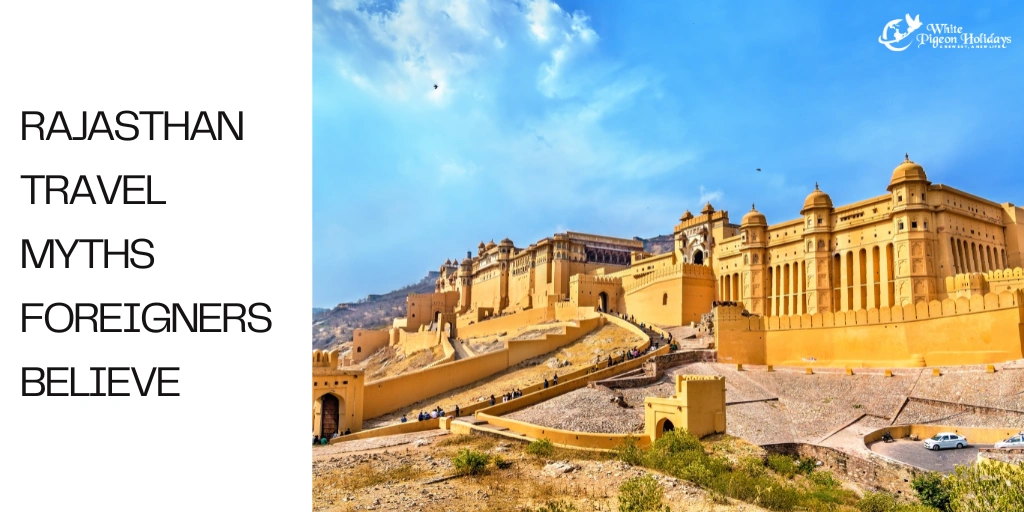
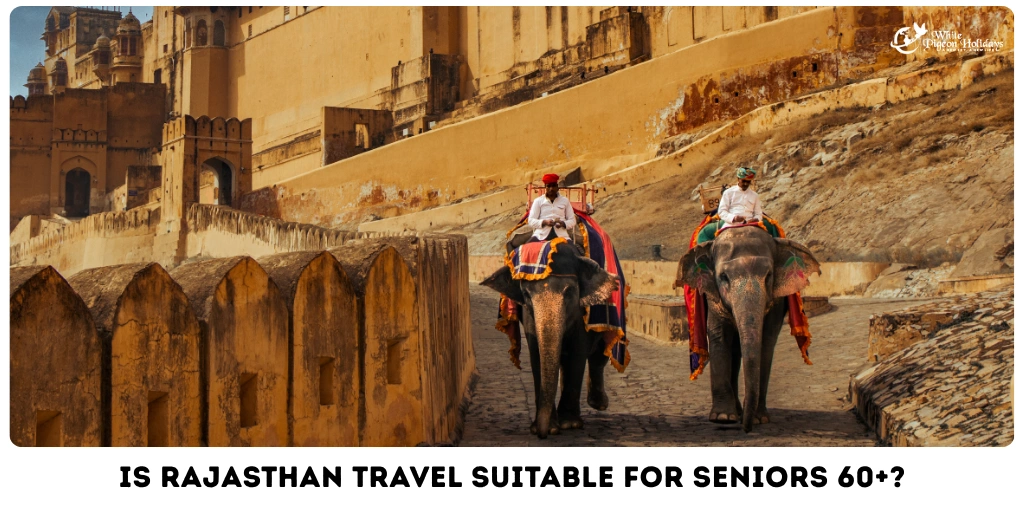
| Amber Fort courtyards | Cobblestone and smooth stone ramps | Moderate — manageable when taken slowly. |
| Mehrangarh Fort | Elevator available; inside museum areas are flatter | Good — elevator bypasses the steep approach. |
| Udaipur City Palace | Mixed surfaces — some ramps and some stairs | Moderate — ground floor areas are more accessible. |
| Jaipur Old City bazaars | Uneven narrow lanes | Challenging for wheelchair users. |
Irregular sandstone surfaces and slopes.
Senior AccessibilityChallenging — walking stick is essential for many travellers.
Cobblestone and smooth stone ramps.
Senior AccessibilityModerate — manageable when taken slowly.
Elevator available; inside museum areas are flatter.
Senior AccessibilityGood — elevator helps avoid the steep approach.
Mixed surfaces with some ramps and stairs.
Senior AccessibilityModerate — ground floor areas are easier to access.
Uneven narrow lanes.
Senior AccessibilityChallenging for wheelchair users.
The Fix
Ask your travel consultant to confirm surface conditions at every planned site. Request the itinerary to be designed around your specific mobility needs, not the average traveller.
If you use a walking stick, Rajasthan is generally manageable. If you use a wheelchair, accessible paths exist at some sites like Mehrangarh and parts of City Palace, but not everywhere. Jaisalmer Fort's interior lanes are especially difficult for wheelchair users.
Mistake 6: Eating Adventurously Too Early in the Trip
This is especially relevant for travelers from the US whose digestive systems are not accustomed to Indian spices, oils, and microbial environment.
Rajasthan’s street food is genuinely excellent. Kachori from Rawat Misthan Bhandar in Jaipur, pyaaz kachori from Jodhpur’s Shahi Samosa, dal baati churma from any roadside dhaba — these are real culinary experiences, not tourist traps.
But eating street food on Day 1 or Day 2 frequently results in traveler’s diarrhea — which can sideline a senior traveler for 24–48 hours and affect the entire trip.
The fix:
Days 1–3: eat exclusively at your hotel restaurant or a reputable sit-down restaurant with a clean kitchen. Drink only sealed bottled water. Avoid ice in drinks everywhere except your hotel. Avoid raw salads and cut fruit from street stalls.
By Day 4 or 5, if your stomach has settled, you can explore more adventurously with confidence.
The goal is not to avoid Rajasthani food. The goal is to time your introduction to it correctly.
Mistake 7: Ignoring the Scam Ecosystem Around Heritage Sites
This is not meant to alarm — Rajasthan is safe. But there is a well-documented pattern of overcharging and misdirection targeting foreign tourists, particularly around Jaipur and Jaisalmer.
Travel Tourister’s guide to Rajasthan tourist mistakes notes that tourists commonly lose ₹5,000–20,000 ($60–240) across a week to various scams — primarily overcharging for taxi rides, gem purchases pushed by drivers who receive commissions, and fake “government tourist offices” near major sites.
The most common patterns:
- A driver offers to take you to a “government gem emporium” or “government handicraft store” — these are almost never government-run
- Unofficial guides approach outside fort entrances offering “better deals” than licensed guides inside
- Auto-rickshaw drivers quote one price and charge another at destination
- Shops near major sites claim their products are “fixed price” to avoid bargaining — they’re not
The fix:
Book all your transport through your tour operator — not off the street. Use only government-licensed guides (they carry an ID card issued by the state tourism department). If a driver or guide takes you to a shop, you’re under no obligation to buy — leave politely. For shopping, research fair price ranges before you go.
Senior Rajasthan Pre-Trip Checklist
A comfortable Rajasthan journey begins with the right preparation. Our printable pre-trip checklist helps senior travellers review the important details before departure, including hotel requirements, climate-based packing, doctor consultation points, and carry-on essentials. Use this guide to organise your documents, health preparations, and travel items before you begin your Rajasthan adventure.
Mistake 8: Not Building Afternoon Rest Into Every Sightseeing Day
Senior travelers consistently report that the afternoon rest period was the single habit that made the difference between a tiring trip and an energizing one.
Rajasthan’s most effective daily rhythm for older travelers is:
6:30 – 9:30 AM: Sightseeing (coolest part of the day, best light, fewest crowds) 9:30 – 11:30 AM: Second site or market exploration (still manageable) 11:30 AM – 3:30 PM: Hotel, lunch, rest (do not fight this window) 3:30 – 6:30 PM: Second half of sightseeing or cultural experience Evening: Dinner, cultural show, or relaxed bazaar walk
Travelers who try to maintain continuous sightseeing from 9 AM to 5 PM — the way a 35-year-old might — consistently hit a wall by Day 3 and spend Day 4 recovering in the hotel.
The afternoon rest is not laziness. It’s what makes you capable of enjoying Day 7 as much as Day 1.
Mistake 9: Skipping the Cultural Experiences That Require No Physical Effort
Many senior travelers focus their itinerary almost entirely on forts and palaces — and overlook the Rajasthan experiences that are simultaneously the most memorable and the least physically demanding.
What gets underutilized:
- Evening cultural shows — Kalbelia snake-charmer dance, Rajasthani folk music, puppet shows — performed at heritage hotels and cultural centres in Jaipur, Jodhpur, and Udaipur. Seated. 60–90 minutes. Extraordinary.
- Lake Pichola boat ride (Udaipur) — 45 minutes on calm water with views of the lake palace. Zero walking beyond boarding.
- Chokhi Dhani (Jaipur) — a traditional Rajasthani village experience with folk performances, camel rides (optional), and a full dinner. Seated most of the evening.
- Hotel cooking experiences — several heritage hotels offer half-day Rajasthani cooking demonstrations. Seated, fascinating, and results in lunch.
- Textile and block printing workshops — Jaipur is the centre of India’s block printing tradition. 2-hour workshop, mostly seated.
These experiences often become the most-mentioned memories from the trip. They’re also the ones most commonly cut when itineraries are too rushed.
Want an Itinerary That Gets the Pacing Right From the Start?
A comfortable Rajasthan journey depends on getting the route, timing, and daily pace right from day one. Share your travel dates, cities of interest, and any health considerations, and we will create a day-by-day plan designed around your comfort. Your itinerary will include suitable rest periods, meaningful cultural experiences, practical travel timings, and carefully selected accessible hotels so you can enjoy Rajasthan without feeling rushed.
Frequently Asked Questions
Practical answers to help senior travellers enjoy Rajasthan with comfort, confidence, and fewer surprises.
What is the single biggest mistake senior travelers make in Rajasthan?
The most common mistake is trying to cover too many cities in too few days.
A packed itinerary turns a relaxing cultural journey into constant driving, rushed sightseeing, and limited time to enjoy each destination.
Is it really necessary to have a private vehicle rather than shared transport?
For senior travellers, a private vehicle is highly recommended.
It provides flexibility for rest stops, slower mornings, comfort breaks, and itinerary changes when needed. A dedicated driver makes the entire journey easier to manage.
How do I identify a good licensed guide in Rajasthan?
Licensed guides carry official identification issued by the tourism authorities.
The safest option is arranging guides through your tour operator or hotel concierge. Avoid accepting offers from people approaching you outside monuments.
Is bargaining expected in Rajasthan markets?
Yes, especially in local markets selling textiles, handicrafts, and jewellery.
A respectful negotiation is normal. Government-run emporiums such as Rajasthali offer fixed prices and can help you understand fair market value.
What happens if I feel unwell mid-trip? Can the itinerary be adjusted?
Yes, with a private tour.
A rest day can usually be added without affecting the entire journey. This flexibility is one of the biggest advantages of private senior travel arrangements.
Are there scams specifically targeting senior tourists?
Scams are not specifically aimed at seniors, but unfamiliar travellers may receive more attention from sellers or unofficial guides.
The best protection is arranging transport, guides, and experiences through a verified operator before arrival.
Can I drink the water in Rajasthan if the hotel provides bottles?
Yes, sealed bottled water from reputable hotels is safe.
Always check that the cap seal is intact. Avoid tap water and be cautious with ice outside trusted hotels and restaurants.
What should I do if I am overcharged for a taxi or auto-rickshaw?
For small differences, it is usually best to avoid unnecessary stress.
For larger issues, agree on prices before starting journeys or use trusted transport apps and pre-arranged private transfers whenever possible.
How much physical effort do evening cultural shows involve?
Very little.
Most cultural shows involve comfortable seating and a 60–90 minute performance. They are a relaxing way to enjoy Rajasthan after a day of sightseeing.
Is it safe for a senior to travel Rajasthan without a travel companion?
Yes, many solo seniors travel successfully through Rajasthan.
However, we recommend having local support through a private operator, driver, and reliable contacts rather than travelling completely independently without assistance.
Contact White Pigeon Holidays
Planning an India tour around your pace, comfort, and peace of mind starts with one conversation.
We specialise in private, personally arranged India holidays for senior travellers from the UK. Every itinerary is planned from scratch around your interests, travel pace, comfort level, and preferred style of travel. Nothing is taken off a shelf.